Suzuki Shuichi, Oura Tomonori, Takeuchi Masakazu, Boye Kristina S
Medicines Development Unit Japan, Eli Lilly Japan K.K, Sannomiya Plaza Bldg. 7-1-5, Isogamidori, Chuo-ku, Kobe, 651-0086, Japan.
Global Patient Outcomes and Real World Evidence, Eli Lilly and Company, Lilly Corporate Center, Indianapolis, IN, 46285, USA.
Health Qual Life Outcomes. 2017 Jun 12;15(1):123. doi: 10.1186/s12955-017-0696-7.
Standardized patient-reported outcome (PRO) questionnaires can be utilized to evaluate treatment satisfaction (subjective evaluation of treatment) in patients with type 2 diabetes (T2D). These outcomes are important because they may affect patient adherence and overall study results.
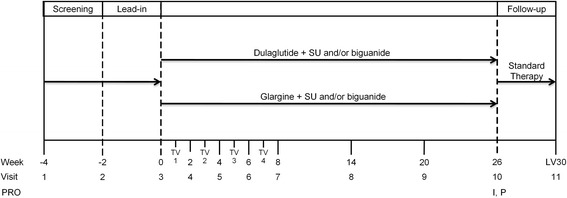
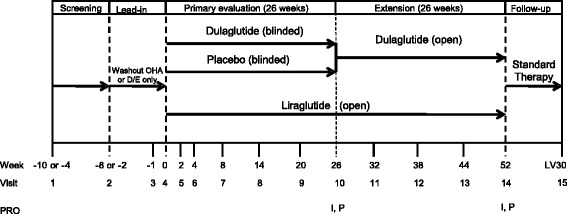
PROs were evaluated in two randomized 26-week clinical trials in Japanese patients with T2D taking dulaglutide 0.75 mg (dulaglutide) once weekly; comparators were once-daily liraglutide (0.9 mg/day) and once-weekly placebo in one study and once-daily insulin glargine (glargine) in the other study. The Perceptions About Medications-Diabetes 21 Questionnaire - Japanese version (PAM-D21-J) and the Injectable Diabetes Medication Questionnaire - Japanese version (IDMQ-J) were completed by patients in both studies. These measures were both considered exploratory endpoints. All scale scores range from 0 to 100, with higher scores reflecting better outcomes.
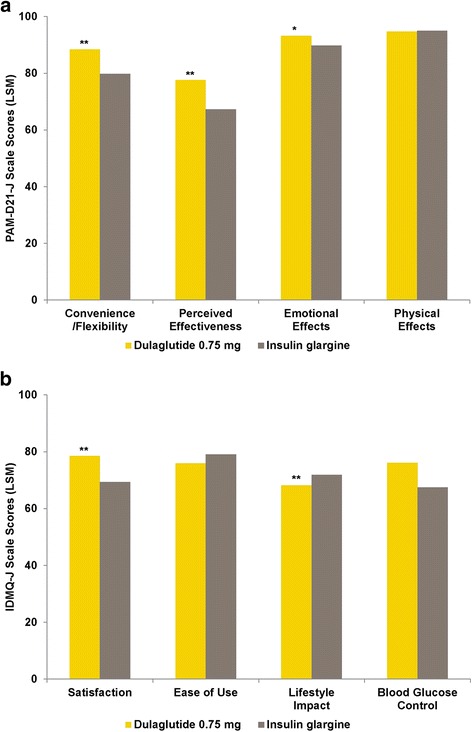
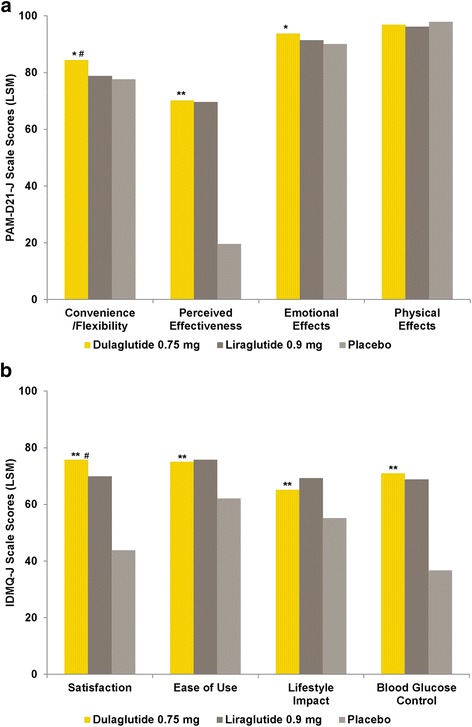
Patients reported that dulaglutide was more convenient and flexible than liraglutide (PAM-D21-J Convenience/Flexibility subscale: dulaglutide least-square mean [LSM], 84.58; liraglutide LSM, 78.94; p = .026), and that they were more satisfied with dulaglutide than with liraglutide (IDMQ-J Satisfaction subscale: dulaglutide, 75.24; liraglutide, 69.53; p = .012). Patients also reported that dulaglutide was more convenient and flexible than glargine (PAM-D21-J Convenience/Flexibility subscale: dulaglutide, 87.89; glargine, 79.22; p < .001), and that they were more satisfied with dulaglutide than with glargine (IDMQ-J Satisfaction subscale: dulaglutide, 78.86; glargine, 69.66; p < .001), and felt dulaglutide was more effective than glargine, with fewer symptoms and adverse events (PAM-D21-J Perceived Effectiveness subscale: dulaglutide, 77.61; glargine, 67.22; p < .001; Emotional Effects subscale: dulaglutide, 93.02; glargine, 89.55; p = .017; IDMQ-J Blood Glucose Control subscale: dulaglutide, 76.33; glargine, 67.57; p < .001). In addition, patients responded that dulaglutide was superior to placebo in the PAM-D21-J Convenience/Flexibility, Perceived Effectiveness, and Emotional Effects subscales and all IDMQ-J subscales (Satisfaction, Ease of Use, Lifestyle Impact, Blood Glucose Control).
Overall, after 26 weeks of once-weekly dulaglutide administration in Japanese patients with T2D, PROs were generally positive versus the three comparator treatments (liraglutide, glargine, and placebo), suggesting increased treatment satisfaction through better blood glucose control and convenience/flexibility and reduced negative emotional effects of diabetes.
ClinicalTrials.gov (monotherapy study: NCT01558271 , registered March 12, 2012; combination therapy study: NCT01584232 , registered April 23, 2012).
标准化的患者报告结局(PRO)问卷可用于评估2型糖尿病(T2D)患者的治疗满意度(对治疗的主观评价)。这些结局很重要,因为它们可能会影响患者的依从性和整体研究结果。
在两项针对日本T2D患者的随机、为期26周的临床试验中评估了PRO,这些患者每周一次服用0.75 mg度拉糖肽(dulaglutide);在一项研究中,对照药物为每日一次的利拉鲁肽(0.9 mg/天)和每周一次的安慰剂,在另一项研究中对照药物为每日一次的甘精胰岛素(glargine)。两项研究中的患者均完成了《糖尿病药物认知问卷21 - 日语版》(PAM - D21 - J)和《注射用糖尿病药物问卷 - 日语版》(IDMQ - J)。这些指标均被视为探索性终点。所有量表分数范围为0至100,分数越高表明结局越好。
患者报告称,度拉糖肽比利拉鲁肽更方便、更灵活(PAM - D21 - J便利性/灵活性子量表:度拉糖肽最小二乘均值[LSM],84.58;利拉鲁肽LSM,78.94;p = 0.026),且对度拉糖肽的满意度比利拉鲁肽更高(IDMQ - J满意度子量表:度拉糖肽,75.24;利拉鲁肽,69.53;p = 0.012)。患者还报告称,度拉糖肽比甘精胰岛素更方便、更灵活(PAM - D21 - J便利性/灵活性子量表:度拉糖肽,87.89;甘精胰岛素,79.22;p < 0.001),且对度拉糖肽的满意度比甘精胰岛素更高(IDMQ - J满意度子量表:度拉糖肽,78.86;甘精胰岛素,69.66;p < 0.001),并感觉度拉糖肽比甘精胰岛素更有效,症状和不良事件更少(PAM - D21 - J感知有效性子量表:度拉糖肽,77.61;甘精胰岛素,67.22;p < 0.001;情绪影响子量表:度拉糖肽,93.02;甘精胰岛素,89.55;p = 0.017;IDMQ - J血糖控制子量表:度拉糖肽,76.33;甘精胰岛素,67.57;p < 0.001)。此外,患者回答称,在PAM - D21 - J便利性/灵活性、感知有效性和情绪影响子量表以及所有IDMQ - J子量表(满意度、易用性、生活方式影响、血糖控制)方面,度拉糖肽优于安慰剂。
总体而言,在日本T2D患者中每周一次给予度拉糖肽26周后,与三种对照治疗(利拉鲁肽、甘精胰岛素和安慰剂)相比,PRO总体呈阳性,表明通过更好的血糖控制、便利性/灵活性以及减少糖尿病的负面情绪影响,提高了治疗满意度。
ClinicalTrials.gov(单药治疗研究:NCT01558271,2012年3月12日注册;联合治疗研究:NCT01584232,2012年4月23日注册)。