Lee Pey Yee, Chin Siok-Fong, Neoh Hui-Min, Jamal Rahman
UKM Medical Molecular Biology Institute (UMBI), Universiti Kebangsaan Malaysia, 56000, Cheras, Kuala Lumpur, Malaysia.
J Biomed Sci. 2017 Jun 12;24(1):36. doi: 10.1186/s12929-017-0342-z.
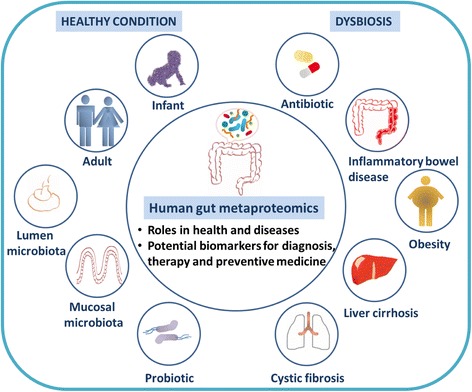
The human gut is home to complex microbial populations that change dynamically in response to various internal and external stimuli. The gut microbiota provides numerous functional benefits that are crucial for human health but in the setting of a disturbed equilibrium, the microbial community can cause deleterious outcomes such as diseases and cancers. Characterization of the functional activities of human gut microbiota is fundamental to understand their roles in human health and disease. Metaproteomics, which refers to the study of the entire protein collection of the microbial community in a given sample is an emerging area of research that provides informative details concerning functional aspects of the microbiota. In this mini review, we present a summary of the progress of metaproteomic analysis for studying the functional role of gut microbiota. This is followed by an overview of the experimental approaches focusing on fecal specimen for metaproteomics and is concluded by a discussion on the challenges and future directions of metaproteomic research.
人类肠道是复杂微生物群落的栖息地,这些微生物群落会根据各种内部和外部刺激而动态变化。肠道微生物群提供了许多对人类健康至关重要的功能益处,但在平衡失调的情况下,微生物群落会导致诸如疾病和癌症等有害后果。表征人类肠道微生物群的功能活动对于理解它们在人类健康和疾病中的作用至关重要。元蛋白质组学是指对给定样本中微生物群落的整个蛋白质集合进行研究,它是一个新兴的研究领域,能提供有关微生物群功能方面的详细信息。在这篇小型综述中,我们总结了元蛋白质组学分析在研究肠道微生物群功能作用方面的进展。接下来概述了针对粪便样本进行元蛋白质组学研究的实验方法,最后讨论了元蛋白质组学研究的挑战和未来方向。