Briese Thomas, Loroño-Pino Maria A, Garcia-Rejon Julian E, Farfan-Ale Jose A, Machain-Williams Carlos, Dorman Karin S, Lipkin W Ian, Blitvich Bradley J
Center for Infection and Immunity, Mailman School of Public Health, Columbia University, New York, NY, USA.
Laboratorio de Arbovirología, Centro de Investigaciones Regionales Dr. Hideyo Noguchi, Universidad Autónoma de Yucatán, Mérida, Yucatán, Mexico.
Virol J. 2017 Jun 12;14(1):110. doi: 10.1186/s12985-017-0777-6.
We previously reported the discovery of a novel, putative flavivirus designated T'Ho virus in Culex quinquefasciatus mosquitoes in the Yucatan Peninsula of Mexico. A 1358-nt region of the NS5 gene was amplified and sequenced but an isolate was not recovered.
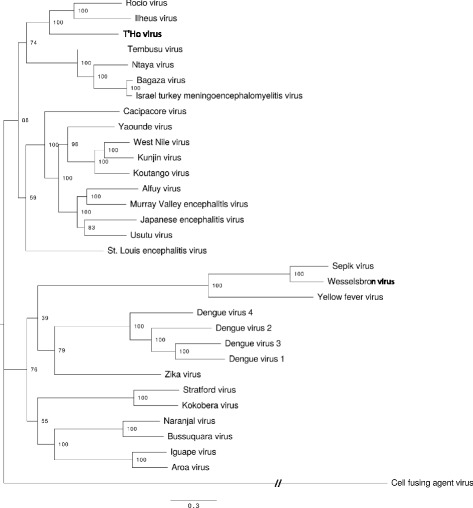
The complete genome of T'Ho virus was sequenced using a combination of unbiased high-throughput sequencing, 5' and 3' rapid amplification of cDNA ends, reverse transcription-polymerase chain reaction and Sanger sequencing. The genome contains a single open reading frame of 10,284 nt which is flanked by 5' and 3' untranslated regions of 97 and 556-nt, respectively. Genome sequence alignments revealed that T'Ho virus is most closely related to Rocio virus (67.4% nucleotide identity) and Ilheus virus (65.9%), both of which belong to the Ntaya group, followed by other Ntaya group viruses (58.8-63.3%) and Japanese encephalitis group viruses (62.0-63.7%). Phylogenetic inference is in agreement with these findings.
This study furthers our understanding of flavivirus genetics, phylogeny and diagnostics. Because the two closest known relatives of T'Ho virus are human pathogens, T'Ho virus could be an unrecognized cause of human disease. It is therefore important that future studies investigate the public health significance of this virus.
我们之前报道了在墨西哥尤卡坦半岛的致倦库蚊中发现了一种新型的、假定的黄病毒,命名为托霍病毒。对NS5基因的一个1358个核苷酸的区域进行了扩增和测序,但未获得分离株。
使用无偏差高通量测序、5'和3' cDNA末端快速扩增、逆转录-聚合酶链反应和桑格测序相结合的方法对托霍病毒的全基因组进行了测序。该基因组包含一个10284个核苷酸的单一开放阅读框,两侧分别是97个核苷酸和556个核苷酸的5'和3'非翻译区。基因组序列比对显示,托霍病毒与罗西奥病毒(核苷酸同一性为67.4%)和伊列乌斯病毒(65.9%)关系最为密切,这两种病毒均属于恩塔亚病毒群,其次是其他恩塔亚病毒群病毒(58.8 - 63.3%)和日本脑炎病毒群病毒(62.0 - 63.7%)。系统发育推断与这些发现一致。
本研究进一步加深了我们对黄病毒遗传学、系统发育和诊断的理解。由于托霍病毒最接近的两个已知亲缘病毒是人类病原体,托霍病毒可能是一种未被认识的人类疾病病因。因此,未来的研究调查这种病毒的公共卫生意义很重要。