Ravuvu Amerita, Friel Sharon, Thow Anne-Marie, Snowdon Wendy, Wate Jillian
School of Regulation and Global Governance (RegNet), The Australian National University, H.C. Coombs Extension Building #8, Fellows Road ACT, Canberra, 0200, Australia.
Menzies Centre for Health Policy, School of Public Health, The University of Sydney, Sydney, Australia.
Global Health. 2017 Jun 13;13(1):33. doi: 10.1186/s12992-017-0257-1.
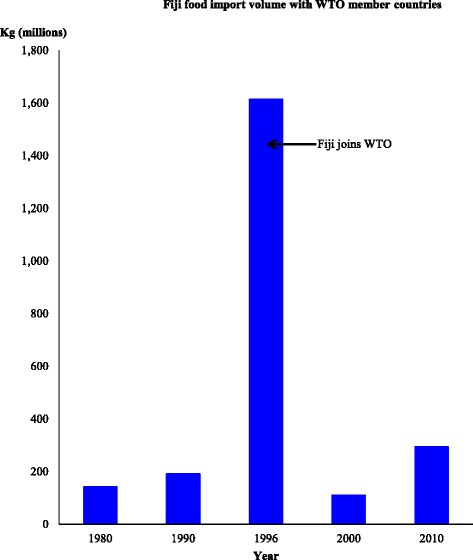
Trade agreements are increasingly recognised as playing an influential role in shaping national food environments and the availability and nutritional quality of the food supply. Global monitoring of food environments and trade policies can strengthen the evidence base for the impact of trade policy on nutrition, and support improved policy coherence. Using the INFORMAS trade monitoring protocol, we reviewed available food supply data to understand associations between Fiji's commitments under WTO trade agreements and food import volume trends.
First, a desk review was conducted to map and record in one place Fiji's commitments to relevant existing trade agreements that have implications for Fiji's national food environment under the domains of the INFORMAS trade monitoring protocol. An excel database was developed to document the agreements and their provisions. The second aspect of the research focused on data extraction. We began with identifying food import volumes into Fiji by country of origin, with a particular focus on a select number of 'healthy and unhealthy' foods. We also developed a detailed listing of transnational food corporations currently operating in Fiji.
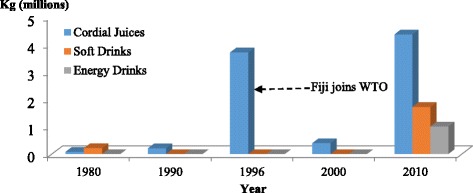
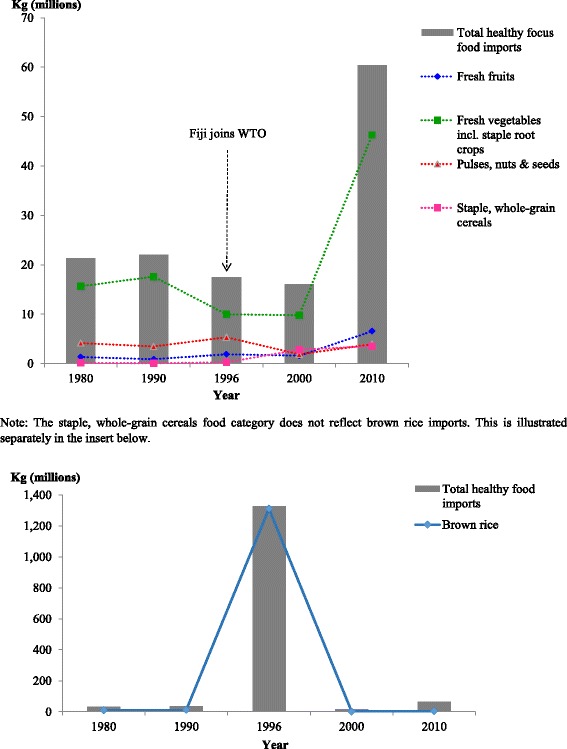
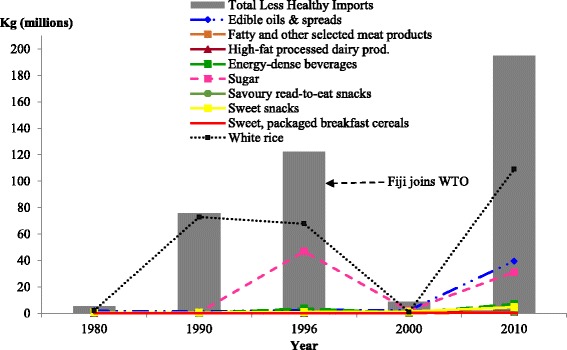
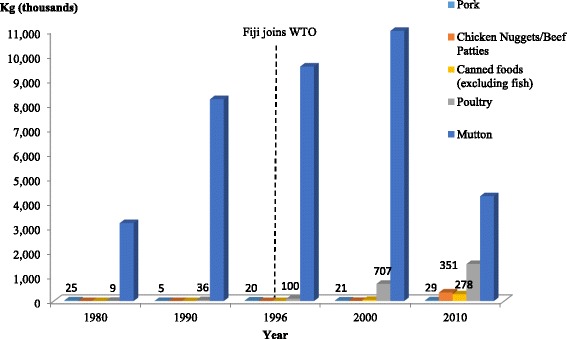
The study suggests that Fiji's WTO membership, in conjunction with associated economic and agricultural policy changes have contributed to increased availability of both healthy and less healthy imported foods. In systematically monitoring the import volume trends of these two categories of food, the study highlights an increase in healthy foods such as fresh fruits and vegetables and whole-grain refined cereals. The study also shows that there has been an increase in less healthy foods including fats and oils; meat; processed dairy products; energy-dense beverages; and processed and packaged foods.
By monitoring the trends of imported foods at country level from the perspective of trade agreements, we are able to develop appropriate and targeted interventions to improve diets and health. This would enable national health interventions to both identify areas of concern, and to ensure that interventions take into account the trade context.
贸易协定在塑造国家食品环境以及食品供应的可获得性和营养质量方面所发挥的影响作用日益得到认可。对食品环境和贸易政策进行全球监测,能够强化贸易政策对营养影响的证据基础,并支持提高政策的连贯性。我们运用国际食品政策研究所在线监测协议(INFORMAS),审查了现有的食品供应数据,以了解斐济在世界贸易组织(WTO)贸易协定下的承诺与食品进口量趋势之间的关联。
首先,开展案头审查,在一个地方梳理并记录斐济对现有相关贸易协定的承诺,这些协定在国际食品政策研究所在线监测协议(INFORMAS)的领域下对斐济的国家食品环境有影响。开发了一个Excel数据库来记录这些协定及其条款。研究的第二个方面聚焦于数据提取。我们首先按原产国确定斐济的食品进口量,特别关注一些“健康和不健康”食品。我们还编制了一份目前在斐济运营的跨国食品公司的详细清单。
该研究表明,斐济加入世界贸易组织(WTO),再加上相关的经济和农业政策变化,导致健康和不太健康的进口食品供应都有所增加。在系统监测这两类食品的进口量趋势时,该研究突出了新鲜水果、蔬菜和全谷物精制谷物等健康食品的增加。该研究还表明,包括油脂、肉类、加工乳制品、高能量饮料以及加工和包装食品在内的不太健康的食品也有所增加。
通过从贸易协定的角度监测国家层面的进口食品趋势,我们能够制定适当且有针对性的干预措施来改善饮食和健康。这将使国家卫生干预措施既能确定关注领域,又能确保干预措施考虑到贸易背景。