Jenkins Nathaniel D M, Miramonti Amelia A, Hill Ethan C, Smith Cory M, Cochrane-Snyman Kristen C, Housh Terry J, Cramer Joel T
Applied Neuromuscular Physiology Laboratory, Oklahoma State UniversityStillwater, OK, United States.
Department of Nutrition and Health Sciences, University of Nebraska-LincolnLincoln, NE, United States.
Front Physiol. 2017 May 29;8:331. doi: 10.3389/fphys.2017.00331. eCollection 2017.
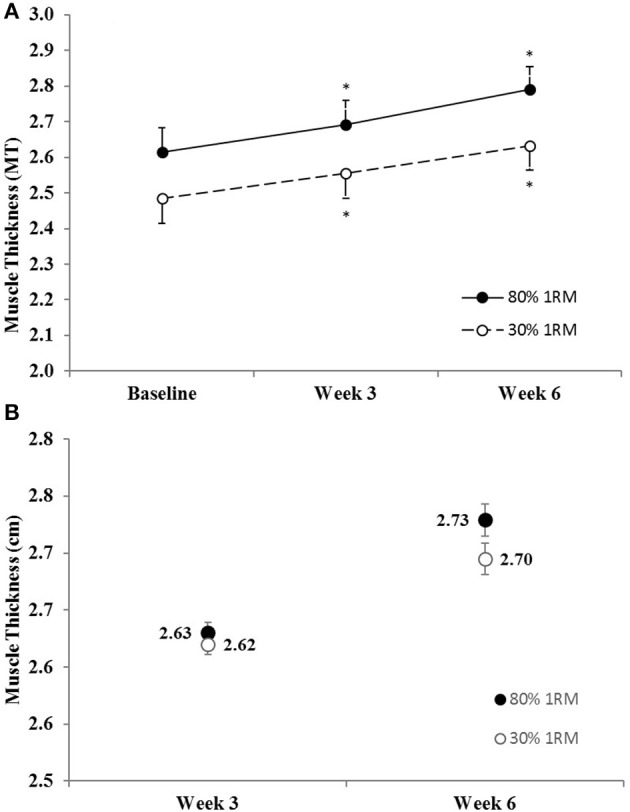
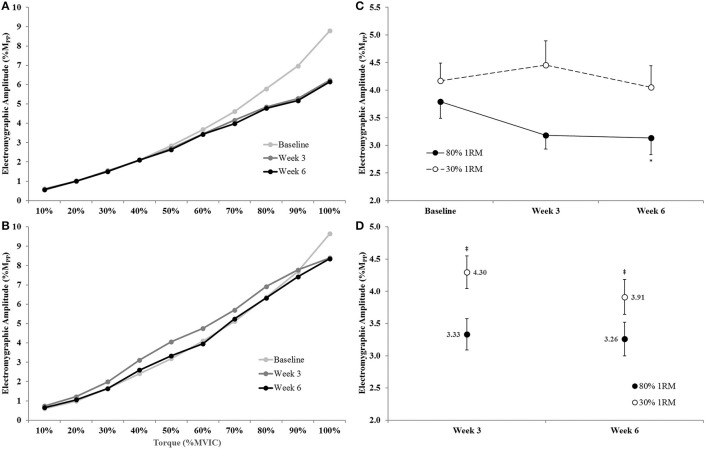
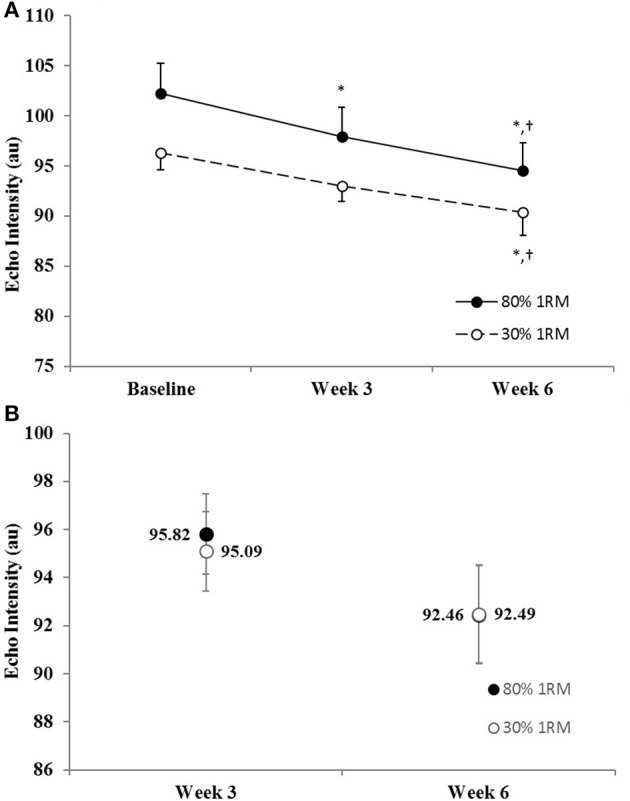
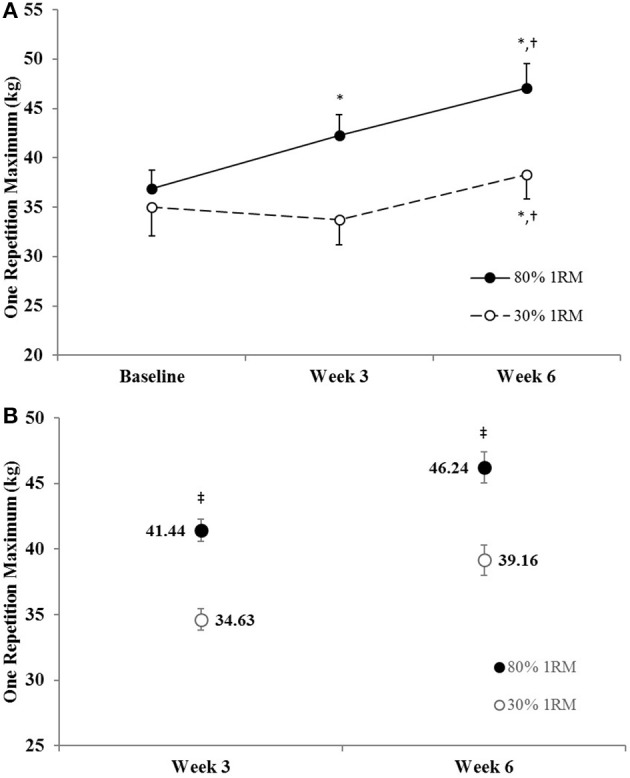
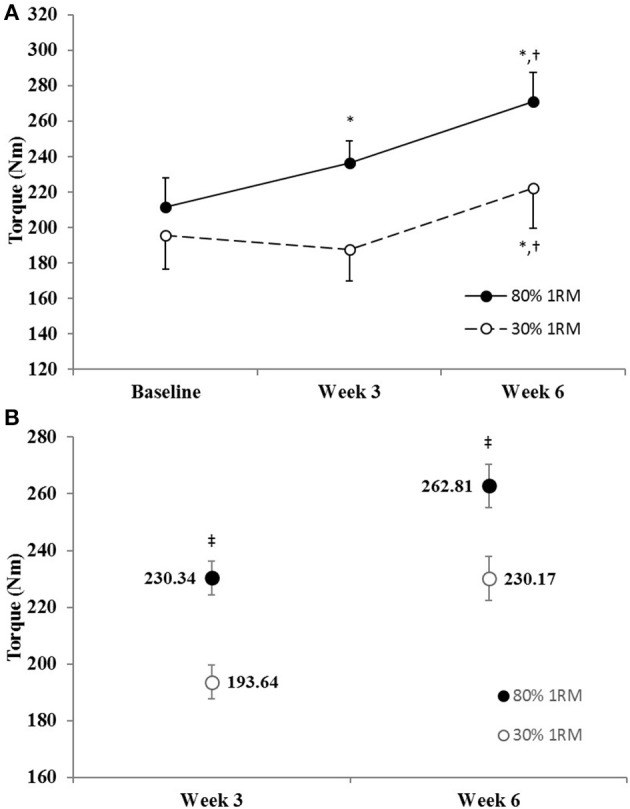
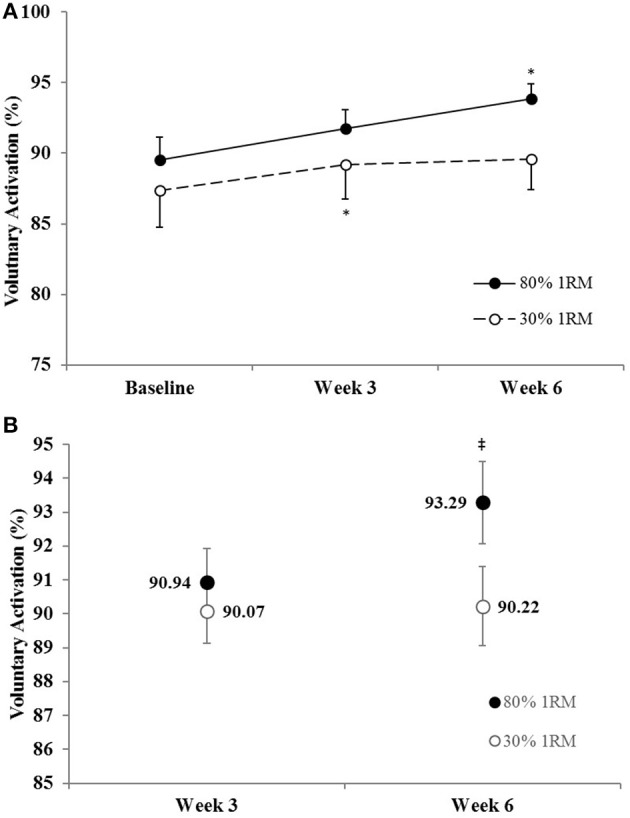
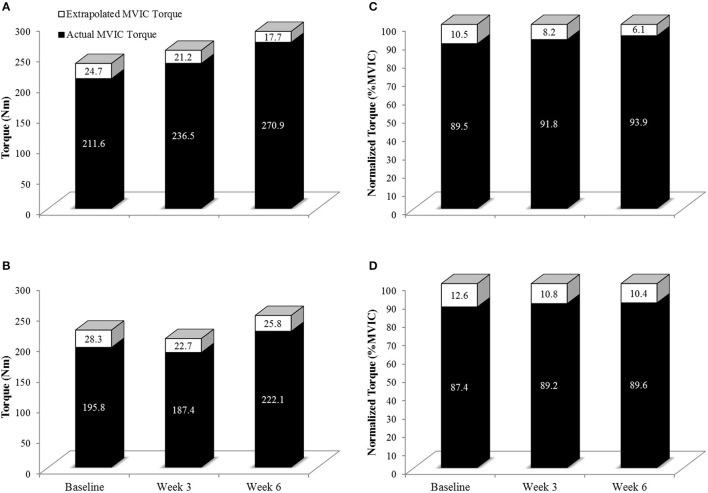
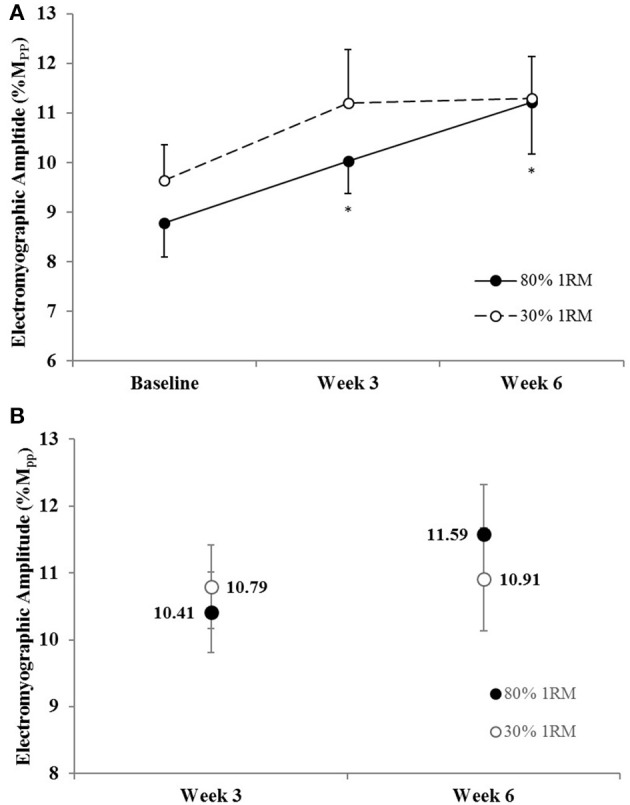
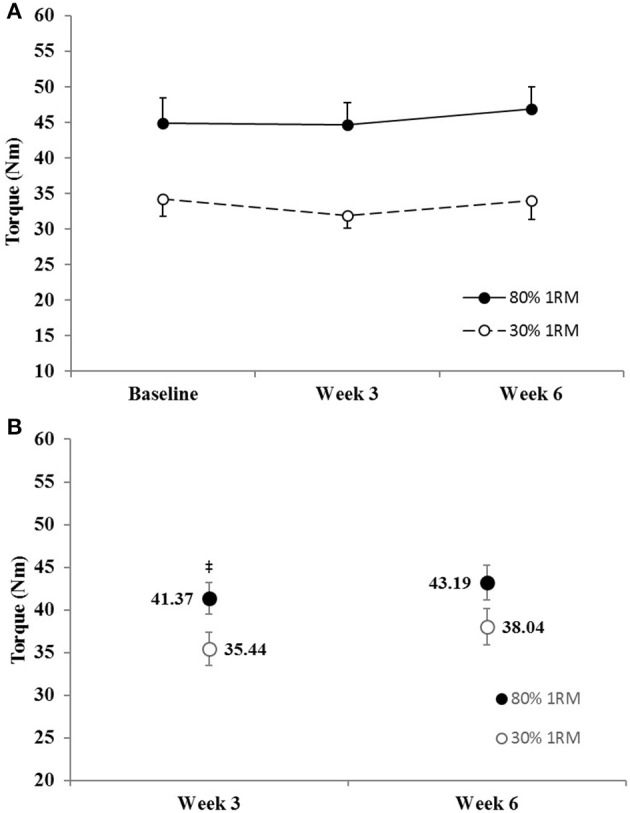
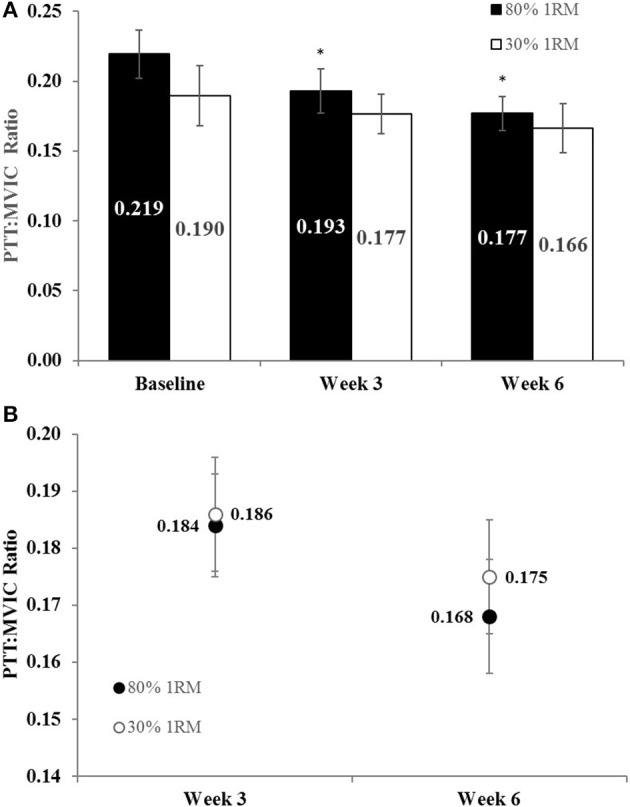
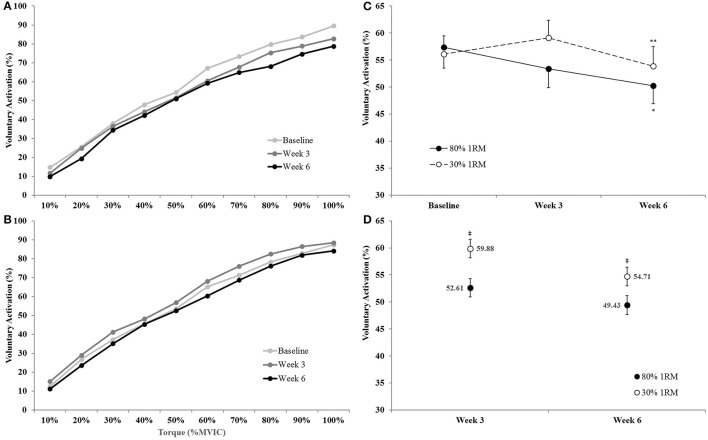
We examined the neuromuscular adaptations following 3 and 6 weeks of 80 vs. 30% one repetition maximum (1RM) resistance training to failure in the leg extensors. Twenty-six men (age = 23.1 ± 4.7 years) were randomly assigned to a high- (80% 1RM; = 13) or low-load (30% 1RM; = 13) resistance training group and completed leg extension resistance training to failure 3 times per week for 6 weeks. Testing was completed at baseline, 3, and 6 weeks of training. During each testing session, ultrasound muscle thickness and echo intensity, 1RM strength, maximal voluntary isometric contraction (MVIC) strength, and contractile properties of the quadriceps femoris were measured. Percent voluntary activation (VA) and electromyographic (EMG) amplitude were measured during MVIC, and during randomly ordered isometric step muscle actions at 10-100% of baseline MVIC. There were similar increases in muscle thickness from Baseline to Week 3 and 6 in the 80 and 30% 1RM groups. However, both 1RM and MVIC strength increased from Baseline to Week 3 and 6 to a greater degree in the 80% than 30% 1RM group. VA during MVIC was also greater in the 80 vs. 30% 1RM group at Week 6, and only training at 80% 1RM elicited a significant increase in EMG amplitude during MVIC. The peak twitch torque to MVIC ratio was also significantly reduced in the 80%, but not 30% 1RM group, at Week 3 and 6. Finally, VA and EMG amplitude were reduced during submaximal torque production as a result of training at 80% 1RM, but not 30% 1RM. Despite eliciting similar hypertrophy, 80% 1RM improved muscle strength more than 30% 1RM, and was accompanied by increases in VA and EMG amplitude during maximal force production. Furthermore, training at 80% 1RM resulted in a decreased neural cost to produce the same relative submaximal torques after training, whereas training at 30% 1RM did not. Therefore, our data suggest that high-load training results in greater neural adaptations that may explain the disparate increases in muscle strength despite similar hypertrophy following high- and low-load training programs.
我们研究了腿部伸肌进行3周和6周、80%与30%的一次重复最大值(1RM)抗阻训练直至力竭后的神经肌肉适应性变化。26名男性(年龄=23.1±4.7岁)被随机分配至高负荷(80% 1RM;n=13)或低负荷(30% 1RM;n=13)抗阻训练组,每周进行3次腿部伸展抗阻训练直至力竭,共持续6周。在训练的基线、3周和6周时完成测试。在每次测试期间,测量超声肌肉厚度和回声强度、1RM力量、最大自主等长收缩(MVIC)力量以及股四头肌的收缩特性。在MVIC期间以及在基线MVIC的10%-100%随机排序的等长阶梯肌肉动作期间,测量自愿激活百分比(VA)和肌电图(EMG)幅度。80%和30% 1RM组从基线到第3周和第6周肌肉厚度均有相似增加。然而,从基线到第3周和第6周,80% 1RM组的1RM和MVIC力量增加幅度大于30% 1RM组。在第6周时,80% 1RM组MVIC期间的VA也高于30% 1RM组,并且只有80% 1RM训练在MVIC期间引起EMG幅度显著增加。在第3周和第6周时,80% 1RM组的峰值抽搐扭矩与MVIC比值也显著降低,而30% 1RM组未出现此情况。最后,由于80% 1RM训练,在次最大扭矩产生期间VA和EMG幅度降低,而30% 1RM训练未出现此情况。尽管引发了相似的肌肉肥大,但80% 1RM比30% 1RM更能提高肌肉力量,并且在最大力量产生期间伴随着VA和EMG幅度增加。此外,80% 1RM训练导致训练后产生相同相对次最大扭矩时神经成本降低,而30% 1RM训练则未出现此情况。因此,我们的数据表明,高负荷训练会导致更大的神经适应性变化,这可能解释了尽管高负荷和低负荷训练计划后肌肉肥大相似,但肌肉力量增加却存在差异的原因。