Li Tiejun, Chen Yanli, Gua Chaojun, Li Xiaodong
Department of Cardiology, Shengjing Hospital of China Medical UniversityShenyang, China.
Front Physiol. 2017 May 30;8:350. doi: 10.3389/fphys.2017.00350. eCollection 2017.
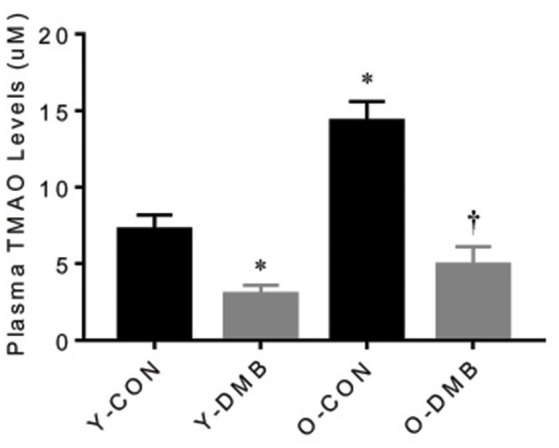
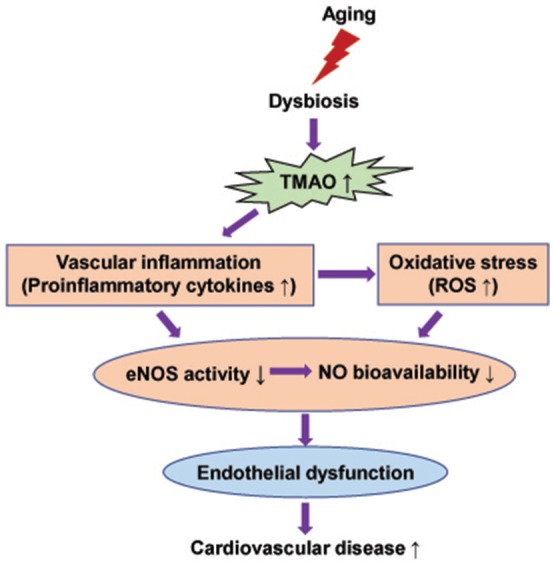
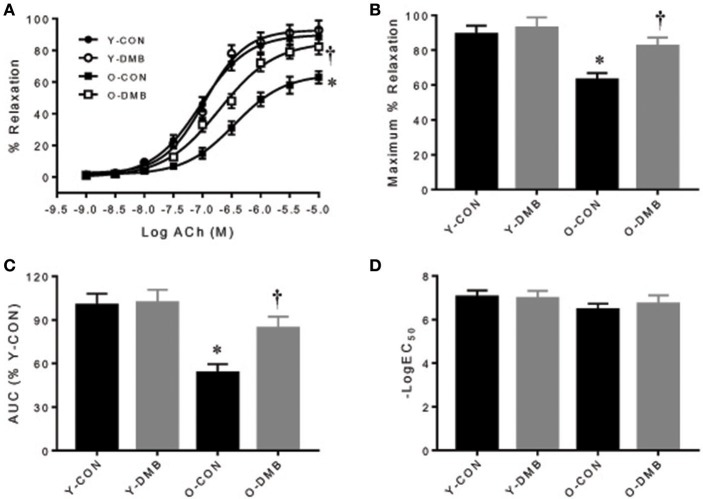
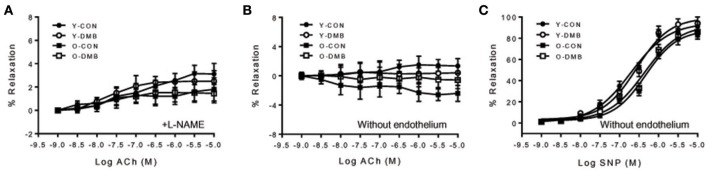
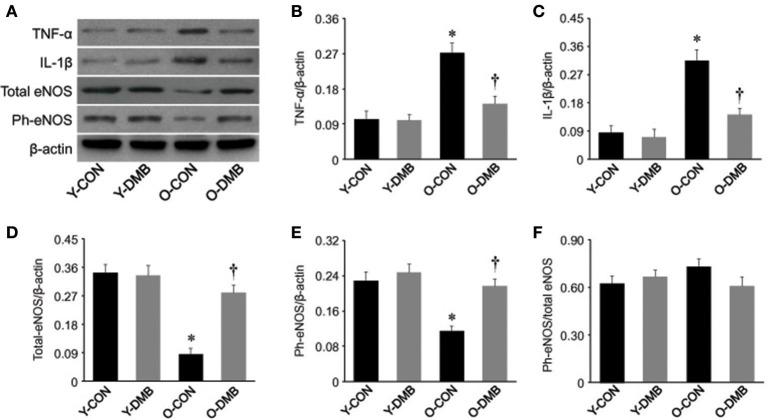
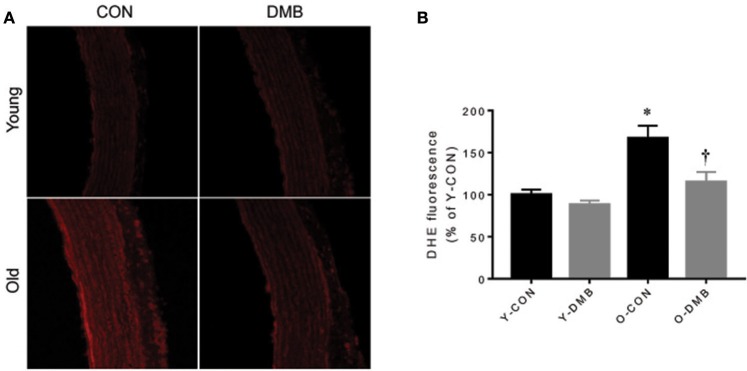
Vascular endothelial dysfunction, a characteristic of the aging process, is an important risk factor for cardiovascular disease in aging. Although, vascular inflammation and oxidative stress are major contributors to endothelial dysfunction in aging, the underlying mechanisms during the aging process are not fully understood. Accumulating evidence reveals that gut microbiota-dependent metabolite trimethylamine-N-oxide (TMAO) is implicated in the pathogenesis of many cardiovascular diseases. We tested the hypothesis that aging increases circulating TMAO levels, which induce vascular inflammation and oxidative stress, resulting in age-associated endothelial dysfunction. Old (22-mo-old) and young (4-mo-old) Fischer-344 rats were treated without (control) or with 1.0% 3,3-Dimethyl-1-butanol (DMB, an inhibitor of trimethylamine formation) in drinking water for 8 weeks. Compared with young control group, old control group had markedly higher plasma TMAO levels, which were reduced by DMB treatment. Endothelium-dependent relaxation of aorta in response to acetylcholine was impaired in old control group compared with young control group as indicated by decreased maximal relaxation (E) and reduced area under the curve (AUC). E and AUC were both normalized in old rats treated with DMB. No difference in endothelial-independent relaxation in response to sodium nitroprusside was observed among groups. Molecular studies revealed that old control group exhibits increased expression of proinflammatory cytokines and superoxide production, and decreased expression of endothelial nitric-oxide synthase (eNOS) in the aorta, all of which were restored by DMB treatment. These results suggest that aging increases circulating TMAO levels, which may impair eNOS-derived NO bioavailability by increasing vascular inflammation and oxidative stress, contributing to aging-associated endothelial dysfunction.
血管内皮功能障碍是衰老过程的一个特征,是衰老过程中心血管疾病的重要危险因素。虽然血管炎症和氧化应激是衰老过程中内皮功能障碍的主要促成因素,但衰老过程中的潜在机制尚未完全了解。越来越多的证据表明,肠道微生物群依赖性代谢产物氧化三甲胺(TMAO)与许多心血管疾病的发病机制有关。我们检验了这样一个假设:衰老会增加循环中TMAO的水平,从而诱导血管炎症和氧化应激,导致与年龄相关的内皮功能障碍。将老年(22月龄)和年轻(4月龄)的Fischer-344大鼠分为两组,一组不做处理(对照组),另一组在饮水中添加1.0%的3,3-二甲基-1-丁醇(DMB,一种三甲胺形成抑制剂),持续处理8周。与年轻对照组相比,老年对照组的血浆TMAO水平显著更高,而DMB处理可降低该水平。与年轻对照组相比,老年对照组主动脉对乙酰胆碱的内皮依赖性舒张功能受损,表现为最大舒张度(E)降低和曲线下面积(AUC)减小。用DMB处理的老年大鼠的E和AUC均恢复正常。各组之间对硝普钠的非内皮依赖性舒张功能没有差异。分子研究表明,老年对照组主动脉中促炎细胞因子的表达增加、超氧化物生成增加,而内皮型一氧化氮合酶(eNOS)的表达降低,而DMB处理可使所有这些指标恢复正常。这些结果表明,衰老会增加循环中TMAO的水平,这可能通过增加血管炎症和氧化应激来损害eNOS衍生的NO生物利用度,从而导致与衰老相关的内皮功能障碍。