Department of Pharmacology, University of California, San Diego, La Jolla, CA, USA.
Department of Pharmacology and Molecular Sciences, Johns Hopkins School of Medicine, Baltimore, MD, USA.
FEBS J. 2018 Jan;285(2):203-219. doi: 10.1111/febs.14134. Epub 2017 Jul 6.
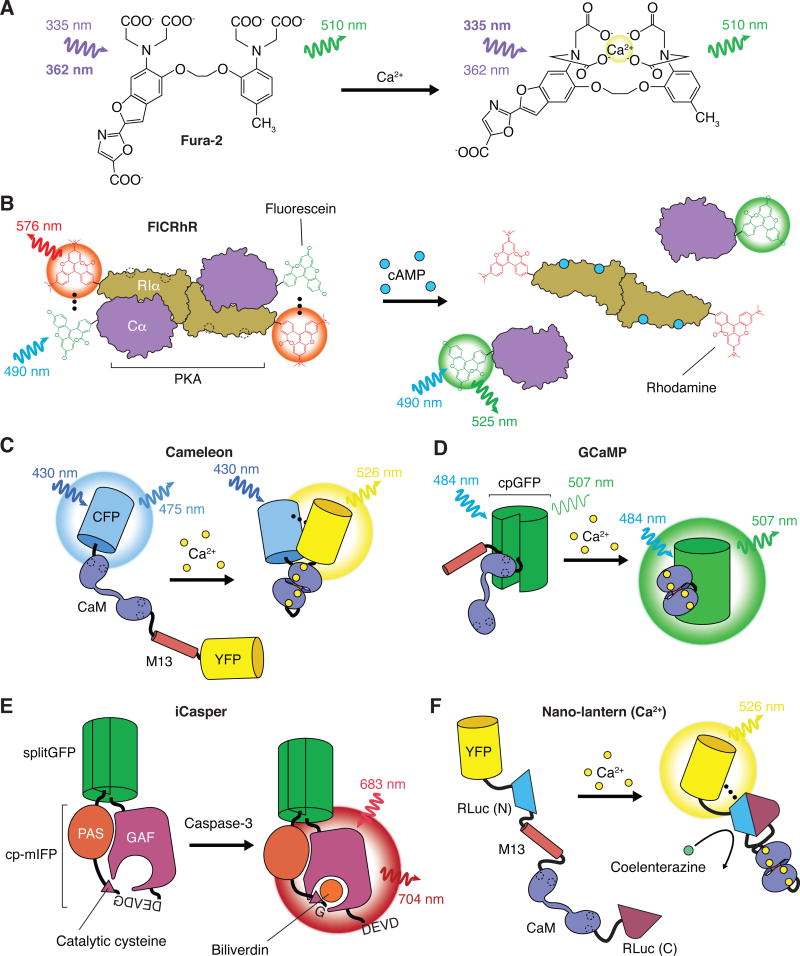
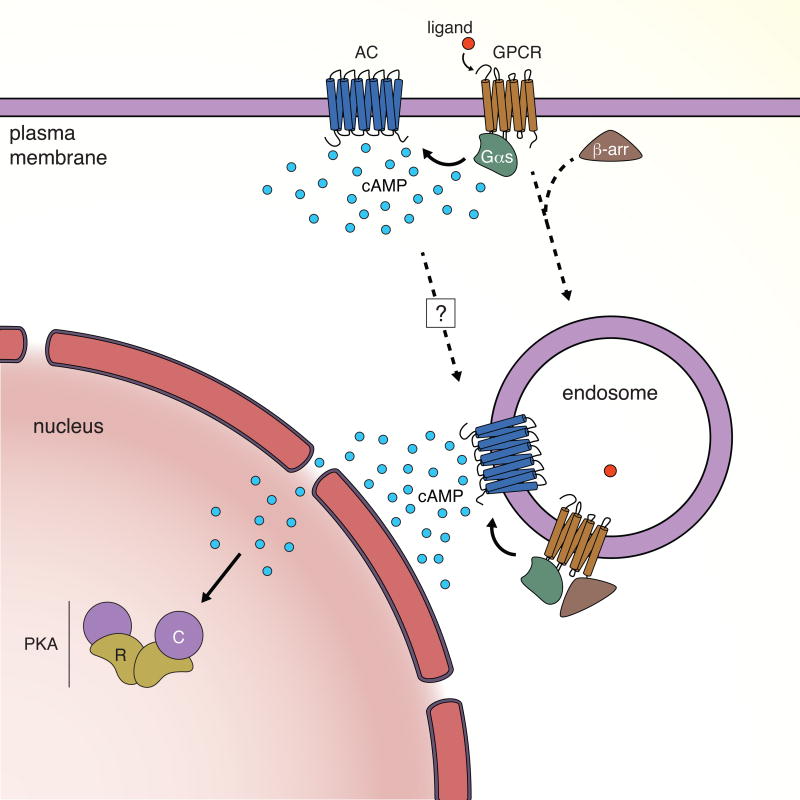
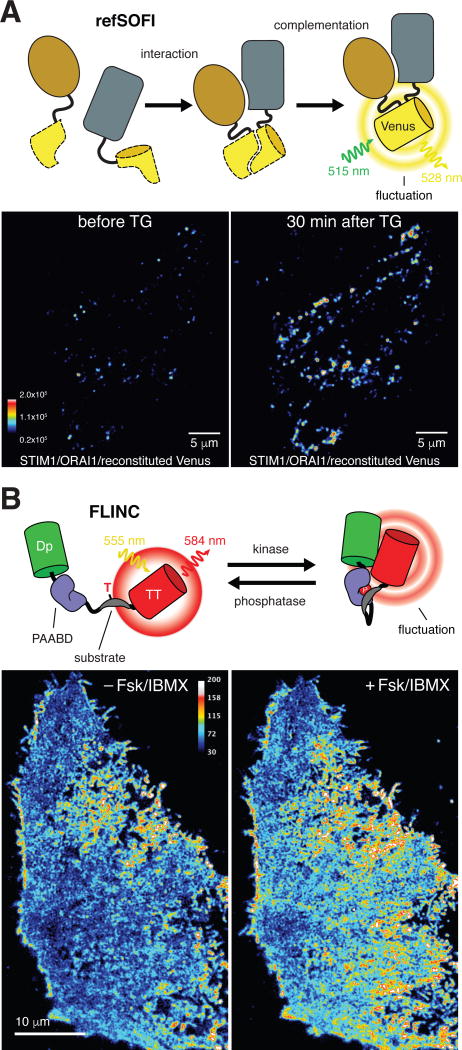
Synergistic advances in fluorescent protein engineering and live-cell imaging techniques in recent years have fueled the concurrent development and application of genetically encoded fluorescent reporters that are tailored for tracking signaling dynamics in living systems over multiple length and time scales. These biosensors are uniquely suited for this challenging task, owing to their specificity, sensitivity, and versatility, as well as to the noninvasive and nondestructive nature of fluorescence and the power of genetic encoding. Over the past 10 years, a growing number of fluorescent reporters have been developed for tracking a wide range of biological signals in living cells and animals, including second messenger and metabolite dynamics, enzyme activation and activity, and cell cycle progression and neuronal activity. Many of these biosensors are gaining wide use and are proving to be indispensable for unraveling the complex biological functions of individual signaling molecules in their native environment, the living cell, shedding new light on the structural and molecular underpinnings of cell signaling. In this review, we highlight recent advances in protein engineering that are likely to help expand and improve the design and application of these valuable tools. We then turn our focus to specific examples of live-cell imaging using genetically encoded fluorescent reporters as an important platform for advancing our understanding of G protein-coupled receptor signaling and neuronal activity.
近年来,荧光蛋白工程和活细胞成像技术的协同进步,推动了基因编码荧光报告蛋白的同步发展和应用,这些报告蛋白专门用于跟踪活系统中多个长度和时间尺度上的信号转导动态。这些生物传感器具有特异性、敏感性和多功能性,以及荧光的非侵入性和非破坏性和遗传编码的强大功能,非常适合这项具有挑战性的任务。在过去的 10 年中,已经开发出越来越多的荧光报告蛋白,用于跟踪活细胞和动物中广泛的生物信号,包括第二信使和代谢物动态、酶激活和活性以及细胞周期进程和神经元活性。其中许多生物传感器正在得到广泛应用,并被证明对于揭示单个信号分子在其天然环境(活细胞)中的复杂生物学功能是不可或缺的,为细胞信号转导的结构和分子基础提供了新的认识。在这篇综述中,我们强调了蛋白质工程的最新进展,这些进展可能有助于扩展和改进这些有价值工具的设计和应用。然后,我们将重点转向使用基因编码荧光报告蛋白进行活细胞成像的具体示例,作为推进我们对 G 蛋白偶联受体信号转导和神经元活性理解的重要平台。