Cickovski Trevor, Peake Eli, Aguiar-Pulido Vanessa, Narasimhan Giri
Bioinformatics Research Group (BioRG) & Biomolecular Sciences Institute, School of Computing & Information Sciences, Florida International University, 11200 SW 8th St, Miami, 33196, FL, USA.
Department of Computer Science, Eckerd College, 4200 54th Avenue South, Saint Petersburg, 33711, FL, USA.
BMC Bioinformatics. 2017 Jun 7;18(Suppl 8):239. doi: 10.1186/s12859-017-1659-z.
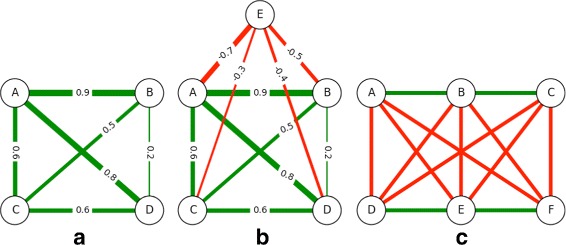
The notion of centrality is used to identify "important" nodes in social networks. Importance of nodes is not well-defined, and many different notions exist in the literature. The challenge of defining centrality in meaningful ways when network edges can be positively or negatively weighted has not been adequately addressed in the literature. Existing centrality algorithms also have a second shortcoming, i.e., the list of the most central nodes are often clustered in a specific region of the network and are not well represented across the network.
We address both by proposing Ablatio Triadum (ATria), an iterative centrality algorithm that uses the concept of "payoffs" from economic theory.
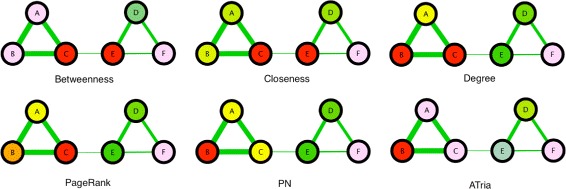
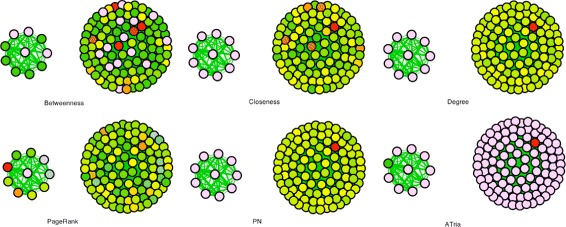
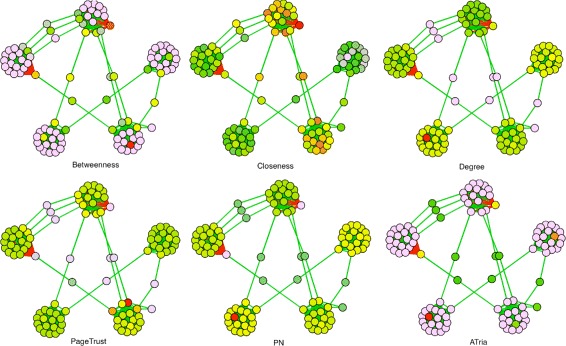
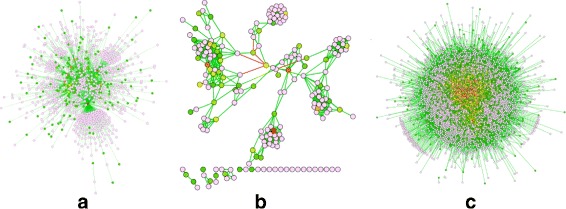
We compare our algorithm with other known centrality algorithms and demonstrate how ATria overcomes several of their shortcomings. We demonstrate the applicability of our algorithm to synthetic networks as well as biological networks including bacterial co-occurrence networks, sometimes referred to as microbial social networks.
We show evidence that ATria identifies three different kinds of "important" nodes in microbial social networks with different potential roles in the community.
中心性的概念用于识别社交网络中的“重要”节点。节点的重要性定义并不明确,文献中存在许多不同的概念。当网络边可以被赋予正权重或负权重时,以有意义的方式定义中心性这一挑战在文献中尚未得到充分解决。现有的中心性算法还有第二个缺点,即最中心节点的列表通常聚集在网络的特定区域,在整个网络中没有得到很好的体现。
我们通过提出Ablatio Triadum(ATria)来解决这两个问题,这是一种迭代中心性算法,它使用了经济理论中的“收益”概念。
我们将我们的算法与其他已知的中心性算法进行比较,并展示ATria如何克服它们的几个缺点。我们证明了我们的算法在合成网络以及生物网络(包括细菌共现网络,有时称为微生物社交网络)中的适用性。
我们有证据表明,ATria在微生物社交网络中识别出三种不同类型的“重要”节点,它们在群落中具有不同的潜在作用。