
微生物“社交网络”。
Microbial "social networks".
作者信息
Fernandez Mitch, Riveros Juan D, Campos Michael, Mathee Kalai, Narasimhan Giri
出版信息
BMC Genomics. 2015;16 Suppl 11(Suppl 11):S6. doi: 10.1186/1471-2164-16-S11-S6. Epub 2015 Nov 10.
BACKGROUND
It is well understood that distinct communities of bacteria are present at different sites of the body, and that changes in the structure of these communities have strong implications for human health. Yet, challenges remain in understanding the complex interconnections between the bacterial taxa within these microbial communities and how they change during the progression of diseases. Many recent studies attempt to analyze the human microbiome using traditional ecological measures and cataloging differences in bacterial community membership. In this paper, we show how to push metagenomic analyses beyond mundane questions related to the bacterial taxonomic profiles that differentiate one sample from another.
METHODS
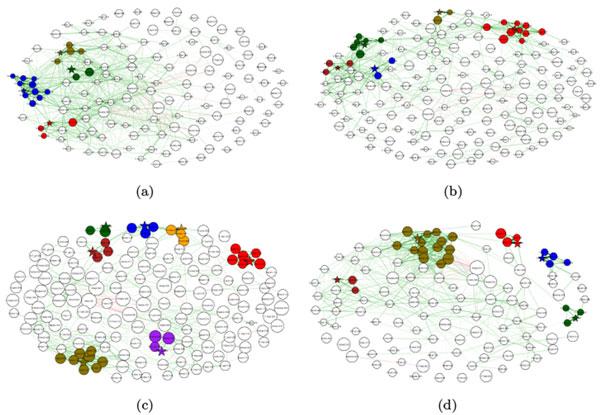
We develop tools and techniques that help us to investigate the nature of social interactions in microbial communities, and demonstrate ways of compactly capturing extensive information about these networks and visually conveying them in an effective manner. We define the concept of bacterial "social clubs", which are groups of taxa that tend to appear together in many samples. More importantly, we define the concept of "rival clubs", entire groups that tend to avoid occurring together in many samples. We show how to efficiently compute social clubs and rival clubs and demonstrate their utility with the help of examples including a smokers' dataset and a dataset from the Human Microbiome Project (HMP).
RESULTS
The tools developed provide a framework for analyzing relationships between bacterial taxa modeled as bacterial co-occurrence networks. The computational techniques also provide a framework for identifying clubs and rival clubs and for studying differences in the microbiomes (and their interactions) of two or more collections of samples.
CONCLUSIONS
Microbial relationships are similar to those found in social networks. In this work, we assume that strong (positive or negative) tendencies to co-occur or co-infect is likely to have biological, physiological, or ecological significance, possibly as a result of cooperation or competition. As a consequence of the analysis, a variety of biological interpretations are conjectured. In the human microbiome context, the pattern of strength of interactions between bacterial taxa is unique to body site.
背景
人们清楚地知道,不同的细菌群落存在于身体的不同部位,并且这些群落结构的变化对人类健康有着重大影响。然而,在理解这些微生物群落中细菌分类群之间的复杂相互联系以及它们在疾病进展过程中如何变化方面,仍然存在挑战。最近许多研究试图使用传统的生态学方法分析人类微生物组,并对细菌群落成员的差异进行编目。在本文中,我们展示了如何将宏基因组分析超越与区分一个样本与另一个样本的细菌分类特征相关的普通问题。
方法
我们开发了有助于研究微生物群落中社会相互作用本质的工具和技术,并展示了紧凑地捕获有关这些网络的广泛信息并以有效方式直观呈现它们的方法。我们定义了细菌“社交俱乐部”的概念,即倾向于在许多样本中一起出现的分类群组。更重要的是,我们定义了“竞争俱乐部”的概念,即倾向于在许多样本中避免一起出现的整个组。我们展示了如何有效地计算社交俱乐部和竞争俱乐部,并借助包括吸烟者数据集和人类微生物组计划(HMP)数据集在内的示例展示它们的效用。
结果
所开发的工具为分析建模为细菌共现网络的细菌分类群之间的关系提供了一个框架。这些计算技术还为识别俱乐部和竞争俱乐部以及研究两个或更多样本集合的微生物组(及其相互作用)差异提供了一个框架。
结论
微生物关系与社交网络中的关系相似。在这项工作中,我们假设强烈的(正或负)共现或共感染倾向可能具有生物学、生理学或生态学意义,这可能是合作或竞争的结果。作为分析的结果,推测了各种生物学解释。在人类微生物组背景下,细菌分类群之间相互作用强度的模式因身体部位而异。


 Zotero 插件