Junbo Wang, Sijia Liu, Hongying Chen, Lei Liu, Pu Wang
Department of Orthopaedics, West China Hospital, Sichuan University, GuoXue Road 37, 610041, Chengdu, Sichuan, People's Republic of China.
Rehabilitation Medicine Center, West China Hospital, Sichuan University, Chengdu, Sichuan, People's Republic of China.
BMC Musculoskelet Disord. 2017 Jun 15;18(1):260. doi: 10.1186/s12891-017-1579-0.
Whole-body vibration(WBV) has been suggested for the prevention of subchondral bone loss of knee osteoarthritis (OA) . This study examined the effects of different frequency of whole-body vibration on subchondral trabecular bone microarchitecture, cartilage degradation and metabolism of the tibia and femoral condyle bone, and joint pain in an anterior cruciate ligament transection (ACLT)-induced knee osteoarthritisrabbit model.
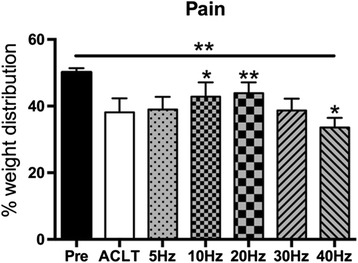
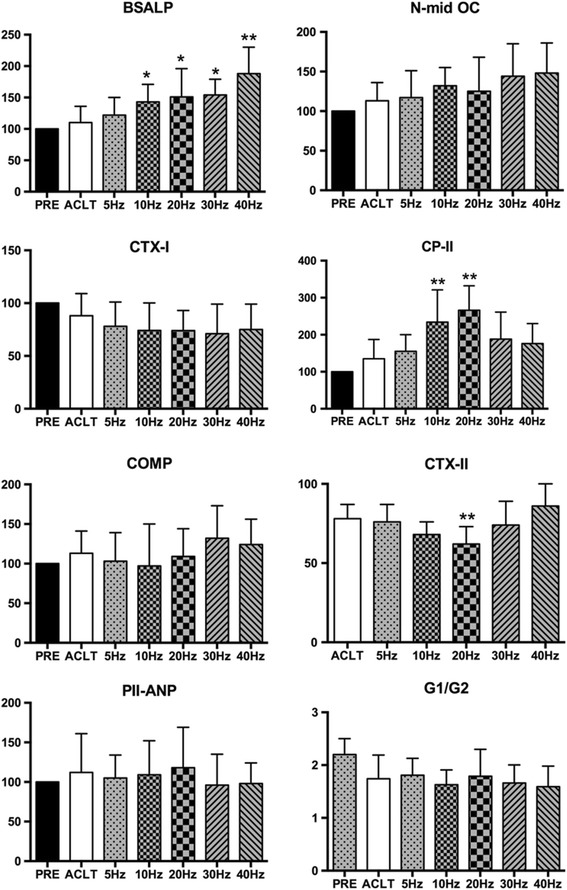
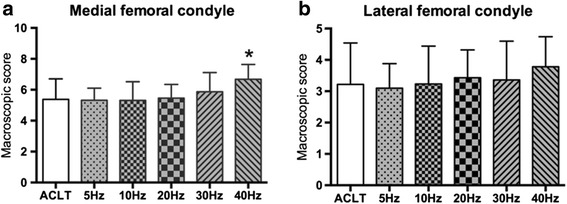
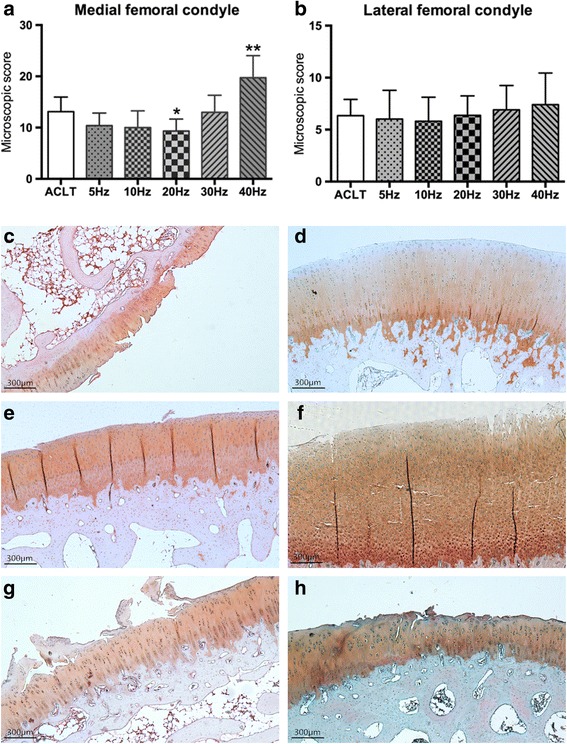
Ninety adult rabbits were divided into six groups: all groups received unilateral ACLT; Group 1, ACLT only; Group 2, 5 Hz WBV; Group 3, 10 Hz WBV; Group 4, 20 Hz WBV; Group 5, 30 Hz WBV; and Group 6, 40 Hz WBV. Pain was tested via weight-bearing asymmetry. Subchondral trabecular bone microarchitecture was examined using in vivo micro-computed tomography. Knee joint cartilage was evaluated by gross morphology, histology, and ECM gene expression level (aggrecan and type II collagen [CTX-II]). Serum bone-specific alkaline phosphatase, N-mid OC, cartilage oligometric protein, CPII, type I collagen, PIIANP, G1/G2 aggrecan levels, and urinary CTX-II were analyzed.
After 8 weeks of low-magnitude WBV, the lower frequency (10 Hz and 20 Hz) WBV treatment decreased joint pain and cartilage resorption, accelerated cartilage formation, delayed cartilage degradation especially at the 20 Hz regimen. However, the higher frequencies (30 Hz and 40 Hz) had worse effects, with worse limb function and cartilage volume as well as higher histological scores and cartilage resorption. In contrast, both prevented loss of trabeculae and increased bone turnover. No significant change was observed in the 5 Hz WBV group.
Our data demonstrate that the lower frequencies (10 Hz and 20 Hz) of low-magnitude WBV increased bone turnover, delayed cartilage degeneration, and caused a significant functional change of the OA-affected limb in ACLT-induced OA rabbit model but did not reverse OA progression after 8 weeks of treatment.
全身振动(WBV)已被建议用于预防膝关节骨关节炎(OA)的软骨下骨丢失。本研究在兔前交叉韧带横断(ACLT)诱导的膝骨关节炎模型中,研究了不同频率的全身振动对软骨下小梁骨微结构、软骨降解以及胫骨和股骨髁骨代谢及关节疼痛的影响。
将90只成年兔分为六组:所有组均接受单侧ACLT;第1组,仅ACLT;第2组,5Hz WBV;第3组,10Hz WBV;第4组,20Hz WBV;第5组,30Hz WBV;第6组,40Hz WBV。通过负重不对称测试疼痛。使用体内微型计算机断层扫描检查软骨下小梁骨微结构。通过大体形态学、组织学和细胞外基质基因表达水平(聚集蛋白聚糖和II型胶原[CTX-II])评估膝关节软骨。分析血清骨特异性碱性磷酸酶、N-中段骨钙素、软骨寡聚蛋白、CPII、I型胶原、PIIANP、G1/G2聚集蛋白聚糖水平和尿CTX-II。
在低强度WBV治疗8周后,较低频率(10Hz和20Hz)的WBV治疗可减轻关节疼痛和软骨吸收,加速软骨形成,延迟软骨降解,尤其是在20Hz方案下。然而,较高频率(30Hz和40Hz)的效果更差,肢体功能和软骨体积更差,组织学评分和软骨吸收更高。相比之下,两者都可防止小梁丢失并增加骨转换。5Hz WBV组未观察到显著变化。
我们的数据表明,在ACLT诱导的OA兔模型中,低强度WBV的较低频率(10Hz和20Hz)可增加骨转换,延迟软骨退变,并导致OA受累肢体出现显著功能变化,但在治疗8周后并未逆转OA进展。