State Key Laboratory for Diagnosis and Treatment of Infectious Diseases, The First Affiliated Hospital, College of Medicine, Zhejiang University, Hangzhou, China.
Collaborative Innovation Center for Diagnosis and Treatment of Infectious Diseases, Hangzhou, China.
Exp Mol Med. 2017 Jun 16;49(6):e346. doi: 10.1038/emm.2017.63.
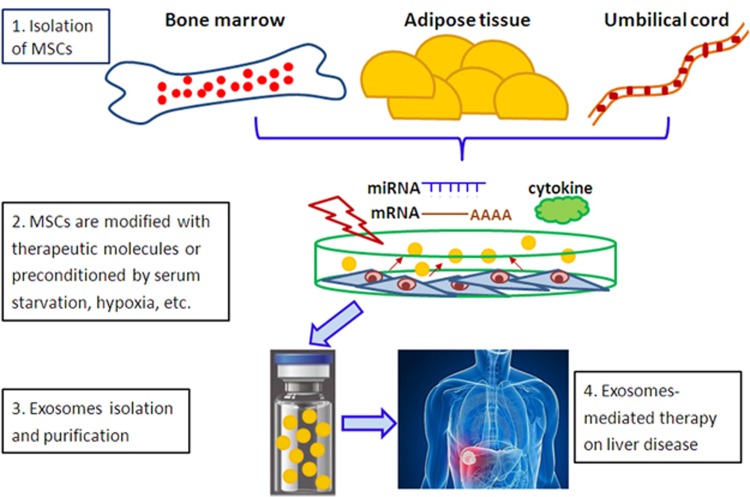
The administration of mesenchymal stem cells (MSCs) as a therapy for liver disease holds great promise. MSCs can differentiate into hepatocytes, reduce liver inflammation, promote hepatic regeneration and secrete protective cytokines. However, the risks of iatrogenic tumor formation, cellular rejection and infusional toxicity in MSC transplantation remain unresolved. Accumulating evidence now suggests that a novel cell-free therapy, MSC-secreted exosomes, might constitute a compelling alternative because of their advantages over the corresponding MSCs. They are smaller and less complex than their parent cells and, thus, easier to produce and store, they are devoid of viable cells, and they present no risk of tumor formation. Moreover, they are less immunogenic than their parent cells because of their lower content in membrane-bound proteins. This paper reviews the biogenesis of MSC exosomes and their physiological functions, and highlights the specific biochemical potential of MSC-derived exosomes in restoring tissue homeostasis. In addition, we summarize the recent advances in the role of exosomes in MSC therapy for various liver diseases, including liver fibrosis, acute liver injury and hepatocellular carcinoma. This paper also discusses the potential challenges and strategies in the use of exosome-based therapies for liver disease in the future.
间充质干细胞(MSCs)作为肝脏疾病治疗的一种方法具有巨大的潜力。MSCs 可以分化为肝细胞,减少肝脏炎症,促进肝再生并分泌保护性细胞因子。然而,MSCs 移植中存在致瘤、细胞排斥和输注毒性等风险尚未得到解决。越来越多的证据表明,一种新型的无细胞治疗方法,即 MSC 分泌的外泌体,可能是一种很有前途的替代方法,因为它们比相应的 MSCs 具有优势。它们比其亲本细胞更小、更简单,因此更容易生产和储存,它们没有活细胞,也不存在形成肿瘤的风险。此外,由于它们的膜结合蛋白含量较低,它们的免疫原性低于其亲本细胞。本文综述了 MSC 外泌体的生物发生及其生理功能,并强调了 MSC 衍生的外泌体在恢复组织内稳态方面的特定生化潜力。此外,我们还总结了外泌体在 MSC 治疗各种肝脏疾病(包括肝纤维化、急性肝损伤和肝细胞癌)中的作用的最新进展。本文还讨论了未来在肝脏疾病的外泌体治疗中使用的潜在挑战和策略。