Cai Wei, Tang Yung-Lung, Wu Song, Li Hong
Research Centre of Brain Function and Psychological Science, Shenzhen UniversityShenzhen, China.
Key Laboratory of Behavioral Science, Institute of Psychology, Chinese Academy of SciencesBeijing, China.
Front Psychol. 2017 May 31;8:858. doi: 10.3389/fpsyg.2017.00858. eCollection 2017.
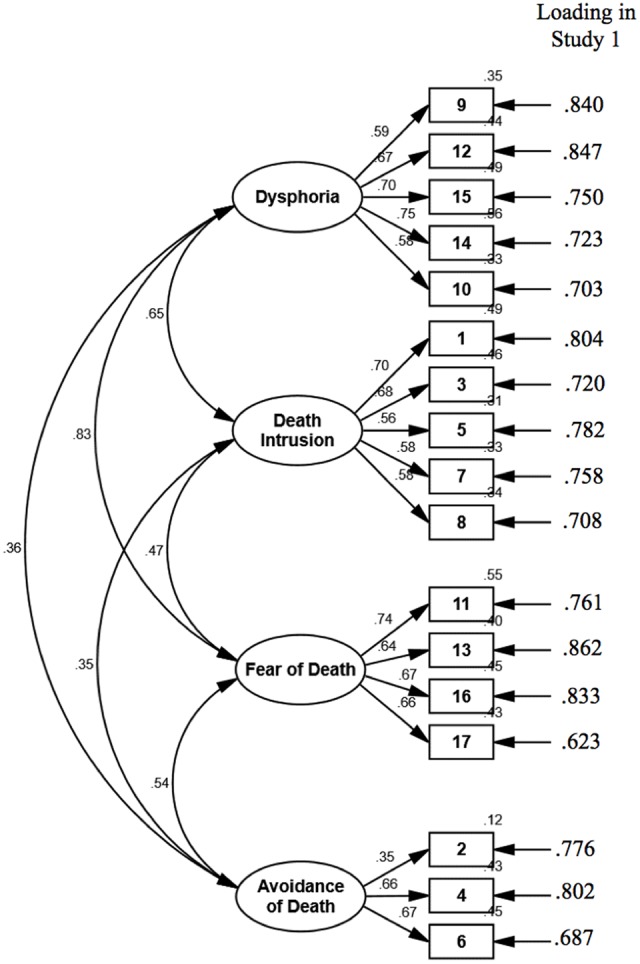
This study developed and validated a new measure to assess the death anxiety (i.e., Scale of Death Anxiety, SDA) on an individual's somatic, cognitive, emotional, and behavioral reactions from a symptomatic perspective in Chinese youth samples. Following a systematic process, a four-factor structure of the SDA was identified through principle components analysis and confirmatory factor analysis that revealed four aspects of death anxiety: Dysphoria, Death Intrusion, Fear of Death, and Avoidance of Death. The results of this study indicate that the SDA has a clear factor structure and good psychometric properties. The SDA supports death anxiety as a multidimensional construct, and the foundational role of fear of death in the generation of death anxiety. This scale is valuable and beneficial to research on death anxiety. This study makes a significant contribution to the literature because the SDA is the first assessment of death anxiety to include the constructs of dysphoria and somatic symptoms. And the potential clinical practice of the SDA was discussed.
本研究开发并验证了一种新的测量方法,用于从症状学角度评估中国青年样本中个体在躯体、认知、情感和行为反应方面的死亡焦虑(即死亡焦虑量表,SDA)。通过系统的过程,经主成分分析和验证性因素分析确定了SDA的四因素结构,揭示了死亡焦虑的四个方面:烦躁不安、死亡侵扰、对死亡的恐惧和对死亡的回避。本研究结果表明,SDA具有清晰的因素结构和良好的心理测量特性。SDA支持死亡焦虑是一个多维结构的观点,以及对死亡的恐惧在死亡焦虑产生中的基础作用。该量表对死亡焦虑的研究具有价值和益处。本研究对文献做出了重大贡献,因为SDA是首次将烦躁不安和躯体症状纳入其中的死亡焦虑评估工具。并且还讨论了SDA潜在的临床应用。