Romero-Olivares Adriana L, Allison Steven D, Treseder Kathleen K
Department of Ecology and Evolutionary Biology, University of California Irvine, Irvine, CA, United States of America.
Department of Earth System Science, University of California Irvine, Irvine, CA, United States of America.
PLoS One. 2017 Jun 16;12(6):e0179674. doi: 10.1371/journal.pone.0179674. eCollection 2017.
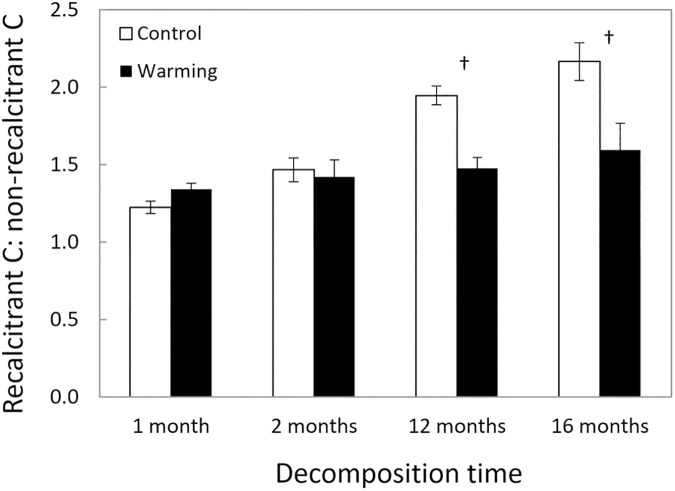
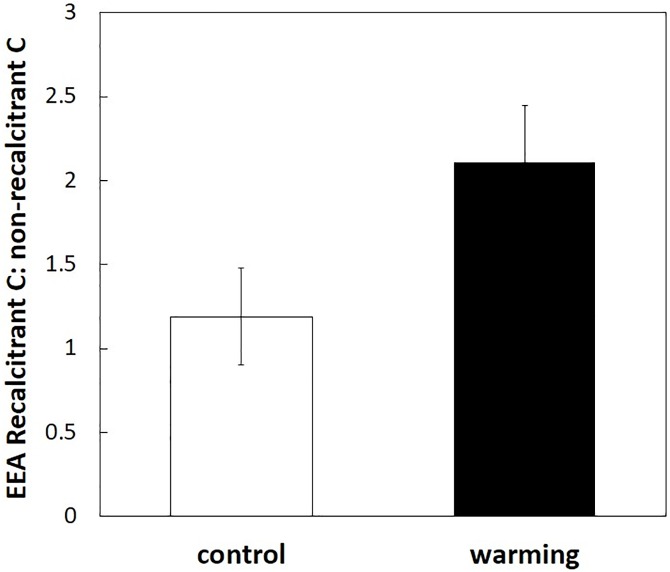
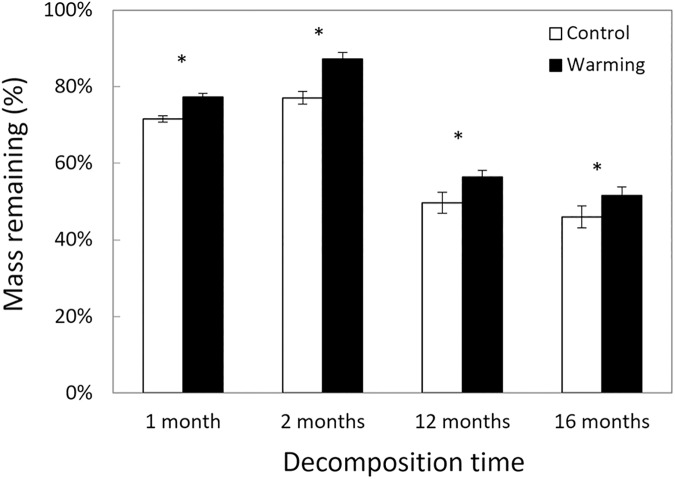
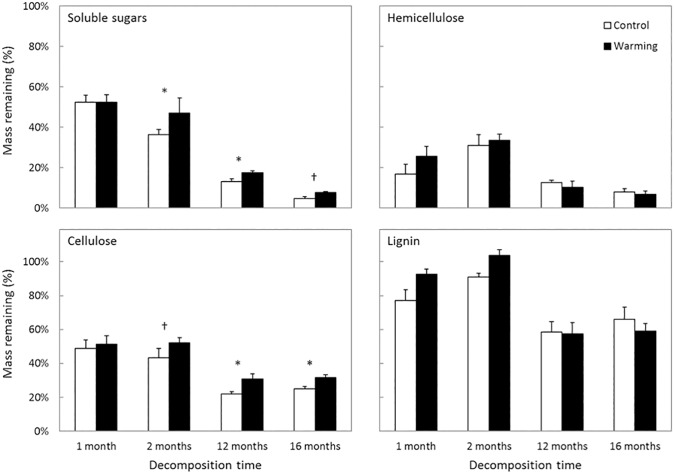
Over the long term, soil carbon (C) storage is partly determined by decomposition rate of carbon that is slow to decompose (i.e., recalcitrant C). According to thermodynamic theory, decomposition rates of recalcitrant C might differ from those of non-recalcitrant C in their sensitivities to global warming. We decomposed leaf litter in a warming experiment in Alaskan boreal forest, and measured mass loss of recalcitrant C (lignin) vs. non-recalcitrant C (cellulose, hemicellulose, and sugars) throughout 16 months. We found that these C fractions responded differently to warming. Specifically, after one year of decomposition, the ratio of recalcitrant C to non-recalcitrant C remaining in litter declined in the warmed plots compared to control. Consistent with this pattern, potential activities of enzymes targeting recalcitrant C increased with warming, relative to those targeting non-recalcitrant C. Even so, mass loss of individual C fractions showed that non-recalcitrant C is preferentially decomposed under control conditions whereas recalcitrant C losses remain unchanged between control and warmed plots. Moreover, overall mass loss was greater under control conditions. Our results imply that direct warming effects, as well as indirect warming effects (e.g. drying), may serve to maintain decomposition rates of recalcitrant C compared to non-recalcitrant C despite negative effects on overall decomposition.
从长期来看,土壤碳(C)储存部分取决于难分解碳(即顽固性碳)的分解速率。根据热力学理论,顽固性碳的分解速率在对全球变暖的敏感性方面可能与非顽固性碳不同。我们在阿拉斯加北方森林的一个升温实验中分解了落叶,并在16个月内测量了顽固性碳(木质素)与非顽固性碳(纤维素、半纤维素和糖类)的质量损失。我们发现这些碳组分对升温的反应不同。具体而言,经过一年的分解后,与对照相比,升温地块中落叶中剩余的顽固性碳与非顽固性碳的比例下降。与这种模式一致的是,针对顽固性碳的酶的潜在活性相对于针对非顽固性碳的酶随着升温而增加。即便如此,单个碳组分的质量损失表明,在对照条件下非顽固性碳优先分解,而在对照地块和升温地块之间顽固性碳的损失保持不变。此外,对照条件下的总体质量损失更大。我们的结果表明,尽管对总体分解有负面影响,但直接升温效应以及间接升温效应(如干燥)可能有助于维持顽固性碳与非顽固性碳相比的分解速率。