Zhang Yin, McMullen Angus, Pontani Lea-Laetitia, He Xiaojin, Sha Ruojie, Seeman Nadrian C, Brujic Jasna, Chaikin Paul M
Physics Department, Center for Soft Matter Research, New York University, 4 Washington Place, New York, New York, 10003, USA.
Institut des NanoSciences de Paris, UMR 7588, Centre National de la Recherche Scientifique-University Pierre et Marie Curie, 4 Place Jussieu, Paris, France.
Nat Commun. 2017 Jun 16;8(1):21. doi: 10.1038/s41467-017-00070-0.
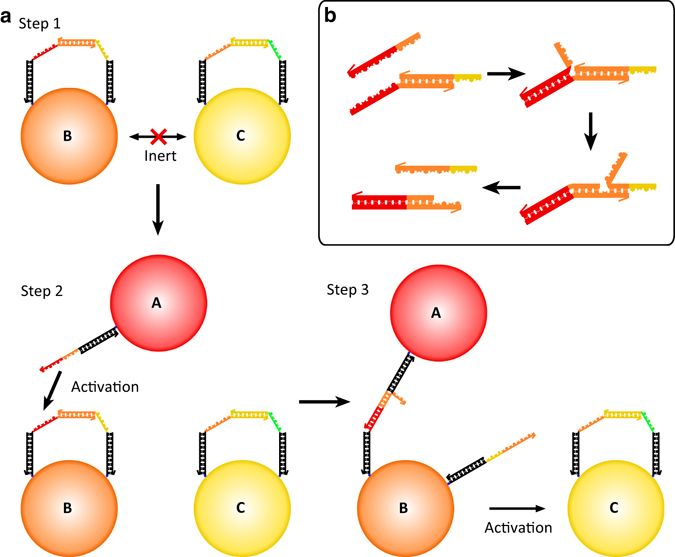
Complex structures and devices, both natural and manmade, are often constructed sequentially. From crystallization to embryogenesis, a nucleus or seed is formed and built upon. Sequential assembly allows for initiation, signaling, and logical programming, which are necessary for making enclosed, hierarchical structures. Although biology relies on such schemes, they have not been available in materials science. Here, we demonstrate programmed sequential self-assembly of DNA functionalized emulsions. The droplets are initially inert because the grafted DNA strands are pre-hybridized in pairs. Active strands on initiator droplets then displace one of the paired strands and thus release its complement, which in turn activates the next droplet in the sequence, akin to living polymerization. Our strategy provides time and logic control during the self-assembly process, and offers a new perspective on the synthesis of materials.Natural complex systems are often constructed by sequential assembly but this is not readily available for synthetic systems. Here, the authors program the sequential self-assembly of DNA functionalized emulsions by altering the DNA grafted strands.
无论是天然的还是人造的复杂结构和装置,通常都是按顺序构建的。从结晶到胚胎发育,都会先形成一个核或种子,然后在此基础上构建。顺序组装允许启动、信号传导和逻辑编程,这些对于形成封闭的分层结构是必不可少的。尽管生物学依赖于这样的方案,但在材料科学中却无法实现。在这里,我们展示了DNA功能化乳液的程序化顺序自组装。液滴最初是惰性的,因为接枝的DNA链预先成对杂交。引发剂液滴上的活性链随后取代其中一条配对链,从而释放其互补链,进而激活序列中的下一个液滴,类似于活性聚合。我们的策略在自组装过程中提供了时间和逻辑控制,并为材料合成提供了新的视角。天然复杂系统通常通过顺序组装构建,但这在合成系统中并不容易实现。在这里,作者通过改变接枝的DNA链对DNA功能化乳液的顺序自组装进行编程。