Aliomrani Mehdi, Jafarian Abbas, Zolfaghari Behzad
Department of Toxicology and Pharmacology, School of Pharmacy, Tehran University of Medical Sciences, Tehran, Iran.
Department of Pharmaceutical Biotechnology, School of Pharmacy and Pharmaceutical Sciences, Isfahan University of Medical Sciences, Isfahan, Iran.
Adv Biomed Res. 2017 Jun 6;6:68. doi: 10.4103/2277-9175.192734. eCollection 2017.
Cancer is a term for a large group of different diseases, all involving uncontrolled cell growth. Many of plants have been traditionally used for the treatment of ulcers, tumors, warts, and other diseases. In addition, in the last decade, there are studies showing cytotoxic effects of different species of on tumor cell lines. In this study, we attempted to determine if possess any cytotoxic activity.
Solvents extracted the plant powder with various polarities by a maceration method, and qualitative phytochemical analyzes were carried out on them to identify the constituents. On the other hand, the possible cytotoxicity of different extracts on Hela and HT-29 tumor cells was measured by 3-(4,5-dimethylthiazol-2-yl)-2,5-diphenyltetrazolium bromide assay and 50% reduction in cell survival was considered as a cytotoxic effect. Analyze of variance followed by Student-Newman-Keuls test was used to see the differences among the groups.
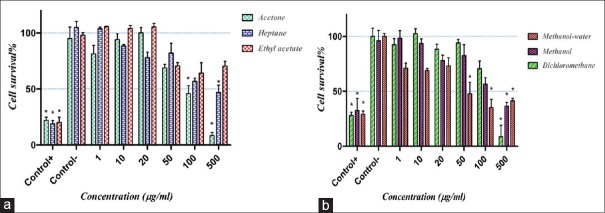
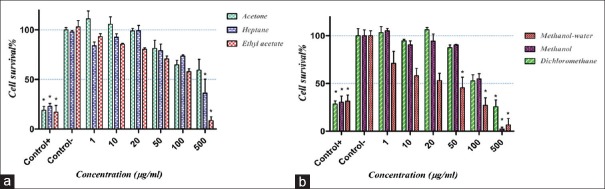
Phytochemical analysis of showed the presence of flavonoid, alkaloid, anthraquinone and tannin in plant aerial parts. Methanol-water, acetone, dichloromethane, methanol, and heptane extracts of significantly reduced viability of Hela cells ( < 0.05) with inhibitory concentration 50% (IC) of 50, 90, 230, 420, and 450 μg/ml, respectively. While methanol-water, dichloromethane, methanol, ethyl acetate, and heptane extracts were cytotoxic with IC of 43, 115, 125, 250, and 390 μg/ml, respectively ( < 0.05), on HT-29 cells.
It can be concluded that is a good candidate for further study toward cytotoxic agents.
癌症是一大类不同疾病的统称,所有这些疾病都涉及细胞的失控生长。许多植物传统上被用于治疗溃疡、肿瘤、疣和其他疾病。此外,在过去十年中,有研究表明不同种类的[植物名称]对肿瘤细胞系具有细胞毒性作用。在本研究中,我们试图确定[植物名称]是否具有任何细胞毒性活性。
采用浸渍法用不同极性的溶剂提取植物粉末,并对其进行定性植物化学分析以鉴定成分。另一方面,通过3-(4,5-二甲基噻唑-2-基)-2,5-二苯基四氮唑溴盐法测定不同提取物对Hela和HT-29肿瘤细胞的潜在细胞毒性,细胞存活率降低50%被视为细胞毒性作用。采用方差分析和Student-Newman-Keuls检验来观察各组之间的差异。
[植物名称]的植物化学分析表明,其地上部分存在黄酮类、生物碱、蒽醌和单宁。[植物名称]的甲醇-水、丙酮、二氯甲烷、甲醇和庚烷提取物显著降低了Hela细胞的活力(P<0.05),其半数抑制浓度(IC50)分别为50、90、230、420和450μg/ml。而甲醇-水、二氯甲烷、甲醇、乙酸乙酯和庚烷提取物对HT-29细胞具有细胞毒性,IC50分别为43、115、125、250和390μg/ml(P<0.05)。
可以得出结论,[植物名称]是进一步研究细胞毒性剂的良好候选者。