Physical Chemistry I and Research Center of Micro and Nanochemistry and Engineering (Cμ), Department of Chemistry and Biology, University of Siegen , Adolf-Reichwein-Str. 2, 57076 Siegen, Germany.
Department of Biochemistry, Yong Loo Lin School of Medicine, National University of Singapore , 14 Medical Drive, Singapore 117599, Singapore.
ACS Appl Mater Interfaces. 2017 Jul 12;9(27):22321-22331. doi: 10.1021/acsami.7b07166. Epub 2017 Jun 28.
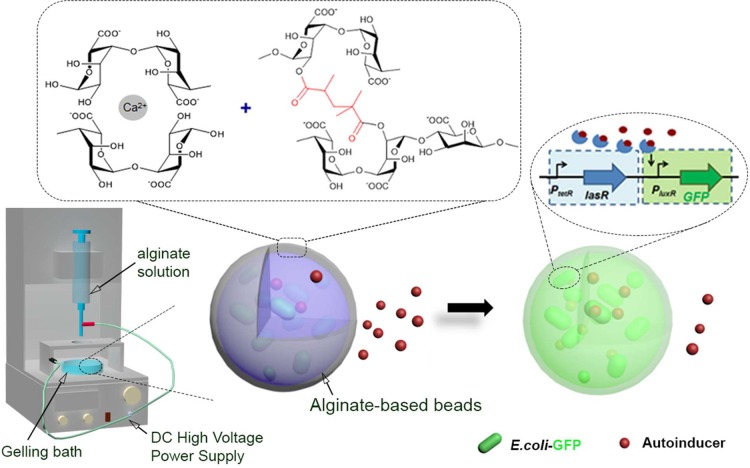
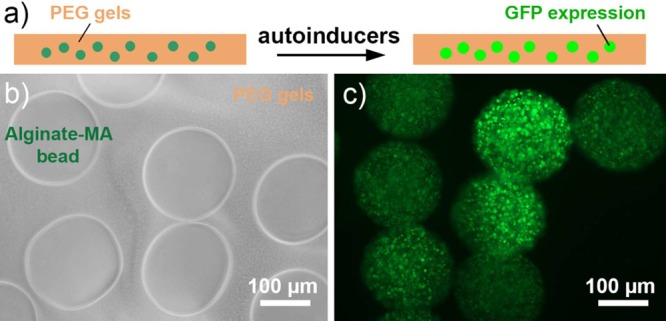
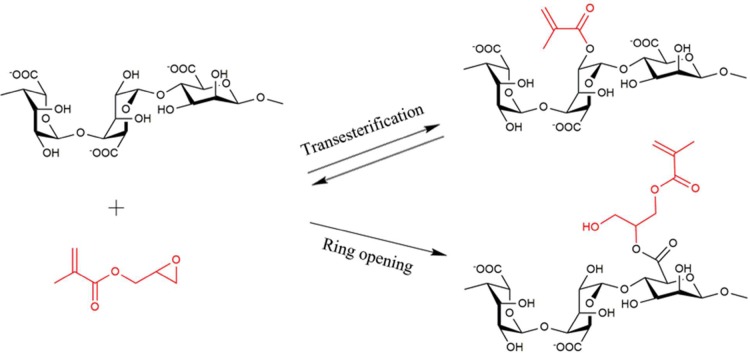
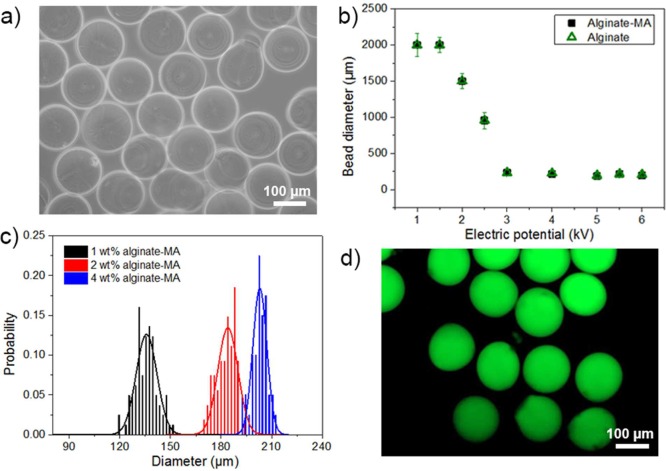
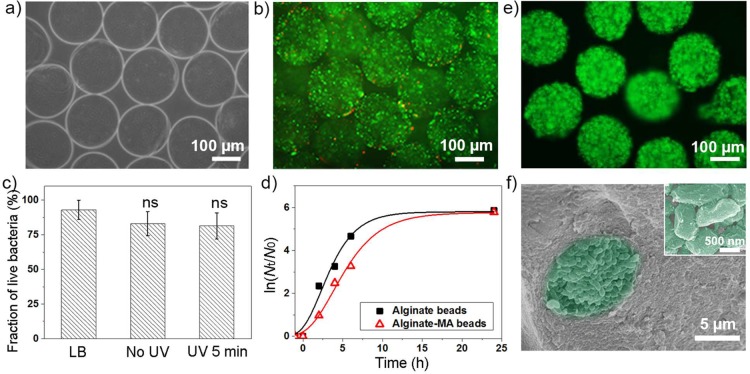
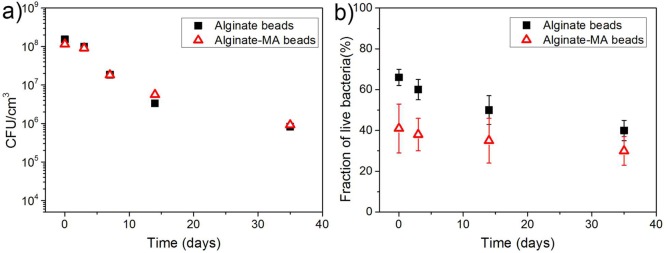
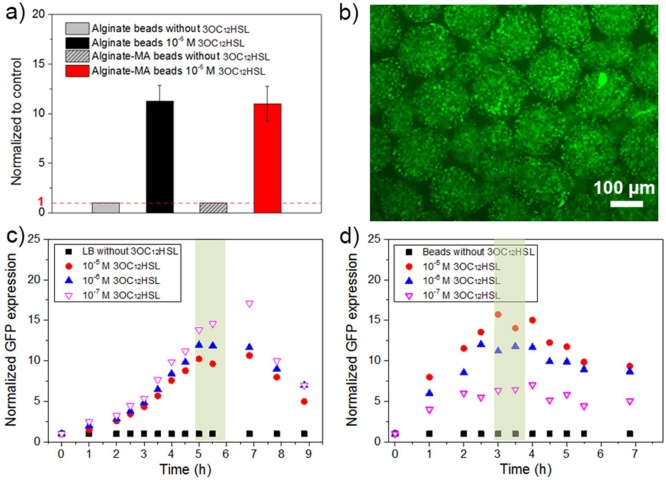
Quorum sensing, in which bacteria communities use signaling molecules for inter- and intracellular communication, has been intensively studied in recent decades. In order to fabricate highly sensitive easy-to-handle point of care biosensors that detect quorum sensing molecules, we have developed, as is reported here, reporter bacteria loaded alginate-methacrylate (alginate-MA) hydrogel beads. The alginate-MA beads, which were obtained by electrostatic extrusion, were reinforced by photo-cross-linking to increase stability and thereby to reduce bacteria leaching. In these beads the genetically engineered fluorescent reporter bacterium Escherichia coli pTetR-LasR-pLuxR-GFP (E. coli pLuxR-GFP) was encapsulated, which responds to the autoinducer N-(3-oxododecanoyl)homoserine lactone secreted by Pseudomonas aeruginosa. After encapsulation in alginate-MA hydrogel beads with diameters in the range of 100-300 μm that were produced by an electrostatic extrusion method and rapid photo-cross-linking, the E. coli pLuxR-GFP were found to possess a high degree of viability and sensing activity. The encapsulated bacteria could proliferate inside the hydrogel beads, when exposed to bacteria culture medium. In media containing the autoinducer N-(3-oxododecanoyl)homoserine lactone, the encapsulated reporter bacteria responded with a strong fluorescence signal due to an increased green fluorescent protein (GFP) expression. A prototype dipstick type sensor developed here underlines the potential of encapsulation of viable and functional reporter bacteria inside reinforced alginate-methacrylate hydrogel beads for whole cell sensors for bacteria detection.
群体感应,即细菌群落使用信号分子进行细胞间和细胞内通讯,在最近几十年得到了深入研究。为了制造高灵敏度、易于操作的即时护理生物传感器来检测群体感应分子,我们开发了一种报告细菌负载的藻酸盐-甲基丙烯酸盐(alginate-MA)水凝胶珠,如这里所报道的。藻酸盐-MA 珠通过静电挤压获得,并通过光交联增强,以增加稳定性,从而减少细菌浸出。在这些珠子中,封装了经过基因工程改造的荧光报告细菌大肠杆菌 pTetR-LasR-pLuxR-GFP(大肠杆菌 pLuxR-GFP),它对铜绿假单胞菌分泌的自体诱导物 N-(3-氧代十二烷酰)高丝氨酸内酯做出反应。在通过静电挤压法和快速光交联生产的直径在 100-300μm 范围内的藻酸盐-MA 水凝胶珠中封装后,大肠杆菌 pLuxR-GFP 被发现具有高度的生存能力和感应活性。当暴露于细菌培养基中时,封装在水凝胶珠内的细菌可以在水凝胶珠内增殖。在含有自体诱导物 N-(3-氧代十二烷酰)高丝氨酸内酯的培养基中,由于绿色荧光蛋白(GFP)表达增加,封装的报告细菌会产生强烈的荧光信号。这里开发的一种原型试条型传感器强调了将有活力和功能的报告细菌封装在增强的藻酸盐-甲基丙烯酸盐水凝胶珠内用于细菌检测的整体细胞传感器的潜力。