Fisch S, Brinkhaus B, Teut M
Institute for Social Medicine, Epidemiology, and Health Economics, Charité Universitätsmedizin Berlin, Luisenstr. 57, 10098, Berlin, Germany.
Psychotherapy Outpatient Clinic, Daruper Straße 14, D-48653, Coesfeld, Germany.
BMC Complement Altern Med. 2017 Jun 19;17(1):323. doi: 10.1186/s12906-017-1806-0.
Although hypnosis and hypnotherapy have become more popular in recent years, the evidence for hypnosis to influence perceived stress is unclear. In this systematic review we searched and evaluated randomized clinical studies investigating the effect of hypnosis on perceived stress reduction and coping.
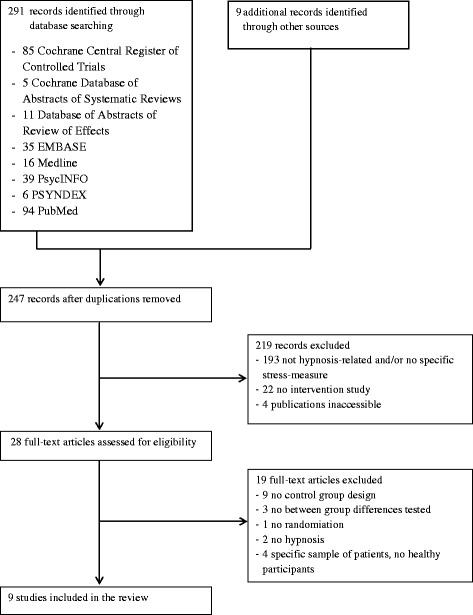
The Cochrane Central Register of Controlled Trials, the Cochrane Database of Systematic Reviews, the Database of Abstracts of Review of Effects, EMBASE, Medline, PsycINFO, PSYNDEX and PubMed were systematically screened from their inception until December 2015 for randomized controlled trials (RCTs) reporting about hypnosis or hypnotherapy for stress reduction in healthy participants. Risk of Bias was assessed according the Cochrane Collaboration recommendations.
Nine RCTs with a total of 365 participants met the inclusion criteria and were included in this review. Most included participants were medical students, predominantly female (n = 211). Mean age of participants ranged in most studies between 20 and 25 years, in three studies the mean ages were between 30 and 42 years. Perceived stress was measured by a wide range of psychological questionnaires including Face Valid Stress Test, Stress Thermometer, and immunological data was collected. All nine included studies used explorative designs and showed a high risk of bias. Six out of nine studies reported significant positive effects of hypnosis for stress reduction in the main outcome parameter compared to control groups (3 active controls, 3 no therapy controls). Immunological outcomes were assessed in six studies, the results were inconclusive.
Due to exploratory designs and high risk of bias, the effectiveness of hypnosis or hypnotherapy in stress reduction remains still unclear. More high quality clinical research is urgently needed.
尽管近年来催眠和催眠疗法越来越受欢迎,但催眠对感知压力的影响证据尚不明确。在本系统评价中,我们检索并评估了调查催眠对感知压力减轻和应对效果的随机临床研究。
从Cochrane对照试验中心注册库、Cochrane系统评价数据库、效果评价摘要数据库、EMBASE、Medline、PsycINFO、PSYNDEX和PubMed建库起至2015年12月,系统筛选关于催眠或催眠疗法减轻健康参与者压力的随机对照试验(RCT)。根据Cochrane协作网的建议评估偏倚风险。
9项RCT共365名参与者符合纳入标准并纳入本评价。大多数纳入参与者为医学生,以女性为主(n = 211)。大多数研究中参与者的平均年龄在20至25岁之间,3项研究中平均年龄在30至42岁之间。通过多种心理问卷测量感知压力,包括表面效度压力测试、压力温度计,并收集免疫数据。所有9项纳入研究均采用探索性设计,且显示出较高的偏倚风险。9项研究中有6项报告称,与对照组(3项积极对照,3项无治疗对照)相比,催眠在主要结局参数上对减轻压力有显著的积极效果。6项研究评估了免疫结局,结果尚无定论。
由于采用探索性设计且偏倚风险高,催眠或催眠疗法在减轻压力方面的有效性仍不明确。迫切需要更多高质量的临床研究。