Wang Yu, Lin Zhijian, Zhang Bing, Nie Anzheng, Bian Meng
Department of Clinical Chinese Pharmacy, School of Chinese Pharmacy, Beijing University of Chinese Medicine, Beijing, China.
Nutr Metab (Lond). 2017 Jun 13;14:38. doi: 10.1186/s12986-017-0190-6. eCollection 2017.
Excessive production and/or reduced excretion of uric acid could lead to hyperuricemia, which could be a major cause of disability. Hyperuricemia has received increasing attention in the last few decades due to its global prevalence. L., commonly known as chicory, is a perennial herb of the asteraceae family. It was previously shown to exert potent hypouricemic effects linked with decreasing uric acid formation in the liver by down-regulating the activity of xanthine oxidase, and increasing uric acid excretion by up-regulating the renal OAT3 mRNA expression. The present study aimed to evaluate its extra-renal excretion and possible molecular mechanism underlying the transporter responsible for intestinal uric acid excretion in vivo.
Chicory was administered intragastrically to hyperuricemic rats induced by drinking 10% fructose water. The uricosuric effect was evaluated by determining the serum uric acid level as well as the intestinal uric acid excretion by HPLC. The location and expression levels of ATP-binding cassette transporter, sub-family G, member 2 (ABCG2) in jejunum and ileum were analyzed.
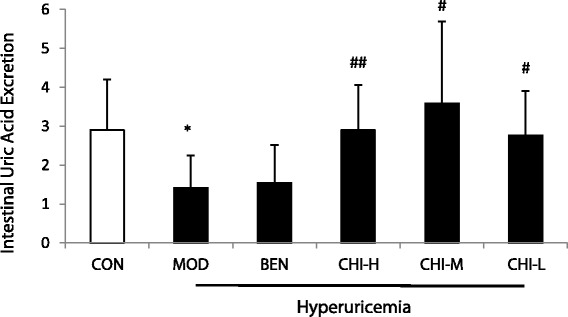
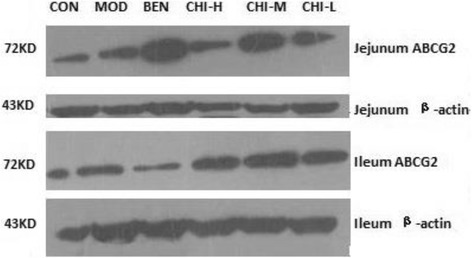
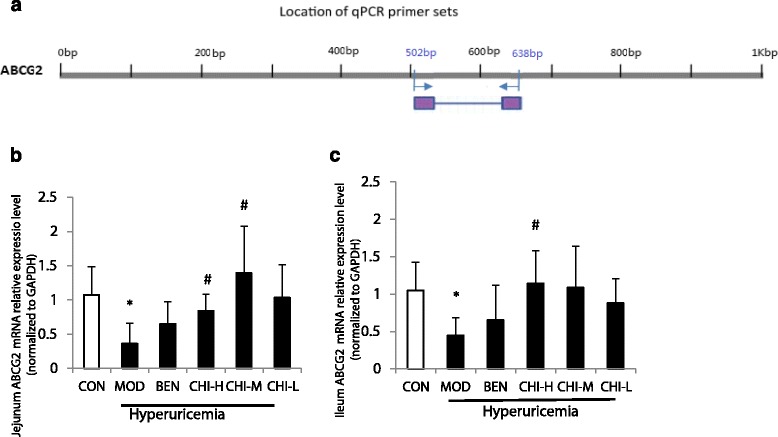
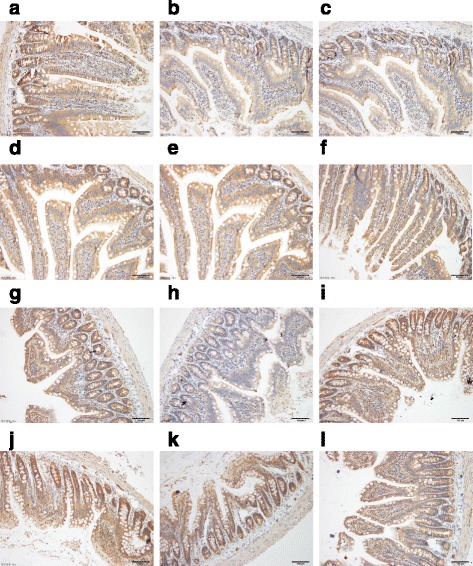
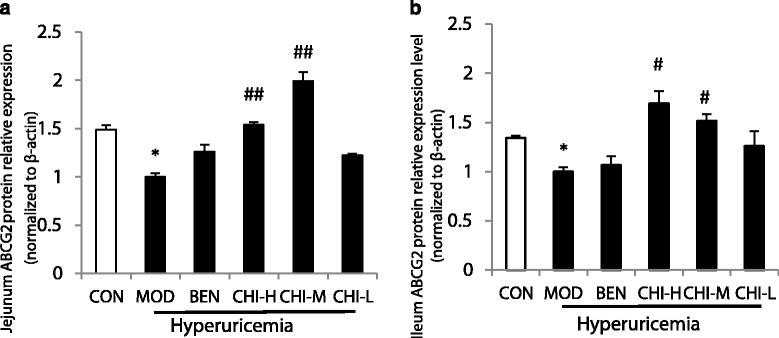
The administration of chicory decreased the serum uric acid level significantly and increased the intestinal uric acid excretion obviously in hyperuricemic rats induced by 10% fructose drinking. Staining showed that ABCG2 was expressed in the apical membrane of the epithelium and glands of the jejunum and ileum in rats. Further examination showed that chicory enhanced the mRNA and protein expressions of ABCG2 markedly in a dose-dependent manner in jejunum and ileum.
These findings indicate that chicory increases uric acid excretion by intestines, which may be related to the stimulation of intestinal uric acid excretion via down-regulating the mRNA and protein expressions of ABCG2.
尿酸生成过多和/或排泄减少可导致高尿酸血症,这可能是导致残疾的主要原因。由于高尿酸血症在全球范围内的流行,在过去几十年中受到了越来越多的关注。菊苣,通常被称为菊苣,是菊科的一种多年生草本植物。先前的研究表明,菊苣具有显著的降尿酸作用,其机制与下调肝脏中黄嘌呤氧化酶的活性从而减少尿酸生成,以及上调肾脏中OAT3 mRNA表达从而增加尿酸排泄有关。本研究旨在评估其肾外排泄情况以及体内负责肠道尿酸排泄的转运体的潜在分子机制。
对饮用10%果糖水诱导的高尿酸血症大鼠进行菊苣灌胃。通过测定血清尿酸水平以及采用高效液相色谱法测定肠道尿酸排泄来评估促尿酸尿作用。分析空肠和回肠中ATP结合盒转运体G亚家族成员2(ABCG2)的定位和表达水平。
给予菊苣可显著降低饮用10%果糖诱导的高尿酸血症大鼠的血清尿酸水平,并明显增加肠道尿酸排泄。染色显示,ABCG2在大鼠空肠和回肠上皮和腺体的顶端膜中表达。进一步检查表明,菊苣在空肠和回肠中以剂量依赖的方式显著增强了ABCG2的mRNA和蛋白表达。
这些发现表明,菊苣可增加肠道尿酸排泄,这可能与通过下调ABCG2的mRNA和蛋白表达来刺激肠道尿酸排泄有关。