Knauer Uwe, Matros Andrea, Petrovic Tijana, Zanker Timothy, Scott Eileen S, Seiffert Udo
Biosystems Engineering, Fraunhofer IFF, Sandtorstr. 22, 39106 Magdeburg, Germany.
Leibniz-Institute of Plant Genetics and Crop Plant Research (IPK), OT Gatersleben, Corrensstraße 3, 06466 Seeland, Germany.
Plant Methods. 2017 Jun 15;13:47. doi: 10.1186/s13007-017-0198-y. eCollection 2017.
Hyperspectral imaging is an emerging means of assessing plant vitality, stress parameters, nutrition status, and diseases. Extraction of target values from the high-dimensional datasets either relies on pixel-wise processing of the full spectral information, appropriate selection of individual bands, or calculation of spectral indices. Limitations of such approaches are reduced classification accuracy, reduced robustness due to spatial variation of the spectral information across the surface of the objects measured as well as a loss of information intrinsic to band selection and use of spectral indices. In this paper we present an improved spatial-spectral segmentation approach for the analysis of hyperspectral imaging data and its application for the prediction of powdery mildew infection levels (disease severity) of intact Chardonnay grape bunches shortly before veraison.
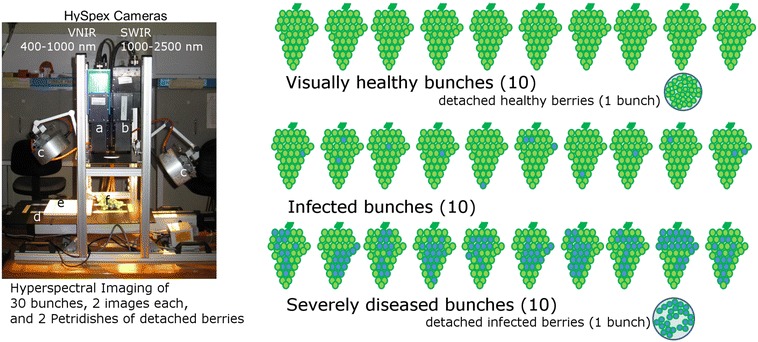
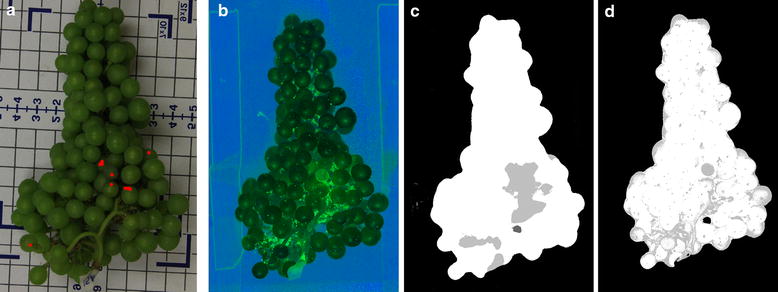
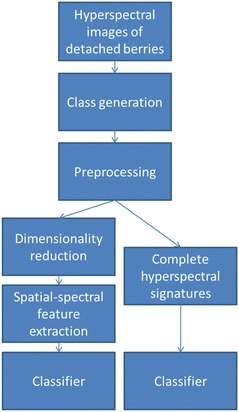
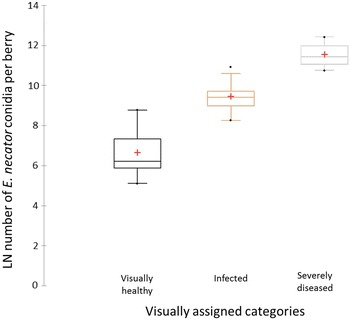
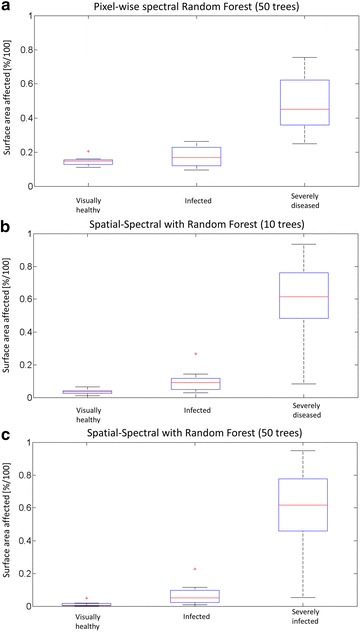
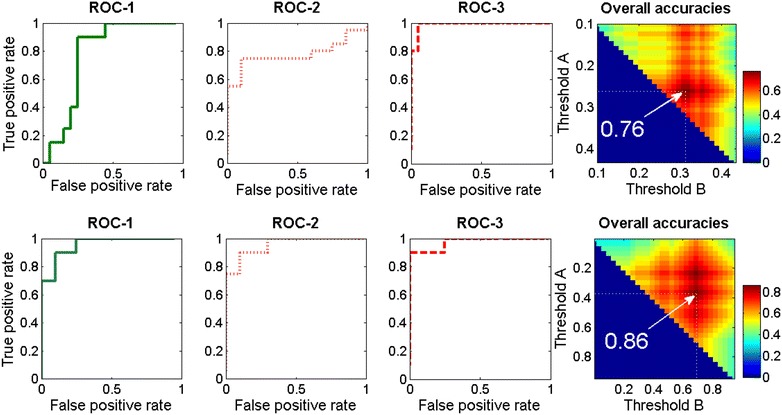
Instead of calculating texture features (spatial features) for the huge number of spectral bands independently, dimensionality reduction by means of Linear Discriminant Analysis (LDA) was applied first to derive a few descriptive image bands. Subsequent classification was based on modified Random Forest classifiers and selective extraction of texture parameters from the integral image representation of the image bands generated. Dimensionality reduction, integral images, and the selective feature extraction led to improved classification accuracies of up to [Formula: see text] for detached berries used as a reference sample (training dataset). Our approach was validated by predicting infection levels for a sample of 30 intact bunches. Classification accuracy improved with the number of decision trees of the Random Forest classifier. These results corresponded with qPCR results. An accuracy of 0.87 was achieved in classification of healthy, infected, and severely diseased bunches. However, discrimination between visually healthy and infected bunches proved to be challenging for a few samples, perhaps due to colonized berries or sparse mycelia hidden within the bunch or airborne conidia on the berries that were detected by qPCR.
An advanced approach to hyperspectral image classification based on combined spatial and spectral image features, potentially applicable to many available hyperspectral sensor technologies, has been developed and validated to improve the detection of powdery mildew infection levels of Chardonnay grape bunches. The spatial-spectral approach improved especially the detection of light infection levels compared with pixel-wise spectral data analysis. This approach is expected to improve the speed and accuracy of disease detection once the thresholds for fungal biomass detected by hyperspectral imaging are established; it can also facilitate monitoring in plant phenotyping of grapevine and additional crops.
高光谱成像作为一种新兴手段,可用于评估植物活力、胁迫参数、营养状况及病害情况。从高维数据集中提取目标值,要么依赖于对全光谱信息进行逐像素处理、合理选择单个波段,要么计算光谱指数。这些方法存在局限性,如分类精度降低、由于所测物体表面光谱信息的空间变化导致稳健性下降,以及波段选择和光谱指数使用所带来的信息损失。在本文中,我们提出了一种改进的空间 - 光谱分割方法,用于分析高光谱成像数据,并将其应用于预测即将进入转色期的完整霞多丽葡萄串白粉病感染水平(病害严重程度)。
并非独立地为大量光谱波段计算纹理特征(空间特征),而是首先通过线性判别分析(LDA)进行降维,以得出一些具有描述性的图像波段。随后的分类基于改进的随机森林分类器,并从生成的图像波段的积分图像表示中选择性提取纹理参数。降维、积分图像和选择性特征提取使作为参考样本(训练数据集)的离体浆果的分类准确率提高至[公式:见原文]。通过预测30个完整葡萄串样本的感染水平对我们的方法进行了验证。分类准确率随着随机森林分类器决策树数量的增加而提高。这些结果与定量聚合酶链反应(qPCR)结果相符。在对健康、感染和严重患病的葡萄串进行分类时,准确率达到了0.87。然而,对于一些样本,区分视觉上健康和感染的葡萄串具有挑战性,这可能是由于被定殖的浆果、隐藏在葡萄串内的稀疏菌丝体或浆果上通过qPCR检测到的气传分生孢子。
已开发并验证了一种基于空间和光谱图像特征相结合的先进高光谱图像分类方法,该方法可能适用于许多现有的高光谱传感器技术,以改进霞多丽葡萄串白粉病感染水平的检测。与逐像素光谱数据分析相比,空间 - 光谱方法尤其提高了对轻度感染水平的检测能力。一旦通过高光谱成像检测到的真菌生物量阈值确定,该方法有望提高病害检测的速度和准确性;它还可以促进葡萄和其他作物的植物表型监测。