Ortí-Lucas Rafael Manuel, Muñoz-Miguel Julio
Social Medicine and Public Health Department, Universidad Católica de Valencia San Vicente Mártir, C/ Espartero,7, Valencia, 46007 Spain.
Preventive Medicine Department, Hospital Clínico Universitario de Valencia, Valencia, Spain.
Antimicrob Resist Infect Control. 2017 Jun 13;6:61. doi: 10.1186/s13756-017-0217-9. eCollection 2017.
HAIs remain a frequent complication for hospitalised patients and pose a challenge that must be tackled by our health systems.
Quasi-experimental study. In order to determine the antimicrobial effectiveness of surface coating agents containing silver ions (BactiBlock®) the degree of contamination of several surfaces in two ICU wards was compared. The association between application of Bactiblock® and surface contamination was analysed using a relative risk (RR). Multivariate logistic regressions were performed for each product applied and each sampling location to adjust for the RR of the contamination of surfaces treated with Bactiblock® for the independent variables.
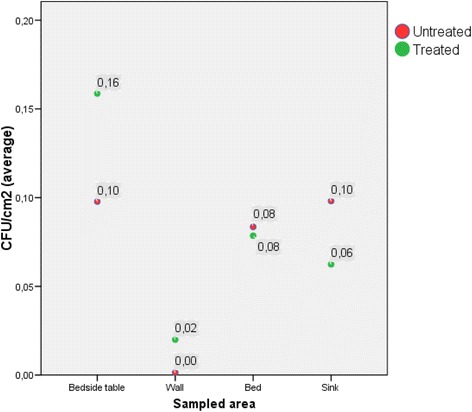
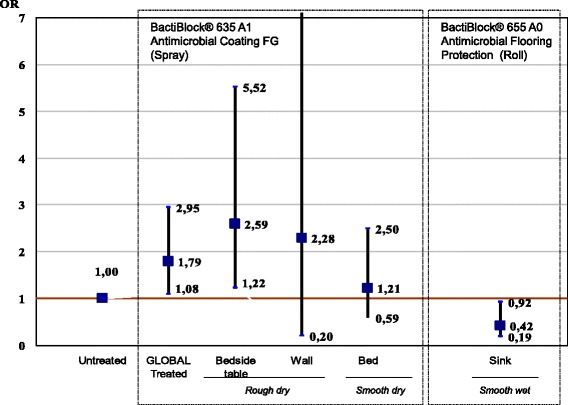
Surface contamination was observed in 31.5% of treated samples and 27.4 of untreated samples. Contamination was equally prominent on bedside Tables (38.7%), bed rails (38.4%) and sinks (38.3%), while the walls showed minimum contamination (2.6%). For beds under isolation protocols, contamination was higher (32.6%) than when no protocol was followed (26.5%) but the difference was not significant ( = 0.148). After stratification for application method and adjusting the multivariate models for period of the study and presence of isolated patients, the risk of contamination after the intervention increased when the coating agent was applied using a spray (OR = 1.79; 95% CI: 1.08-2.95, particularly in a dry and rugged surface such as that of bedside Tables (OR = 2.59; 95% CI: 1.22-5.52); and decreased when the product was applied using a roller on a smooth and continuously cleaned (or wet) Surface (OR = 0.42; 95% CI: 0.19-0.92).
Coating of hospital surfaces with substances containing silver ions may reduce bacterial growth. However, the effectiveness of the coating agent is affected by application method and environmental conditions and the type and cleanness of the surface.
医院获得性感染(HAIs)仍然是住院患者常见的并发症,给我们的卫生系统带来了必须应对的挑战。
准实验研究。为了确定含银离子表面涂层剂(BactiBlock®)的抗菌效果,比较了两个重症监护病房几个表面的污染程度。使用相对风险(RR)分析Bactiblock®的应用与表面污染之间的关联。对每个应用的产品和每个采样位置进行多变量逻辑回归,以针对自变量调整用Bactiblock®处理的表面污染的RR。
在31.5%的处理样本和27.4%的未处理样本中观察到表面污染。污染在床头柜(38.7%)、床栏(38.4%)和水槽(38.3%)上同样显著,而墙壁污染最小(2.6%)。对于遵循隔离方案的病床,污染率(32.6%)高于未遵循方案时(26.5%),但差异不显著(P = 0.148)。在按应用方法分层并针对研究期间和隔离患者的存在调整多变量模型后,当使用喷雾应用涂层剂时,干预后污染风险增加(OR = 1.79;95% CI:1.08 - 2.95),特别是在干燥且粗糙的表面,如床头柜表面(OR = 2.59;95% CI:1.22 - 5.52);而当在光滑且持续清洁(或湿润)的表面上使用滚筒应用产品时,污染风险降低(OR = 0.42;95% CI:0.19 - 0.92)。
用含银离子的物质对医院表面进行涂层处理可能会减少细菌生长。然而,涂层剂的有效性受应用方法、环境条件以及表面类型和清洁程度的影响。