Yamauchi Yumeka, Konno Masae, Ito Shota, Tsunoda Satoshi P, Inoue Keiichi, Kandori Hideki
Department of Life Science and Applied Chemistry, Nagoya Institute of Technology, Nagoya, Aichi 466-8555, Japan.
OptoBioTechnology Research Center, Nagoya Institute of Technology, Nagoya, Aichi 466-8555, Japan.
Biophys Physicobiol. 2017 May 20;14:57-66. doi: 10.2142/biophysico.14.0_57. eCollection 2017.
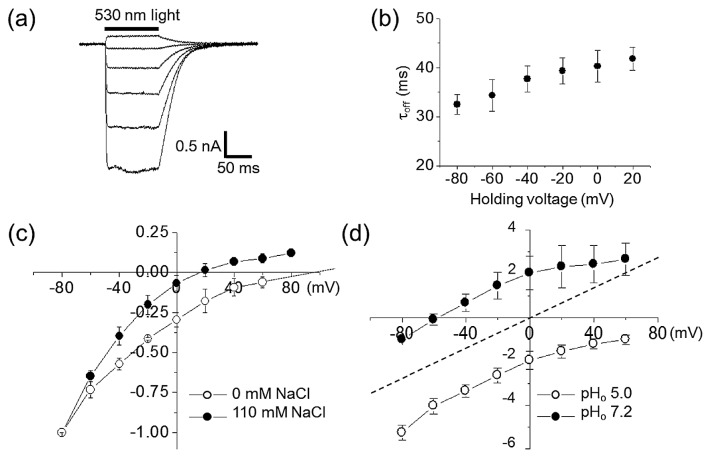
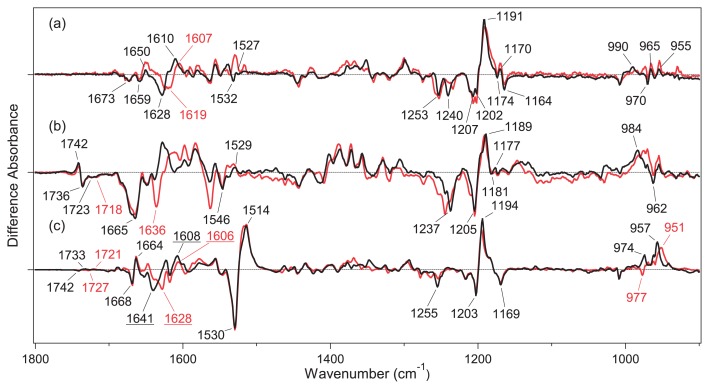
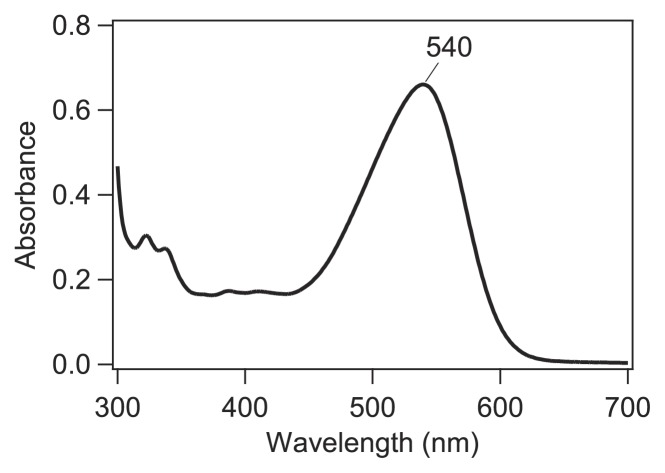
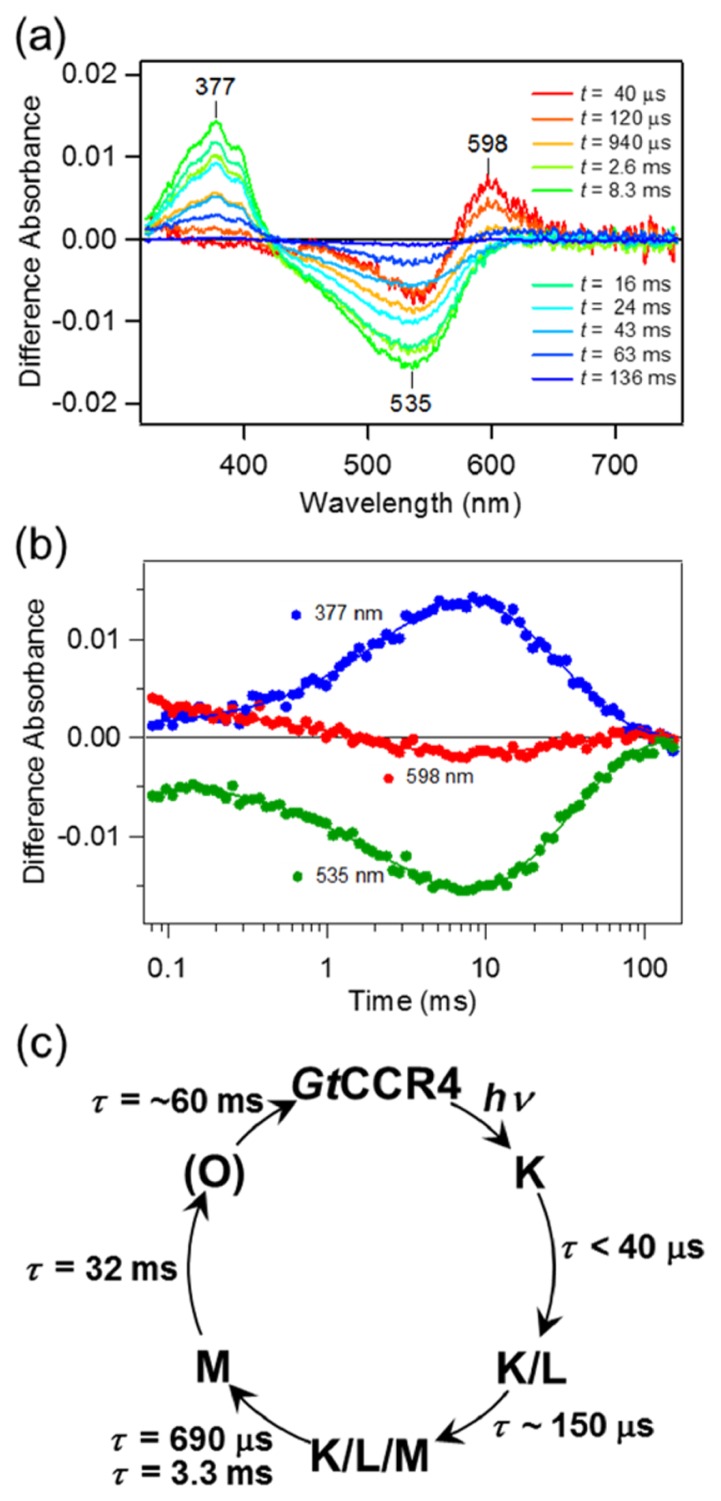
Microbial rhodopsins are membrane proteins found widely in archaea, eubacteria and eukaryotes (fungal and algal species). They have various functions, such as light-driven ion pumps, light-gated ion channels, light sensors and light-activated enzymes. A light-driven proton pump bacteriorhodopsin (BR) contains a DTD motif at positions 85, 89, and 96, which is unique to archaeal proton pumps. Recently, channelrhodopsins (ChRs) containing the DTD motif, whose sequential identity is ~20% similar to BR and to cation ChRs in (CCRs), were found. While extensive studies on ChRs have been performed with CCR2, the molecular properties of DTD ChRs remain an intrigue. In this paper, we studied a DTD rhodopsin from (CCR4) using electrophysiological measurements, flash photolysis, and low-temperature difference FTIR spectroscopy. Electrophysiological measurements clearly showed that CCR4 functions as a light-gated cation channel, similar to other DTD ChRs (CCR1-3). Light-driven proton pump activity was also suggested for CCR4. Both electrophysiological and flash photolysis experiments showed that channel closing occurs upon reprotonation of the Schiff base, suggesting that the dynamics of retinal and channels are tightly coupled in CCR4. From Fourier transform infrared (FTIR) spectroscopy at 77 K, we found that the primary reaction is an all- to a 13- photoisomerization, like other microbial rhodopsins, although perturbations in the secondary structure were much smaller in CCR4 than in CCR2.
微生物视紫红质是广泛存在于古细菌、真细菌和真核生物(真菌和藻类物种)中的膜蛋白。它们具有多种功能,如光驱动离子泵、光门控离子通道、光传感器和光激活酶。光驱动质子泵细菌视紫红质(BR)在第85、89和96位含有一个DTD基序,这是古细菌质子泵所特有的。最近,发现了含有DTD基序的通道视紫红质(ChRs),其序列同一性与BR和阳离子通道视紫红质(CCRs)中的约20%相似。虽然对CCR2进行了广泛的ChRs研究,但DTD ChRs的分子特性仍然是一个谜。在本文中,我们使用电生理测量、闪光光解和低温差傅里叶变换红外光谱对来自[具体物种]的DTD视紫红质(CCR4)进行了研究。电生理测量清楚地表明,CCR4作为光门控阳离子通道发挥作用,类似于其他[具体物种]的DTD ChRs(CCR1 - 3)。还表明CCR4具有光驱动质子泵活性。电生理和闪光光解实验均表明,席夫碱再质子化时通道关闭,这表明视网膜和通道的动力学在CCR4中紧密耦合。通过77K下的傅里叶变换红外(FTIR)光谱,我们发现初级反应是全反式到13 - 顺式光异构化,与其他微生物视紫红质一样,尽管CCR4中二级结构的扰动比CCR2中小得多。