Tang Huaxiu, Solti Imre, Kirkendall Eric, Zhai Haijun, Lingren Todd, Meller Jaroslaw, Ni Yizhao
Department of Biomedical Informatics, Cincinnati Children's Hospital Medical Center (CCHMC), Cincinnati, OH, USA.
Department of Pediatrics, University of Cincinnati, Cincinnati, OH, USA.
Biomed Inform Insights. 2017 Jun 8;9:1178222617713018. doi: 10.1177/1178222617713018. eCollection 2017.
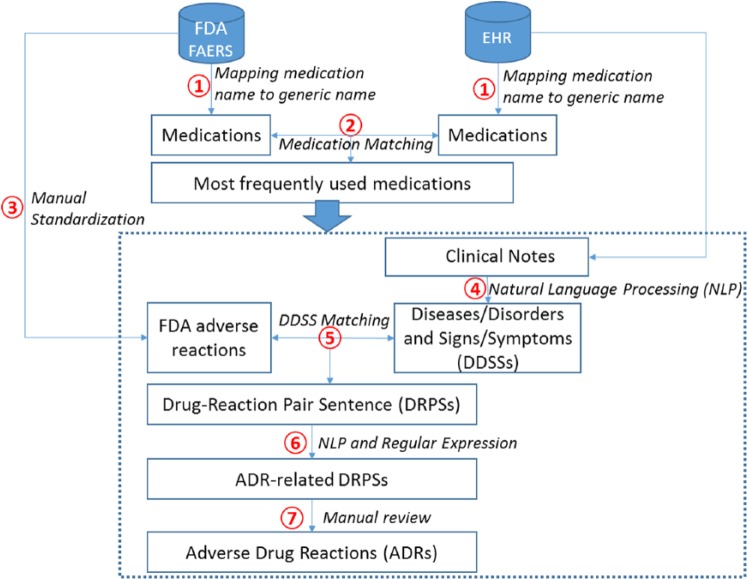
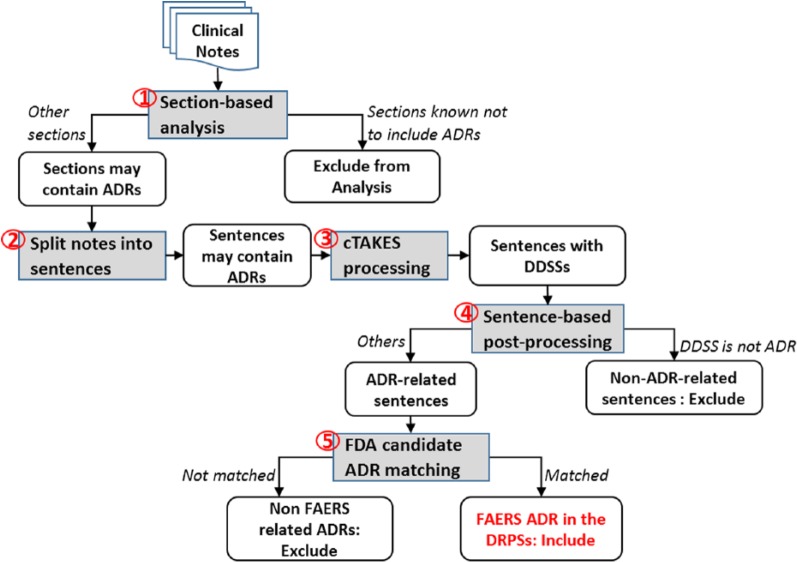
The objective of this study was to determine whether the Food and Drug Administration's Adverse Event Reporting System (FAERS) data set could serve as the basis of automated electronic health record (EHR) monitoring for the adverse drug reaction (ADR) subset of adverse drug events. We retrospectively collected EHR entries for 71 909 pediatric inpatient visits at Cincinnati Children's Hospital Medical Center. Natural language processing (NLP) techniques were used to identify positive diseases/disorders and signs/symptoms (DDSSs) from the patients' clinical narratives. We downloaded all FAERS reports submitted by medical providers and extracted the reported drug-DDSS pairs. For each patient, we aligned the drug-DDSS pairs extracted from their clinical notes with the corresponding drug-DDSS pairs from the FAERS data set to identify Drug-Reaction Pair Sentences (DRPSs). The DRPSs were processed by NLP techniques to identify ADR-related DRPSs. We used clinician annotated, real-world EHR data as reference standard to evaluate the proposed algorithm. During evaluation, the algorithm achieved promising performance and showed great potential in identifying ADRs accurately for pediatric patients.
本研究的目的是确定美国食品药品监督管理局不良事件报告系统(FAERS)数据集是否可作为对药物不良事件中的药物不良反应(ADR)子集进行自动化电子健康记录(EHR)监测的基础。我们回顾性收集了辛辛那提儿童医院医疗中心71909例儿科住院患者就诊的EHR记录。使用自然语言处理(NLP)技术从患者的临床记录中识别阳性疾病/病症和体征/症状(DDSS)。我们下载了医疗服务提供者提交的所有FAERS报告,并提取报告的药物-DDSS对。对于每位患者,我们将从其临床记录中提取的药物-DDSS对与FAERS数据集中相应的药物-DDSS对进行比对,以识别药物反应对句子(DRPS)。通过NLP技术对DRPS进行处理,以识别与ADR相关的DRPS。我们使用临床医生注释的真实世界EHR数据作为参考标准来评估所提出的算法。在评估过程中,该算法表现出了良好的性能,在准确识别儿科患者的ADR方面显示出了巨大潜力。