Chen Kun, Wang Gang, Jin Hongzhong, Xu Jinhua, Zhu Xuejun, Zheng Min, Gu Heng
Institute of Dermatology, Chinese Academy of Medical Sciences and Peking Union Medical College,Nanjing, Jiangsu, China.
Department of Dermatology, Xijing Hospital, Fourth Military Medical University, Xi'an, Shanxi, China.
Oncotarget. 2017 Jul 11;8(28):46381-46389. doi: 10.18632/oncotarget.18453.
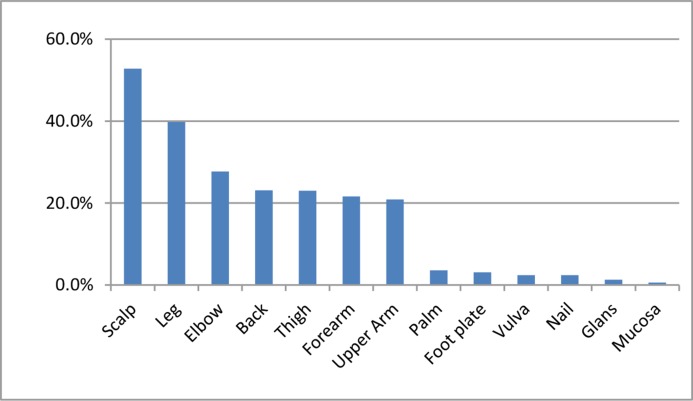
Psoriasis is a worldwide chronic inflammatory disease, involving both skin and joints. In order to characterize psoriasis in Han Chinese population, we conducted this nationwide prospective and hospital based survey, in which 56 hospitals with departments of dermatology participated, located in 33 cities across China. A total of 12,031 outpatients with psoriasis were registered during 2009 to 2010, which the data was collected by standard questionnaires. The main data acquisition included demographics, family history, disease status and other comorbidities. Physical and dermatological examination, including body surface area (BSA) and psoriasis area severity index (PASI) were applied to evaluate the disease severity. Descriptive statistics, 2 tailed t-test and chi-square test were used appropriately for the statistical analysis. From the study, we found that the male and female ratio of the patients was 1.49:1. Mean age of onset was 30.2 ± 14.5 years for males and 27.1 ± 15.6 years for females (P < 0.05). Scalp was the most common onset site (52.8%), The mean PASI was 18.70 ± 10.01, indicating that most patients presenting at the hospitals had moderate-to-severe psoriasis and the majority was psoriasis vulgaris (96.5%). Among 12,031 patients, 23.1% had a family history of psoriasis,16.1% had comorbidities, and 29.9% had nail changes. The most important aggravation factor was season change (60.2%), followed by psychological stress (34.5%), and there significant differences between genders on trigger factors. In conclusion, this study characterizing psoriasis in Han Chinese population, could be used as basic data for future study.
银屑病是一种全球性的慢性炎症性疾病,累及皮肤和关节。为了对中国汉族人群中的银屑病进行特征描述,我们开展了这项全国性的前瞻性医院调研,来自中国33个城市的56家设有皮肤科的医院参与其中。2009年至2010年期间,共登记了12031例银屑病门诊患者,数据通过标准问卷收集。主要的数据采集包括人口统计学信息、家族史、疾病状况和其他合并症。采用体格检查和皮肤科检查,包括体表面积(BSA)和银屑病面积和严重程度指数(PASI)来评估疾病严重程度。描述性统计、双侧t检验和卡方检验被适当地用于统计分析。从研究中我们发现,患者的男女比例为1.49:1。男性的平均发病年龄为30.2±14.5岁,女性为27.1±15.6岁(P<0.05)。头皮是最常见的发病部位(52.8%),平均PASI为18.70±10.01,表明大多数到医院就诊的患者患有中度至重度银屑病,且大多数为寻常型银屑病(96.5%)。在12031例患者中,23.1%有银屑病家族史,16.1%有合并症,29.9%有指甲改变。最重要的加重因素是季节变化(60.2%),其次是心理压力(34.5%),触发因素在性别之间存在显著差异。总之,这项对中国汉族人群银屑病特征的研究,可作为未来研究的基础数据。