Zeytinoglu Isik U, Denton Margaret, Brookman Catherine, Davies Sharon, Sayin Firat K
DeGroote School of Business, McMaster University, Hamilton, ON, Canada.
Department of Health, Aging & Society and Gilbrea Centre, McMaster University, Hamilton, ON, Canada.
BMC Health Serv Res. 2017 Jun 21;17(1):427. doi: 10.1186/s12913-017-2355-4.
The home and community care sector is one of the fastest growing sectors globally and most prominently in mature industrialized countries. Personal support workers (PSWs) are the largest occupational group in the sector. This paper focuses on the emotional health of PSWs working in the home and community care sector in Ontario, Canada. The purpose of this paper is to present evidence on the associations between PSWs' life and work stress and organizational practices of full-time and guaranteed hours, and PSWs' perceptions of support at work and preference for hours.
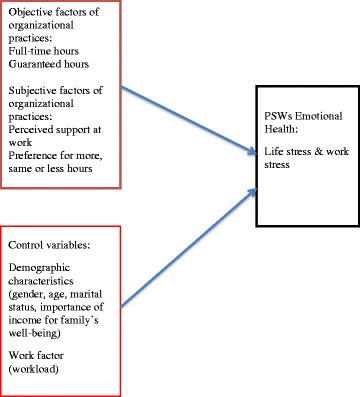
Data come from our 2015 survey of 1543 PSWs. Dependent variables are life and work stress. Independent variables are: objective organizational practices of full-time and guaranteed hours, and subjective organizational practices of perceived support at work, and preferred hours of work. Descriptive statistics, correlations and ordinary least square regression analyses with collinearity tests are conducted.
Organizational practices of employing PSWs in full-time or guaranteed hours are not associated with their life and work stress. However, those who perceive support from their organizations are also the ones reporting lower life and work stress. In addition, those PSWs perceiving support from their supervisor report lower work stress. PSWs would like to work in their preferred hours, and those who prefer to work more hours report lower life and work stress, and conversely, those who prefer to work less hours report life and work stress.
For PSWs in home and community care, perceived support from their organizations and supervisors, and employment in preferred hours are important factors related to their life and work stress.
家庭和社区护理部门是全球发展最快的部门之一,在成熟工业化国家尤为突出。个人支持工作者(PSW)是该部门最大的职业群体。本文聚焦于加拿大安大略省家庭和社区护理部门工作的个人支持工作者的情绪健康。本文的目的是提供证据,说明个人支持工作者的生活和工作压力与全职和有保障工时的组织实践之间的关联,以及个人支持工作者对工作支持的认知和对工时的偏好。
数据来自我们2015年对1543名个人支持工作者的调查。因变量是生活和工作压力。自变量是:全职和有保障工时的客观组织实践、对工作支持的主观组织实践以及偏好的工作时长。进行描述性统计、相关性分析以及带有共线性检验的普通最小二乘法回归分析。
以全职或有保障工时雇佣个人支持工作者的组织实践与他们的生活和工作压力无关。然而,那些感受到组织支持的人报告的生活和工作压力也较低。此外,那些感受到上级支持的个人支持工作者报告的工作压力较低。个人支持工作者希望按自己偏好的工时工作,那些希望工作时长更多的人报告的生活和工作压力较低,相反,那些希望工作时长更少的人报告了生活和工作压力。
对于家庭和社区护理中的个人支持工作者而言,感受到组织和上级的支持以及按偏好的工时就业是与他们的生活和工作压力相关的重要因素。