Jakobsen Marianne, Meyer DeMott Melinda Ashley, Wentzel-Larsen Tore, Heir Trond
Norwegian Centre for Violence and Traumatic Stress Studies, Oslo, Norway.
Regional Center for Child and Adolescent Mental Health, Eastern and Southern Norway, Oslo, Norway.
BMJ Open. 2017 Jun 21;7(6):e015157. doi: 10.1136/bmjopen-2016-015157.
To examine the mental health of unaccompanied refugee minors prospectively during the asylum-seeking process, with a focus on specific stages in the asylum process, such as age assessment, placement in a supportive or non-supportive facility and final decision on the asylum applications.
This was a2½ year follow-up study of unaccompanied minors (UM) seeking asylum in Norway. Data were collected within three weeks (n=138) and at 4 months (n=101), 15 months (n=84) and 26 months (n=69) after arrival.
Initially in an observation and orientation centre for unaccompanied asylum-seeking adolescents, and subsequently wherever the UM were located in other refugee facilities in Norway.
Male UM from Afghanistan, Somalia, Algeria and Iran.
Mental health symptoms assessed by Hopkins Symptom Checklist-25 and Harvard Trauma Questionnaire.
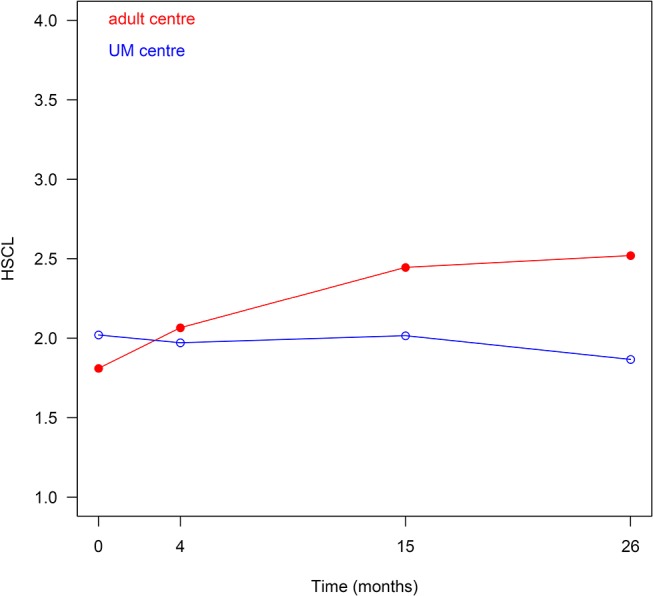
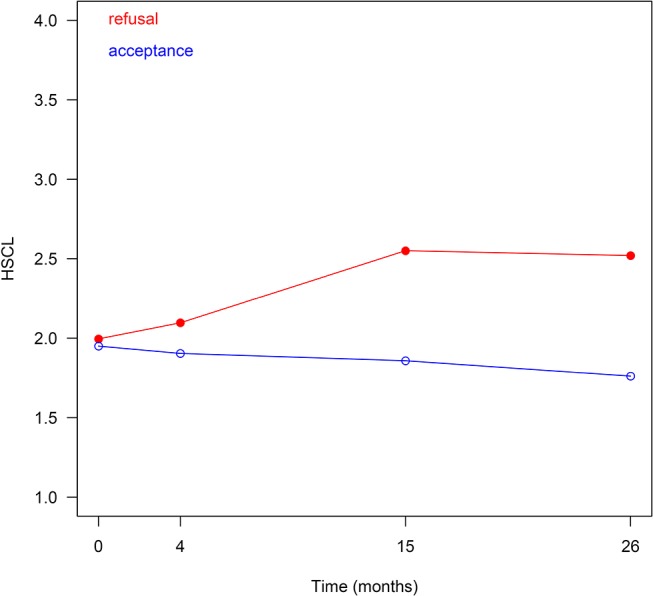
At the group level, the young asylum seekers reported high levels of psychological distress on arrival and symptom levels that stayed relatively unchanged over time. According to age-assessment procedures, 56% of the population were not recognised as minors. Subsequent placement in a low-support facility was associated with higher levels of psychological distress in the follow-up period. Those who were placed in a reception centre for adults had higher levels of psychological distress symptoms both after 15 months and 26 months compared with the remaining participants who were placed in reception centres for youth. Refusal of asylum was highly associated with higher levels of psychological distress.
Mental health trajectory of young asylum seekers appears to be negatively affected by low support and refusal of asylum.
前瞻性地研究无人陪伴的未成年难民在寻求庇护过程中的心理健康状况,重点关注庇护过程中的特定阶段,如年龄评估、安置在支持性或非支持性设施中以及庇护申请的最终决定。
这是一项对在挪威寻求庇护的无人陪伴未成年人进行的为期两年半的随访研究。在抵达后的三周内(n = 138)、4个月(n = 101)、15个月(n = 84)和26个月(n = 69)收集数据。
最初在一个无人陪伴的寻求庇护青少年观察和指导中心,随后在挪威其他难民设施中这些无人陪伴未成年人所在的任何地方。
来自阿富汗、索马里、阿尔及利亚和伊朗的男性无人陪伴未成年人。
通过霍普金斯症状清单-25和哈佛创伤问卷评估心理健康症状。
在群体层面,年轻的寻求庇护者在抵达时报告了高水平的心理困扰,且症状水平随时间相对保持不变。根据年龄评估程序,56%的人未被认定为未成年人。随后被安置在低支持设施中与随访期间较高水平的心理困扰相关。与被安置在青年接待中心的其他参与者相比,那些被安置在成人接待中心的人在15个月和26个月后心理困扰症状水平更高。庇护申请被拒绝与较高水平的心理困扰高度相关。
年轻寻求庇护者的心理健康轨迹似乎受到低支持和庇护申请被拒绝的负面影响。