Department of Psychology, Catholic University of Eichstätt-Ingolstadt, Ostenstraße 25, 85072, Eichstätt, Germany.
BMC Public Health. 2019 Jul 8;19(1):908. doi: 10.1186/s12889-019-7263-6.
Asylum-seeking children and adolescents (ASCs) who have resettled in Western countries show elevated rates of psychological distress, including Posttraumatic Stress Symptoms (PTSS), depression, and anxiety. Most longitudinal data suggest a relatively stable course of symptoms during the first years in exile. However, no longitudinal examination of the mental health of ASCs, who resettled in Europe in the wake of the 2015-17 European migrant crisis, has been conducted so far.
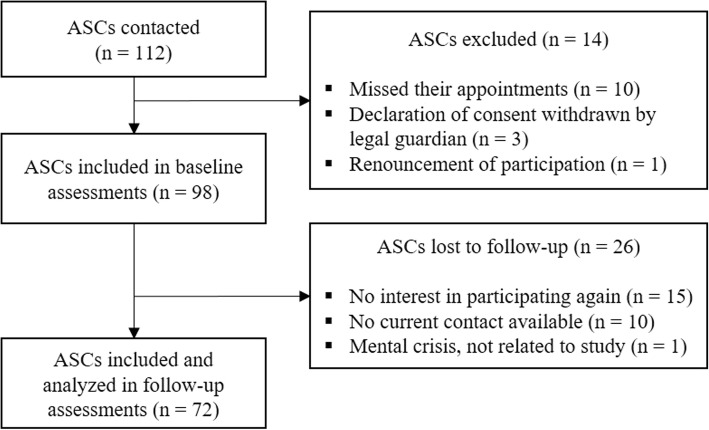
A prospective cohort study looked at 98 ASCs who resettled in southern Germany throughout 2015-17. They mainly came from Afghanistan, Syria, Eritrea, and Iraq. Baseline assessments were undertaken 22 months, on average, after resettlement, and follow-up assessments 1 year thereafter. Seventy-two ASCs could be secured for the follow-up. The measures included self-report questionnaires screening for PTSS, depression, anxiety, externalizing behavior, and post-migration factors that were administered in an interview-like setting. Results were analyzed using hierarchical multiple regression analysis.
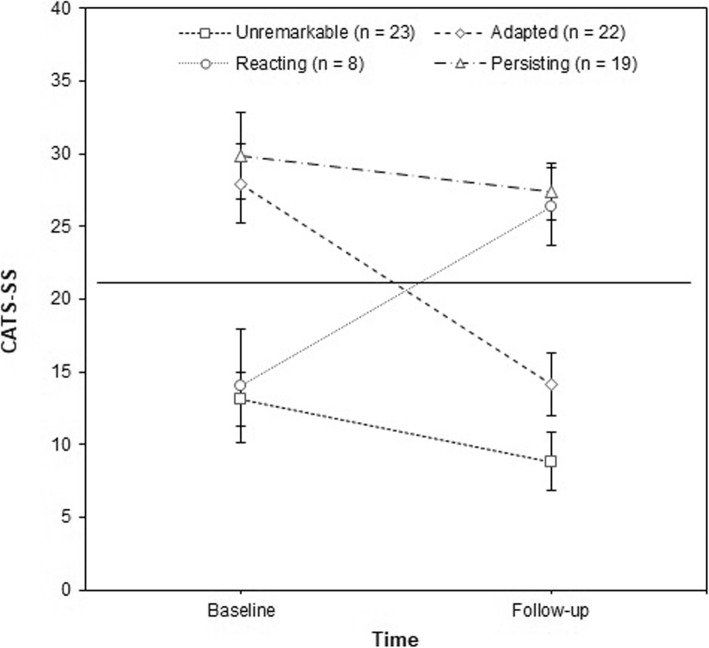
Participating ASCs reported on average eight potentially traumatic experiences and high levels of psychological distress at baseline that had significantly declined at follow-up. At follow-up, rates of clinically significant symptoms ranged from 9.7% (externalizing behavior) to 37.5% (PTSS). There was considerable individual variation in symptom change resulting in multiple mental health trajectories. ASCs whose asylum applications had been rejected presented significantly more symptoms than ASCs whose asylum applications had been accepted between assessments. Baseline psychopathology and asylum status predicted follow-up symptom severity.
In contrast to earlier studies, the symptom severity in this sample of ASCs in Germany ameliorated between assessments. Decisions on the asylum applications of ASCs are thought to contribute to the course of symptoms. Since levels of psychological distress were still high, dissemination and implementation of appropriate treatments for ASCs is crucial.
在西方国家寻求庇护的儿童和青少年(ASCs)表现出较高的心理困扰率,包括创伤后应激症状(PTSS)、抑郁和焦虑。大多数纵向数据表明,在流亡的最初几年中,症状相对稳定。然而,迄今为止,尚无关于在 2015-17 年欧洲移民危机后在欧洲重新安置的 ASCs 的心理健康的纵向研究。
一项前瞻性队列研究观察了 2015-17 年期间在德国南部重新安置的 98 名 ASC。他们主要来自阿富汗、叙利亚、厄立特里亚和伊拉克。基线评估在重新安置后平均 22 个月进行,随后在 1 年后进行随访评估。72 名 ASC 可以参加随访。采用访谈式环境下的自我报告问卷筛查创伤后应激症状、抑郁、焦虑、外化行为和移民后因素进行测量。使用分层多元回归分析对结果进行分析。
参与的 ASC 报告平均有 8 次潜在创伤经历和高水平的心理困扰,基线时有显著下降,随访时有所下降。在随访时,临床显著症状的发生率从 9.7%(外化行为)到 37.5%(PTSS)不等。症状变化存在很大的个体差异,导致出现多种心理健康轨迹。在评估之间,申请庇护被拒绝的 ASC 比申请庇护被接受的 ASC 表现出更多的症状。基线心理病理学和庇护身份预测了随访时的症状严重程度。
与早期研究相比,本研究中德国 ASC 的症状严重程度在评估之间有所改善。ASCs 庇护申请的决定被认为会影响症状的发展。由于心理困扰程度仍然较高,因此对于 ASCs 来说,传播和实施适当的治疗方法至关重要。