Neefjes Elisabeth C W, van den Hurk Renske M, Blauwhoff-Buskermolen Susanne, van der Vorst Maurice J D L, Becker-Commissaris Annemarie, de van der Schueren Marian A E, Buffart Laurien M, Verheul Henk M W
Department of Medical Oncology, VU University Medical Center/Cancer Center Amsterdam, de Boelelaan 1117, 1081 HV, Amsterdam, The Netherlands.
Department of Nutrition and Dietetics, Internal Medicine, VU University Medical Center, de Boelelaan 1117, 1081 HV, Amsterdam, The Netherlands.
J Cachexia Sarcopenia Muscle. 2017 Aug;8(4):623-629. doi: 10.1002/jcsm.12199. Epub 2017 Jun 21.
Cancer-related fatigue (CRF) reduces quality of life and the activity level of patients with cancer. Cancer related fatigue can be reduced by exercise interventions that may concurrently increase muscle mass. We hypothesized that low muscle mass is directly related to higher CRF.
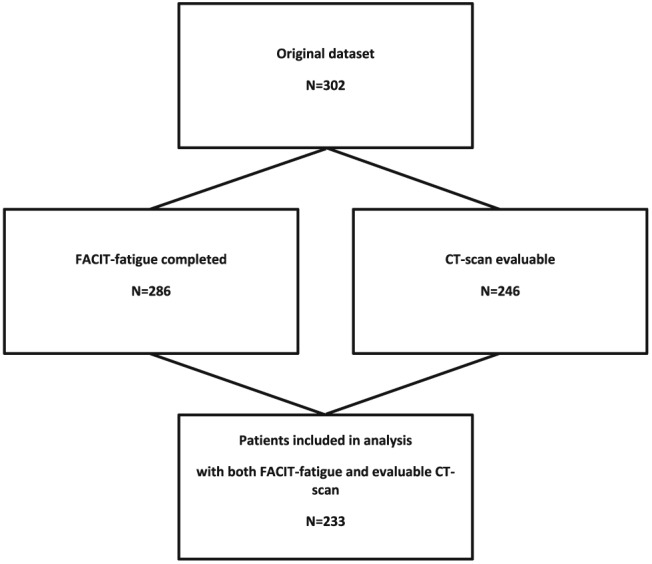
A total of 233 patients with advanced cancer starting palliative chemotherapy for lung, colorectal, breast, or prostate cancer were studied. The skeletal muscle index (SMI) was calculated as the patient's muscle mass on level L3 or T4 of a computed tomography scan, adjusted for height. Fatigue was assessed with the Functional Assessment of Chronic Illness Therapy-fatigue questionnaire (cut-off for fatigue <34). Multiple linear regression analyses were conducted to study the association between SMI and CRF adjusting for relevant confounders.
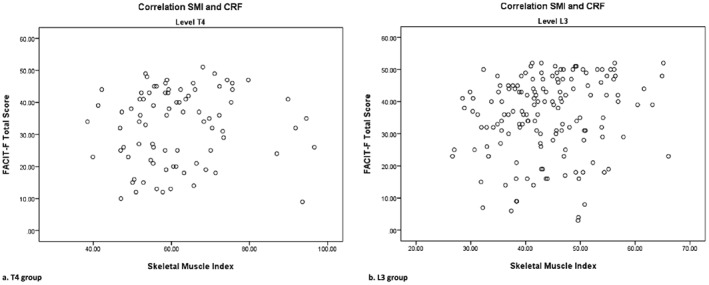
In this group of patients with advanced cancer, the median fatigue score was 36 (interquartile range 26-44). A higher SMI on level L3 was significantly associated with less CRF for men (B 0.447, P 0.004) but not for women (B - 0.401, P 0.090). No association between SMI on level T4 and the Functional Assessment of Chronic Illness Therapy-fatigue score was found (n = 82).
The association between SMI and CRF may lead to the suggestion that male patients may be able to reduce fatigue by exercise interventions aiming at an increased muscle mass. In women with advanced cancer, CRF is more influenced by other causes, because it is not significantly related to muscle mass. To further reduce CRF in both men and women with cancer, multifactorial assessments need to be performed in order to develop effective treatment strategies.
癌症相关疲劳(CRF)会降低癌症患者的生活质量和活动水平。运动干预可减轻癌症相关疲劳,同时可能增加肌肉量。我们假设低肌肉量与较高的CRF直接相关。
共研究了233例开始接受肺癌、结直肠癌、乳腺癌或前列腺癌姑息化疗的晚期癌症患者。骨骼肌指数(SMI)通过计算机断层扫描L3或T4水平的患者肌肉量计算得出,并根据身高进行调整。采用慢性病治疗功能评估-疲劳问卷评估疲劳程度(疲劳临界值<34)。进行多元线性回归分析,以研究SMI与CRF之间的关联,并对相关混杂因素进行校正。
在这组晚期癌症患者中,疲劳评分中位数为36(四分位间距26-44)。L3水平较高的SMI与男性CRF减轻显著相关(B 0.447,P 0.004),但与女性无关(B -0.401,P 0.090)。未发现T4水平的SMI与慢性病治疗功能评估-疲劳评分之间存在关联(n = 82)。
SMI与CRF之间的关联可能提示,男性患者或许能够通过旨在增加肌肉量的运动干预来减轻疲劳。在晚期癌症女性患者中,CRF受其他因素影响更大,因为它与肌肉量无显著关联。为进一步减轻癌症男性和女性患者的CRF,需要进行多因素评估,以制定有效的治疗策略。