Yagi Satomi, Koh Yasuhiro, Akamatsu Hiroaki, Kanai Kuninobu, Hayata Atsushi, Tokudome Nahomi, Akamatsu Keiichiro, Endo Katsuya, Nakamura Seita, Higuchi Masayuki, Kanbara Hisashige, Nakanishi Masanori, Ueda Hiroki, Yamamoto Nobuyuki
Medical Business Unit, Hitachi Chemical Co., Ltd., Ibaraki, Japan.
Third Department of Internal Medicine, Wakayama Medical University, Wakayama, Japan.
PLoS One. 2017 Jun 22;12(6):e0179744. doi: 10.1371/journal.pone.0179744. eCollection 2017.
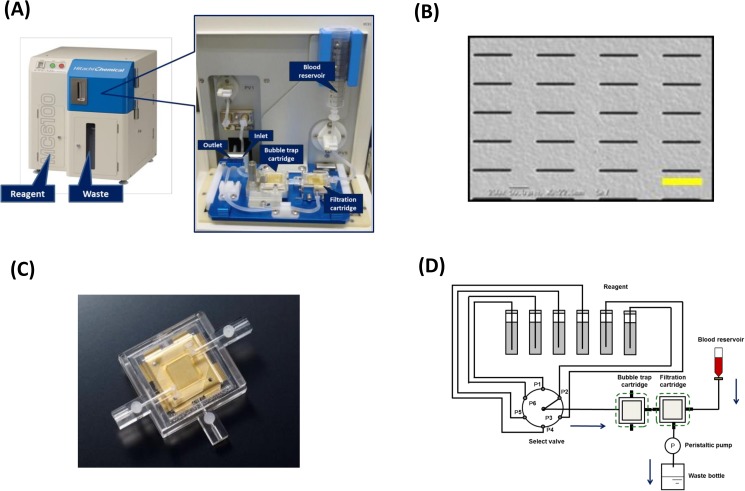
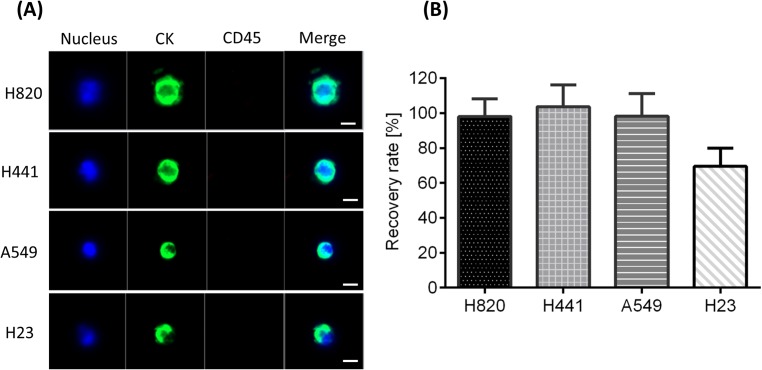
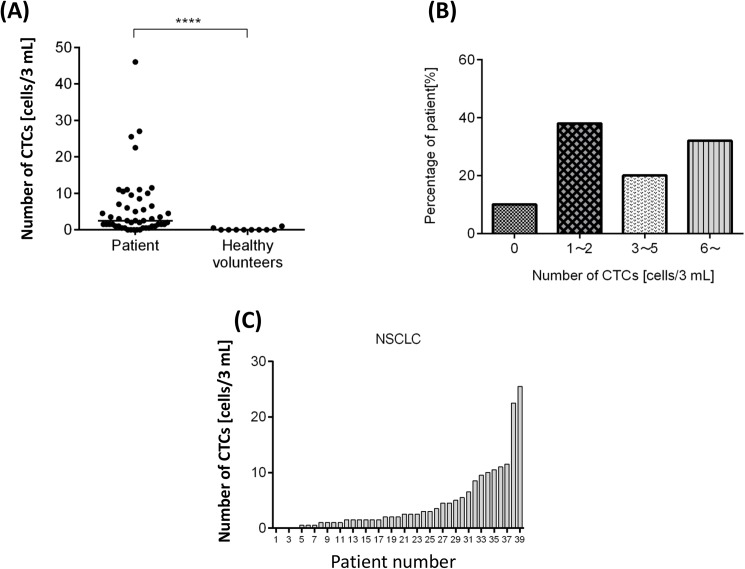
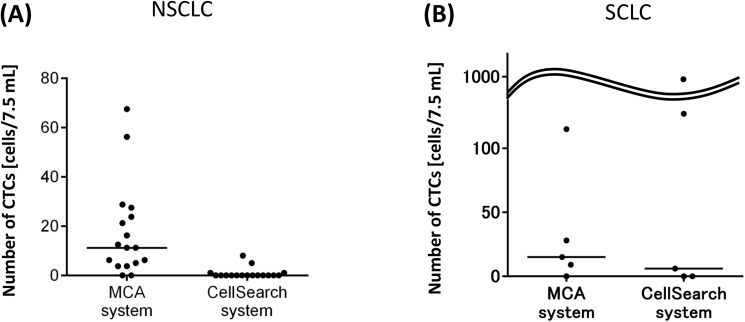
Circulating tumor cells (CTCs), defined as tumor cells circulating in the peripheral blood of patients with solid tumors, are relatively rare. Diagnosis using CTCs is expected to help in the decision-making for precision cancer medicine. We have developed an automated microcavity array (MCA) system to detect CTCs based on the differences in size and deformability between tumor cells and normal blood cells. Herein, we evaluated the system using blood samples from non-small-cell lung cancer (NSCLC) and small-cell lung cancer (SCLC) patients. To evaluate the recovery of CTCs, preclinical experiments were performed by spiking NSCLC cell lines (NCI-H820, A549, NCI-H23 and NCI-H441) into peripheral whole blood samples from healthy volunteers. The recovery rates were 70% or more in all cell lines. For clinical evaluation, 6 mL of peripheral blood was collected from 50 patients with advanced lung cancer and from 10 healthy donors. Cells recovered on the filter were stained. We defined CTCs as DAPI-positive, cytokeratin-positive, and CD45-negative cells under the fluorescence microscope. The 50 lung cancer patients had a median age of 72 years (range, 48-85 years); 76% had NSCLC and 20% had SCLC, and 14% were at stage III disease whereas 86% were at stage IV. One or more CTCs were detected in 80% of the lung cancer patients (median 2.5). A comparison of the CellSearch system with our MCA system, using the samples from NSCLC patients, confirmed the superiority of our system (median CTC count, 0 versus 11 for CellSearch versus MCA; p = 0.0001, n = 17). The study results suggest that our MCA system has good clinical potential for diagnosing CTCs in lung cancer.
循环肿瘤细胞(CTCs)是指实体瘤患者外周血中循环的肿瘤细胞,相对较为罕见。利用CTCs进行诊断有望为精准癌症医学的决策提供帮助。我们开发了一种基于肿瘤细胞与正常血细胞大小和可变形性差异来检测CTCs的自动化微腔阵列(MCA)系统。在此,我们使用非小细胞肺癌(NSCLC)和小细胞肺癌(SCLC)患者的血样对该系统进行了评估。为评估CTCs的回收率,通过将NSCLC细胞系(NCI-H820、A549、NCI-H23和NCI-H441)加入健康志愿者的外周全血样本中进行了临床前实验。所有细胞系的回收率均达到70%或更高。为进行临床评估,从50例晚期肺癌患者和10名健康供者中采集了6 mL外周血。对滤膜上回收的细胞进行染色。在荧光显微镜下,我们将CTCs定义为DAPI阳性、细胞角蛋白阳性且CD45阴性的细胞。50例肺癌患者的中位年龄为72岁(范围48 - 85岁);76%为NSCLC,20%为SCLC,14%处于III期疾病,而86%处于IV期。80%的肺癌患者检测到一个或多个CTCs(中位值为2.5)。使用NSCLC患者的样本将CellSearch系统与我们的MCA系统进行比较,证实了我们系统的优越性(CellSearch与MCA的CTCs中位计数分别为0和11;p = 0.0001,n = 17)。研究结果表明,我们的MCA系统在诊断肺癌CTCs方面具有良好的临床潜力。