School of Agriculture, Food and Rural Development, Newcastle University, Newcastle upon Tyne, UK.
Synthace Ltd, London, UK.
Plant Biotechnol J. 2018 Jan;16(1):337-348. doi: 10.1111/pbi.12775. Epub 2017 Jul 17.
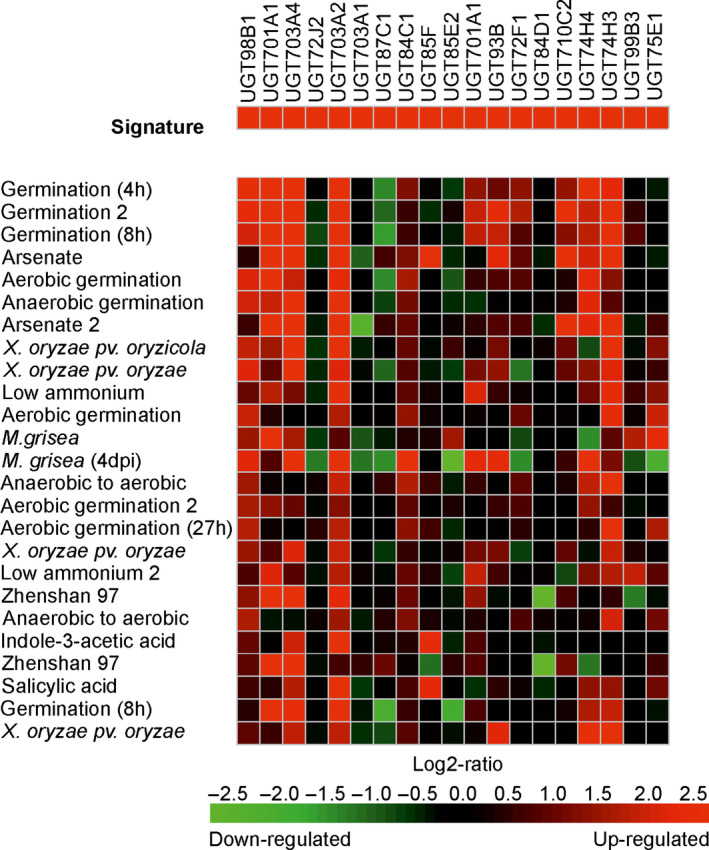
Plants contain large numbers of family 1 UDP-glucose-dependent glycosyltransferases (UGTs), including members that conjugate xenobiotics. Arabidopsis contains 107 UGT genes with 99 family members successfully expressed as glutathione transferase (GST)-fusion proteins in E. coli. A high-throughput catalytic screen was developed based on quantification of the fusion by measuring GST activity. UGT activity using UDP-glucose as donor was then determined using 11 synthetic acceptors bearing hydroxyl, amino and thiol groups that had been shown to undergo conjugation in plant extracts. In total, 44 UGTs, largely members of the D and E groups, were active towards xenobiotics, glucosylating phenol and thiol acceptors. In contrast, N-glucosyltransferase (NGT) activity was almost exclusively restricted to a single enzyme, UGT72B1. Using DNA microarrays, the induction of UGT transcripts following treatment with the herbicide safener fenclorim was compared in Arabidopsis and rice. D and L group members were the most safener-inducible UGTs in both species. The respective Arabidopsis enzymes showed low conjugating activity towards xenobiotics. Using Genevestigator, a small group of safened D and L UGTs were consistently induced in response to biotic and abiotic stress suggestive of protective activities beyond xenobiotic detoxification in both species. The induction of other detoxifying gene families following treatment with fenclorim, namely cytochromes P450 and glutathione transferases, further confirmed the selective enhancement of related subfamily members in the two species giving new insight into the safening response in cereals, where herbicide tolerance is enhanced compared with dicots, which are unresponsive to these treatments.
植物中含有大量家族 1 UDP-葡萄糖依赖性糖基转移酶(UGT),包括与外源化学物结合的成员。拟南芥含有 107 个 UGT 基因,其中 99 个家族成员成功地在大肠杆菌中表达为谷胱甘肽转移酶(GST)融合蛋白。基于 GST 活性的定量,开发了一种高通量催化筛选方法。然后使用 UDP-葡萄糖作为供体,使用 11 种带有羟基、氨基和巯基的合成受体来测定 UGT 活性,这些受体已被证明在植物提取物中发生结合。总共 44 个 UGT,主要是 D 和 E 组的成员,对亲脂性物质具有活性,可使酚类和巯基受体发生葡糖基化。相比之下,N-葡糖苷基转移酶(NGT)活性几乎完全限于单个酶 UGT72B1。使用 DNA 微阵列,比较了除草剂解毒剂 fenclorim 处理后拟南芥和水稻中 UGT 转录物的诱导。在这两个物种中,D 和 L 组成员是最易受解毒剂诱导的 UGT。相应的拟南芥酶对亲脂性物质表现出低的结合活性。使用 Genevestigator,一组小的 safened D 和 L UGT 对生物和非生物胁迫均表现出一致的诱导,这表明它们在两个物种中具有保护活性,不仅可以解毒外源化学物质。在用 fenclorim 处理后,其他解毒基因家族的诱导,即细胞色素 P450 和谷胱甘肽转移酶,进一步证实了这两种作物中相关亚家族成员的选择性增强,这为谷物的解毒反应提供了新的见解,与对外源化学物质处理无反应的双子叶植物相比,谷物的耐受性得到了增强。