Lenguerrand E, Whitehouse M R, Beswick A D, Jones S A, Porter M L, Blom A W
Musculoskeletal Research Unit, School of Clinical Sciences, University of Bristol, 1st Floor Learning & Research Building, Southmead Hospital, Bristol, BS10 5NB, UK.
Cardiff & Vale University Health Board, University Hospital Llandough, Penlan Road, Llandough, Penarth, Vale of Glamorgan, CF64 2XX, UK.
Bone Joint Res. 2017 Jun;6(6):391-398. doi: 10.1302/2046-3758.66.BJR-2017-0003.R1.
We used the National Joint Registry for England, Wales, Northern Ireland and the Isle of Man (NJR) to investigate the risk of revision due to prosthetic joint infection (PJI) for patients undergoing primary and revision hip arthroplasty, the changes in risk over time, and the overall burden created by PJI.
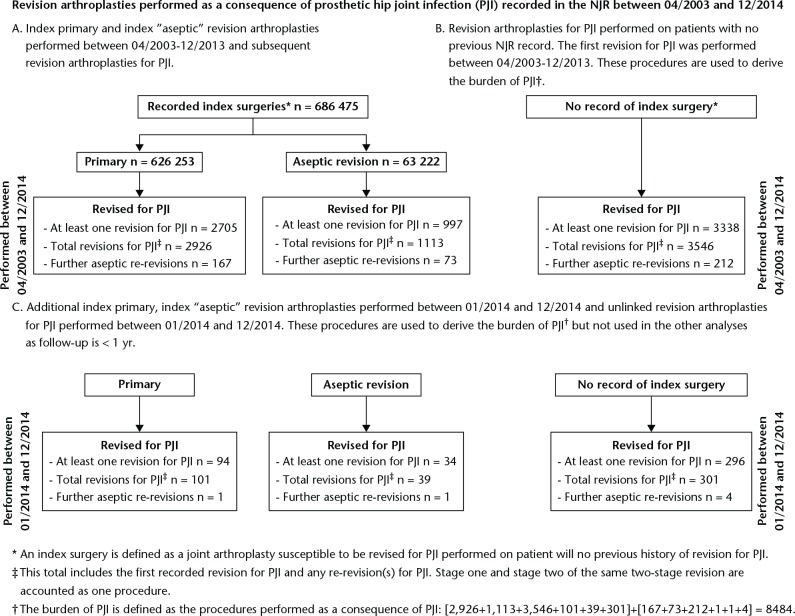
We analysed revision total hip arthroplasties (THAs) performed due to a diagnosis of PJI and the linked index procedures recorded in the NJR between 2003 and 2014. The cohort analysed consisted of 623 253 index primary hip arthroplasties, 63 222 index revision hip arthroplasties and 7585 revision THAs performed due to a diagnosis of PJI. The prevalence, cumulative incidence functions and the burden of PJI (total procedures) were calculated. Overall linear trends were investigated with log-linear regression.
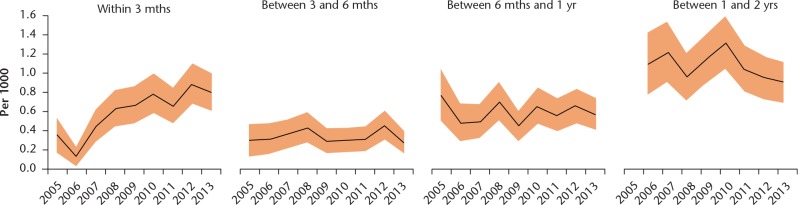
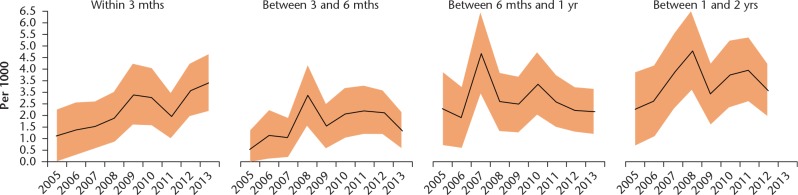
We demonstrated a prevalence of revision THA due to prosthetic joint infection of 0.4/100 procedures following primary and 1.6/100 procedures following revision hip arthroplasty. The prevalence of revision due to PJI in the three months following primary hip arthroplasty has risen 2.3-fold (95% confidence interval (CI) 1.3 to 4.1) between 2005 and 2013, and 3.0-fold (95% CI 1.1 to 8.5) following revision hip arthroplasty. Over 1000 procedures are performed annually as a consequence of hip PJI, an increase of 2.6-fold between 2005 and 2013.
Although the risk of revision due to PJI following hip arthroplasty is low, it is rising and, coupled with the established and further predicted increased incidence of both primary and revision hip arthroplasty, this represents a growing and substantial treatment burden.: E. Lenguerrand, M. R. Whitehouse, A. D. Beswick, S. A. Jones, M. L. Porter, A. W. Blom. Revision for prosthetic joint infection following hip arthroplasty: Evidence from the National Joint Registry. 2017;6:391-398. DOI: 10.1302/2046-3758.66.BJR-2017-0003.R1.
我们利用英格兰、威尔士、北爱尔兰和马恩岛国家联合注册中心(NJR),调查初次和翻修髋关节置换术患者因人工关节感染(PJI)进行翻修的风险、风险随时间的变化以及PJI造成的总体负担。
我们分析了2003年至2014年期间因诊断为PJI而进行的翻修全髋关节置换术(THA)以及NJR中记录的相关初次手术。分析的队列包括623253例初次髋关节置换术、63222例初次翻修髋关节置换术以及7585例因诊断为PJI而进行的翻修THA。计算了PJI的患病率、累积发病率函数和负担(总手术数)。采用对数线性回归研究总体线性趋势。
我们发现,初次髋关节置换术后因人工关节感染进行翻修THA的患病率为0.4/100例手术,翻修髋关节置换术后为1.6/100例手术。2005年至2013年期间,初次髋关节置换术后三个月内因PJI进行翻修的患病率上升了2.3倍(95%置信区间(CI)1.3至4.1),翻修髋关节置换术后上升了3.0倍(95%CI 1.1至8.5)。每年因髋关节PJI进行的手术超过1000例,2005年至2013年期间增加了2.6倍。
虽然髋关节置换术后因PJI进行翻修的风险较低,但呈上升趋势,而且,鉴于初次和翻修髋关节置换术既定的以及进一步预测的发病率增加,这代表着日益增加的重大治疗负担。:E. 伦盖兰德、M.R. 怀特豪斯、A.D. 贝斯威克、S.A. 琼斯、M.L. 波特、A.W. 布洛姆。髋关节置换术后人工关节感染的翻修:来自国家联合注册中心的证据。2017;6:391 - 398。DOI:10.1302/2046 - 3758.66.BJR - 2017 - 0003.R1。