Zhao Yong-Xin, Yang Ji, Lv Feng-Hua, Hu Xiao-Ju, Xie Xing-Long, Zhang Min, Li Wen-Rong, Liu Ming-Jun, Wang Yu-Tao, Li Jin-Quan, Liu Yong-Gang, Ren Yan-Ling, Wang Feng, Hehua EEr, Kantanen Juha, Arjen Lenstra Johannes, Han Jian-Lin, Li Meng-Hua
CAS Key Laboratory of Animal Ecology and Conservation Biology, Institute of Zoology, Chinese Academy of Sciences (CAS), Beijing, China.
University of Chinese Academy of Sciences (UCAS), Beijing, China.
Mol Biol Evol. 2017 Sep 1;34(9):2380-2395. doi: 10.1093/molbev/msx181.
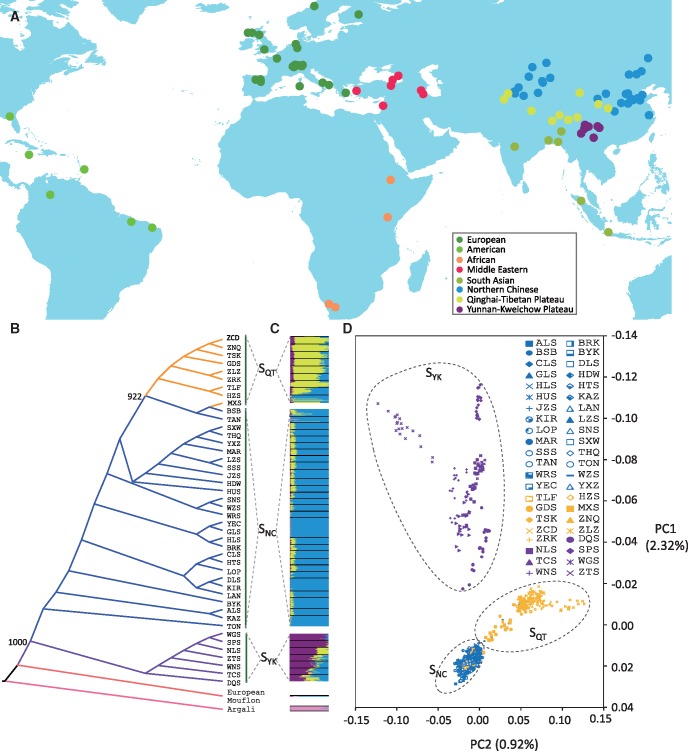
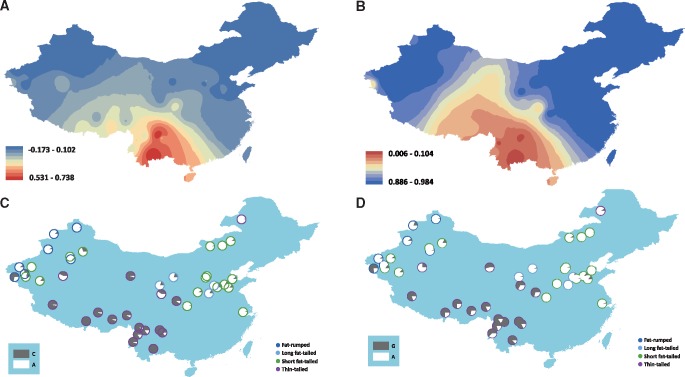
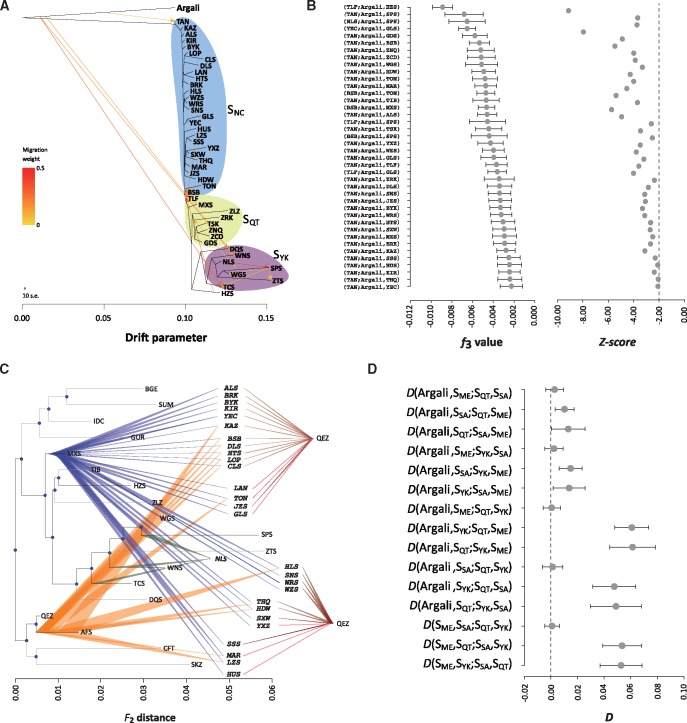
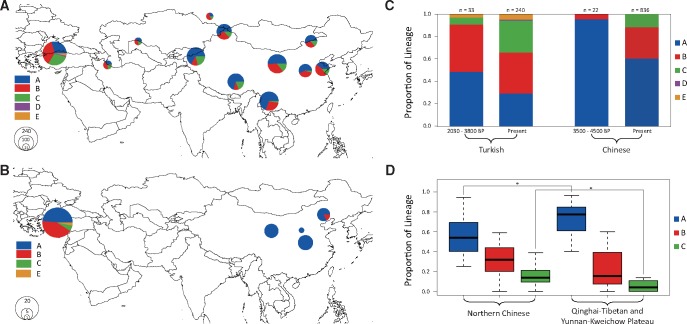
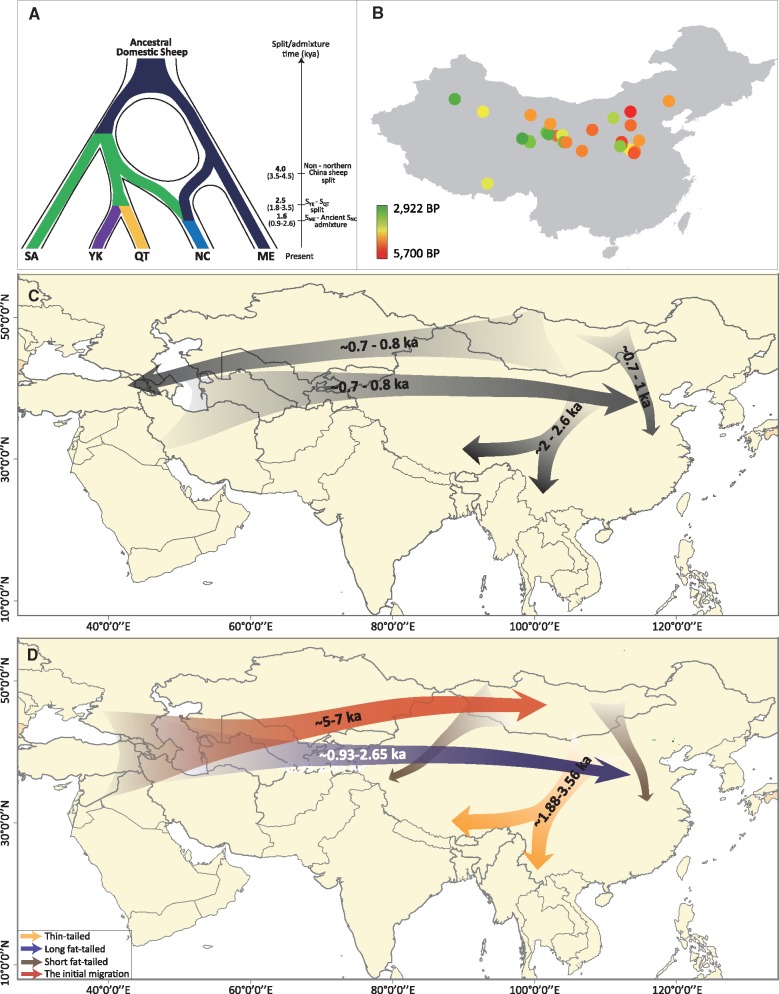
China has a rich resource of native sheep (Ovis aries) breeds associated with historical movements of several nomadic societies. However, the history of sheep and the associated nomadic societies in ancient China remains poorly understood. Here, we studied the genomic diversity of Chinese sheep using genome-wide SNPs, mitochondrial and Y-chromosomal variations in > 1,000 modern samples. Population genomic analyses combined with archeological records and historical ethnic demographics data revealed genetic signatures of the origins, secondary expansions and admixtures, of Chinese sheep thereby revealing the peopling patterns of nomads and the expansion of early pastoralism in East Asia. Originating from the Mongolian Plateau ∼5,000‒5,700 years ago, Chinese sheep were inferred to spread in the upper and middle reaches of the Yellow River ∼3,000‒5,000 years ago following the expansions of the Di-Qiang people. Afterwards, sheep were then inferred to reach the Qinghai-Tibetan and Yunnan-Kweichow plateaus ∼2,000‒2,600 years ago by following the north-to-southwest routes of the Di-Qiang migration. We also unveiled two subsequent waves of migrations of fat-tailed sheep into northern China, which were largely commensurate with the migrations of ancestors of Hui Muslims eastward and Mongols southward during the 12th‒13th centuries. Furthermore, we revealed signs of argali introgression into domestic sheep, extensive historical mixtures among domestic populations and strong artificial selection for tail type and other traits, reflecting various breeding strategies by nomadic societies in ancient China.
中国拥有丰富的本土绵羊(Ovis aries)品种资源,这些品种与几个游牧社会的历史迁徙有关。然而,中国古代绵羊及相关游牧社会的历史仍鲜为人知。在此,我们利用全基因组单核苷酸多态性(SNPs)、线粒体和Y染色体变异,对1000多个现代样本进行研究,分析了中国绵羊的基因组多样性。群体基因组分析结合考古记录和历史民族人口统计数据,揭示了中国绵羊的起源、二次扩张和混合的遗传特征,从而揭示了游牧民族的迁徙模式以及东亚早期畜牧业的扩张情况。中国绵羊大约在5000 - 5700年前起源于蒙古高原,据推断,在氐羌民族扩张之后,于3000 - 5000年前在黄河中上游地区传播开来。此后,据推断,绵羊在2000 - 2600年前沿着氐羌民族北至西南的迁徙路线到达了青藏高原和云贵高原。我们还发现了两波随后的肥尾绵羊向中国北方的迁徙浪潮,这在很大程度上与12至13世纪回族穆斯林祖先向东迁徙以及蒙古族向南迁徙相吻合。此外,我们揭示了盘羊基因渗入家羊的迹象、家羊群体之间广泛的历史混合以及对尾型和其他性状的强烈人工选择,反映了中国古代游牧社会的各种育种策略。