Wakabayashi Hitoshi, Wijayanto Titis, Tochihara Yutaka
Laboratory of Environmental Ergonomics, Faculty of Engineering, Hokkaido University, N13 W8, Kita-ku, Sapporo, 060-8628, Hokkaido, Japan.
Department of Mechanical and Industrial Engineering, Gadjah Mada University, Yogyakarta, Indonesia.
J Physiol Anthropol. 2017 Jun 23;36(1):28. doi: 10.1186/s40101-017-0144-8.
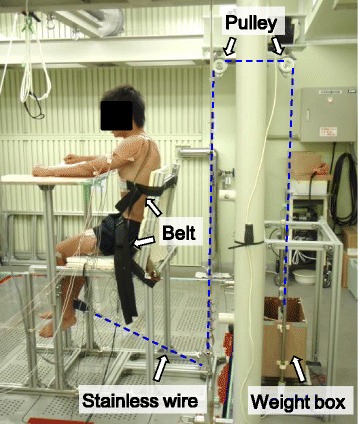
Human adaptability to cold environment has been focused on in the physiological anthropology and related research area. Concerning the human acclimatization process in the natural climate, it is necessary to conduct a research assessing comprehensive effect of cold environment and physical activities in cold. This study investigated the effect of cold water immersion on the exercise performance and neuromuscular function during maximal and submaximal isometric knee extension.
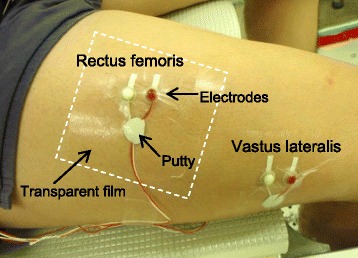
Nine healthy males participated in this study. They performed maximal and submaximal (20, 40, and 60% maximal load) isometric knee extension pre- and post-immersion in 23, 26, and 34 °C water. The muscle activity of the rectus femoris (RF) and vastus lateralis (VL) was measured using surface electromyography (EMG). The percentages of the maximum voluntary contraction (%MVC) and mean power frequency (MPF) of EMG data were analyzed.
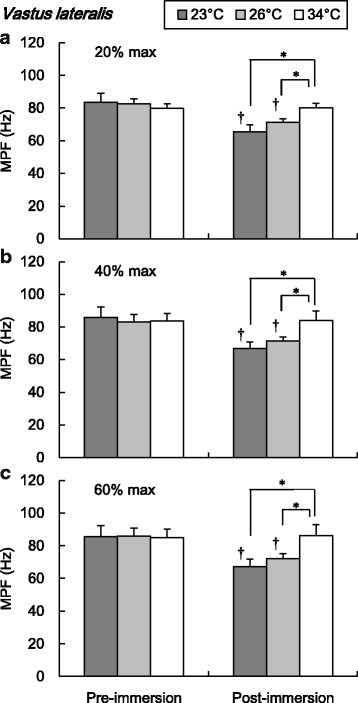
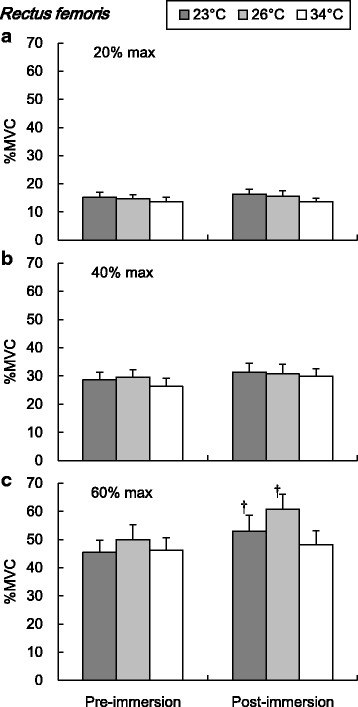
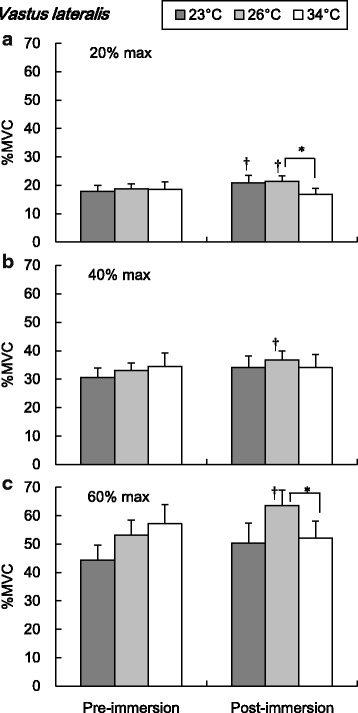
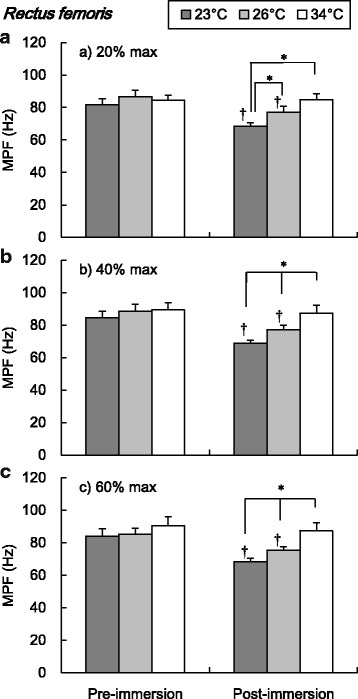
The post-immersion maximal force was significantly lower in 23 °C than in 26 and 34 °C conditions (P < 0.05). The post-immersion %MVC of RF was significantly higher than pre-immersion during 60% maximal exercise in 23 and 26 °C conditions (P < 0.05). In the VL, the post-immersion %MVC was significantly higher than pre-immersion in 23 and 26 °C conditions during 20% maximal exercise and in 26 °C at 40 and 60% maximal intensities (P < 0.05). The post-immersion %MVC of VL was significantly higher in 26 °C than in 34 °C at 20 and 60% maximal load (P < 0.05). The post-immersion MPF of RF during 20% maximal intensity was significantly lower in 23 °C than in 26 and 34 °C conditions (P < 0.05), and significantly different between three water temperature conditions at 40 and 60% maximal intensities (P < 0.05). The post-immersion MPF of VL during three submaximal trials were significantly lower in 23 and 26 °C than in 34 °C conditions (P < 0.05).
The lower shift of EMG frequency would be connected with the decrease in the nerve and muscle fibers conduction velocity. To compensate for the impairment of each muscle fibers function, more muscle fibers might be recruited to maintain the working load. This might result in the greater amplitude of EMG after the cold immersion.
人体对寒冷环境的适应性一直是生理人类学及相关研究领域的关注焦点。关于自然气候下人体的适应过程,有必要开展一项研究来评估寒冷环境和寒冷状态下身体活动的综合影响。本研究调查了冷水浸泡对最大和次最大等长膝关节伸展运动表现及神经肌肉功能的影响。
九名健康男性参与了本研究。他们在23℃、26℃和34℃的水中浸泡前后分别进行了最大和次最大(最大负荷的20%、40%和60%)等长膝关节伸展运动。使用表面肌电图(EMG)测量股直肌(RF)和股外侧肌(VL)的肌肉活动。分析EMG数据的最大自主收缩百分比(%MVC)和平均功率频率(MPF)。
23℃条件下浸泡后的最大力量显著低于26℃和34℃条件下(P<0.05)。在23℃和26℃条件下,60%最大运动强度时,RF浸泡后的%MVC显著高于浸泡前(P<0.05)。在VL中,23℃和26℃条件下,20%最大运动强度时浸泡后的%MVC显著高于浸泡前,26℃条件下40%和60%最大强度时浸泡后的%MVC也显著高于浸泡前(P<0.05)。20%和60%最大负荷时,26℃条件下VL浸泡后的%MVC显著高于34℃条件下(P<0.05)。20%最大强度时,23℃条件下RF浸泡后的MPF显著低于26℃和34℃条件下(P<0.05),40%和60%最大强度时,三种水温条件下的MPF也存在显著差异(P<0.05)。三次次最大试验中,23℃和26℃条件下VL浸泡后的MPF显著低于34℃条件下(P<0.05)。
EMG频率的降低可能与神经和肌肉纤维传导速度的下降有关。为了补偿各肌肉纤维功能的损害,可能会募集更多的肌肉纤维来维持工作负荷。这可能导致冷浸泡后EMG幅度更大。