Institut des Sciences Cognitives Marc Jeannerod, UMR 5304, Centre National de la Recherche Scientifique (CNRS) & Université de Lyon, Bron, France; Faculté de Psychologie et des Sciences de l'Education, Université de Genève, 1205 Genève, Switzerland.
Institut des Sciences Cognitives Marc Jeannerod, UMR 5304, Centre National de la Recherche Scientifique (CNRS) & Université de Lyon, Bron, France.
Dev Cogn Neurosci. 2018 Apr;30:324-332. doi: 10.1016/j.dcn.2017.06.001. Epub 2017 Jun 13.
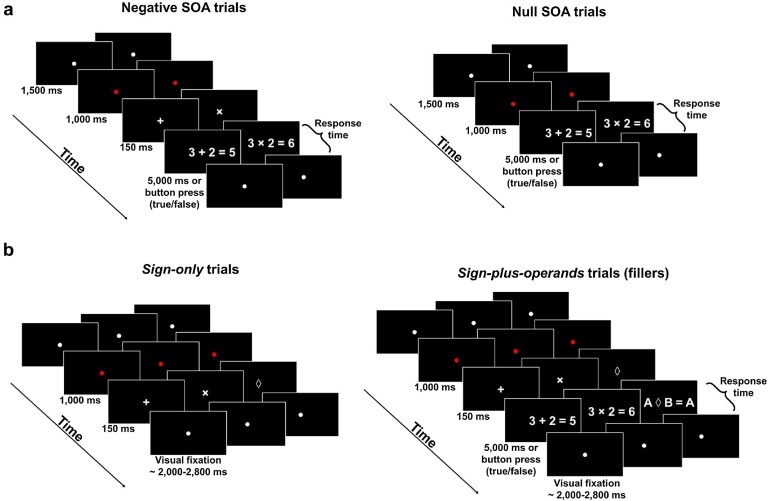
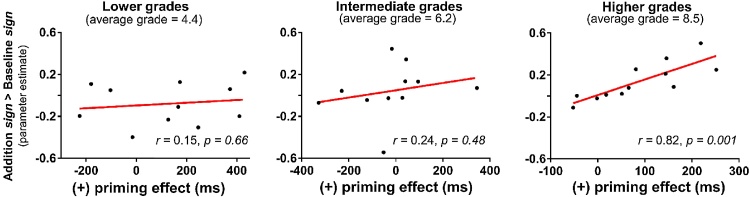
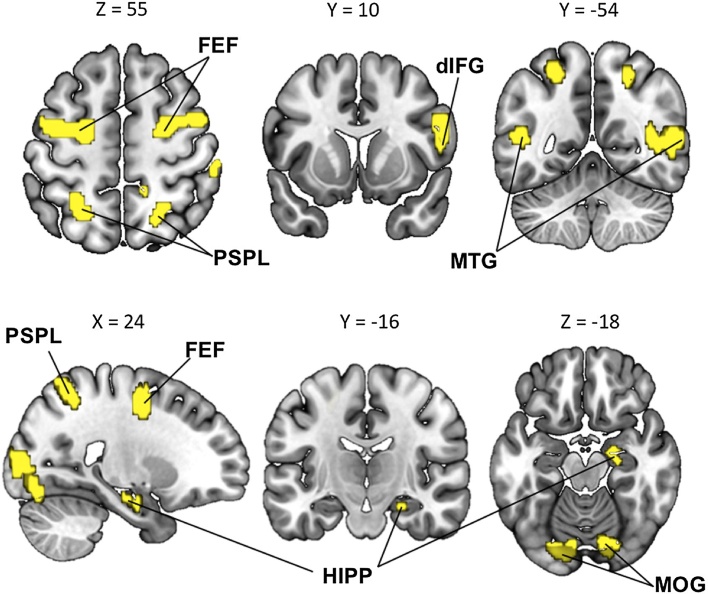
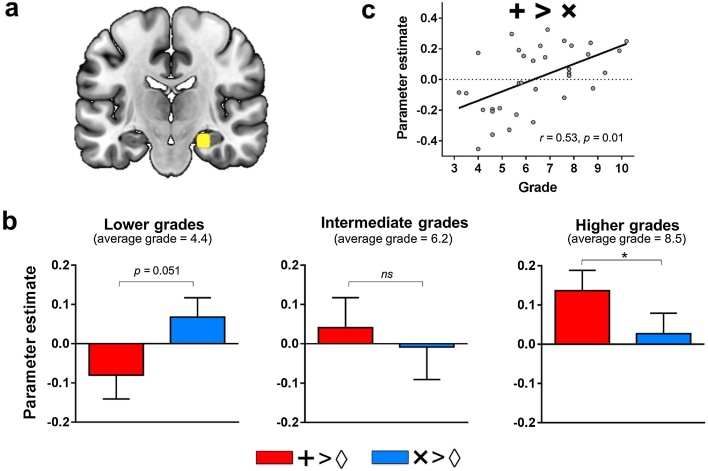
Understanding the meaning of abstract mathematical symbols is a cornerstone of arithmetic learning in children. Studies have long focused on the role of spatial intuitions in the processing of numerals. However, it has been argued that such intuitions may also underlie symbols that convey fundamental arithmetic concepts, such as arithmetic operators. In the present cross-sectional study, we used fMRI to investigate how and when associations between arithmetic operators and brain regions processing spatial information emerge in children from 3 to 10 grade. We found that the mere perception of a '+' sign elicited grade-related increases of spatial activity in the right hippocampus. That is, merely perceiving '+' signs - without any operands - elicited enhanced hippocampal activity after around 7 grade (12-13 years old). In these children, hippocampal activity in response to a '+' sign was further correlated with the degree to which calculation performance was facilitated by the preview of that sign before an addition problem, an effect termed operator-priming. Grade-related increases of hippocampal spatial activity were operation-specific because they were not observed with '×' signs, which might evoke rote retrieval rather than numerical manipulation. Our study raises the possibility that hippocampal spatial mechanisms help build associations between some arithmetic operators and space throughout age and/or education.
理解抽象数学符号的含义是儿童算术学习的基石。长期以来,研究一直集中在空间直觉在数字处理中的作用上。然而,有人认为,这种直觉也可能是基本算术概念(如算术运算符)背后的符号基础。在本横断面研究中,我们使用 fMRI 来研究 3 至 10 年级儿童的算术运算符与处理空间信息的大脑区域之间的关联是如何以及何时出现的。我们发现,仅仅感知到一个“+”号就会引起大脑右侧海马体的与年级相关的空间活动增加。也就是说,仅仅感知到“+”号——没有任何操作数——就会在大约 7 年级(12-13 岁)之后引起海马体活动增强。在这些孩子中,对“+”号的反应的海马体活动与该符号在加法问题之前的预览促进计算表现的程度进一步相关,这种效应称为运算符启动。与年级相关的海马体空间活动增加是特定于操作的,因为它们不会与“×”号一起出现,因为“×”号可能会引发死记硬背而不是数值操作。我们的研究提出了一种可能性,即海马体的空间机制有助于在整个年龄和/或教育过程中建立一些算术运算符与空间之间的关联。