Sreekanth Kandammathe Valiyaveedu, Alapan Yunus, ElKabbash Mohamed, Wen Amy M, Ilker Efe, Hinczewski Michael, Gurkan Umut A, Steinmetz Nicole F, Strangi Giuseppe
Department of Physics, Case Western Reserve University, 10600 Euclid Avenue, Cleveland, OH 44106, USA.
Case Biomanufacturing and Microfabrication Laboratory, Mechanical and Aerospace Engineering Department, Case Western Reserve University, Cleveland, OH 44106, USA.
Adv Opt Mater. 2016 Nov;4(11):1767-1772. doi: 10.1002/adom.201600448. Epub 2016 Aug 2.
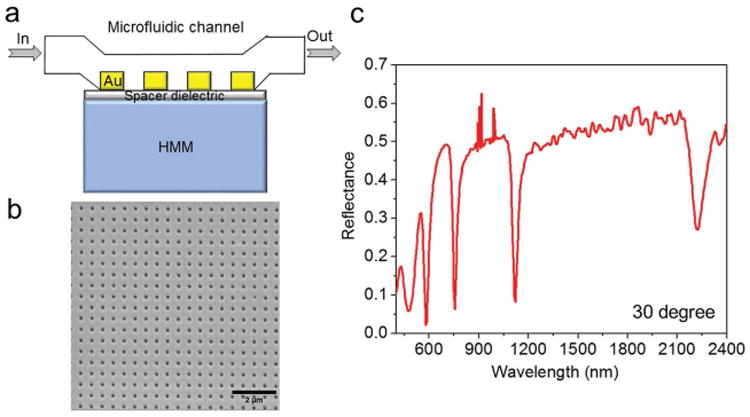
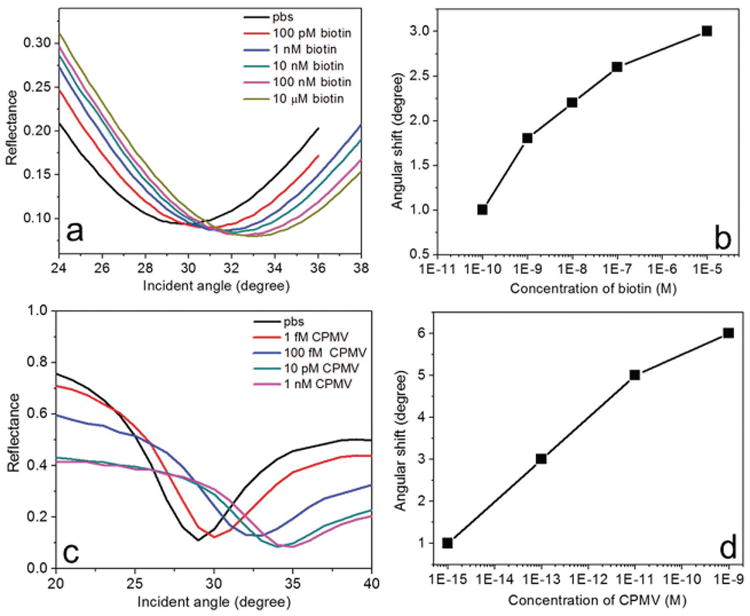
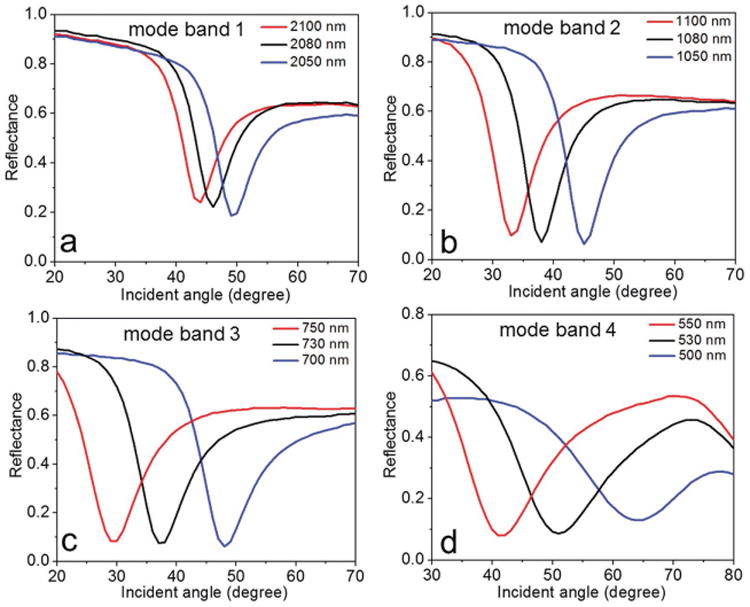
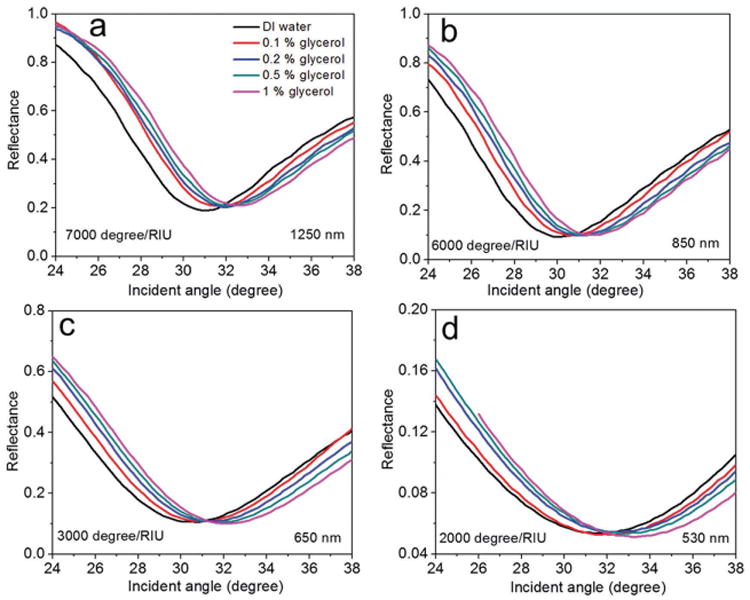
Surface plasmon resonance (SPR) sensors operate mainly on prism and grating coupling techniques, with spectral and angular scans being the two major interrogation schemes. Among them, the angular scan technique has several advantages including higher measurement precision owing to its higher signal-to-noise ratio. The currently available SPR sensor arrangements provide a maximum angular sensitivity of 500°-600° per RIU. Here, we report the study of grating coupled-hyperbolic metamaterial (GC-HMM) sensors with high angular sensitivity. The experimental studies show extraordinary angular sensitivities from visible to near infrared (NIR) wavelengths by exciting bulk plasmon polaritons associated with hyperbolic metamaterials, with a maximum of 7000° per RIU. This angular-scan plasmonic biosensor has been used for the detection of low molecular weight biomolecules such as biotin (244 Da) and high molecular weight macromolecules such as Cowpea mosaic virus (CPMV, 5.6 × 10 Da) at ultralow concentrations. The miniaturized sensing device can be integrated with microfluidic systems for the development of next-generation biosensors for lab-on-a-chip and point-of-care applications.
表面等离子体共振(SPR)传感器主要基于棱镜和光栅耦合技术工作,光谱扫描和角度扫描是两种主要的检测方案。其中,角度扫描技术具有多个优点,包括由于其较高的信噪比而具有更高的测量精度。目前可用的SPR传感器装置提供的最大角度灵敏度为每折射率单位(RIU)500°-600°。在此,我们报告了具有高角度灵敏度的光栅耦合-双曲线超材料(GC-HMM)传感器的研究。实验研究表明,通过激发与双曲线超材料相关的体等离子体激元极化子,在从可见光到近红外(NIR)波长范围内具有非凡的角度灵敏度,最高可达每RIU 7000°。这种角度扫描等离子体生物传感器已用于检测超低浓度的低分子量生物分子,如生物素(244 Da)和高分子量大分子,如豇豆花叶病毒(CPMV,5.6×10 Da)。这种小型化传感装置可与微流体系统集成,用于开发用于芯片实验室和即时检测应用的下一代生物传感器。