Koppelmans Vincent, Bloomberg Jacob J, Mulavara Ajitkumar P, Seidler Rachael D
School of Kinesiology, University of Michigan, 401 Washtenaw Ave., Ann Arbor, MI 48109-2214 USA.
NASA Johnson Space Center, Houston, TX 77058 USA.
NPJ Microgravity. 2016 Dec 19;2:2. doi: 10.1038/s41526-016-0001-9. eCollection 2016.
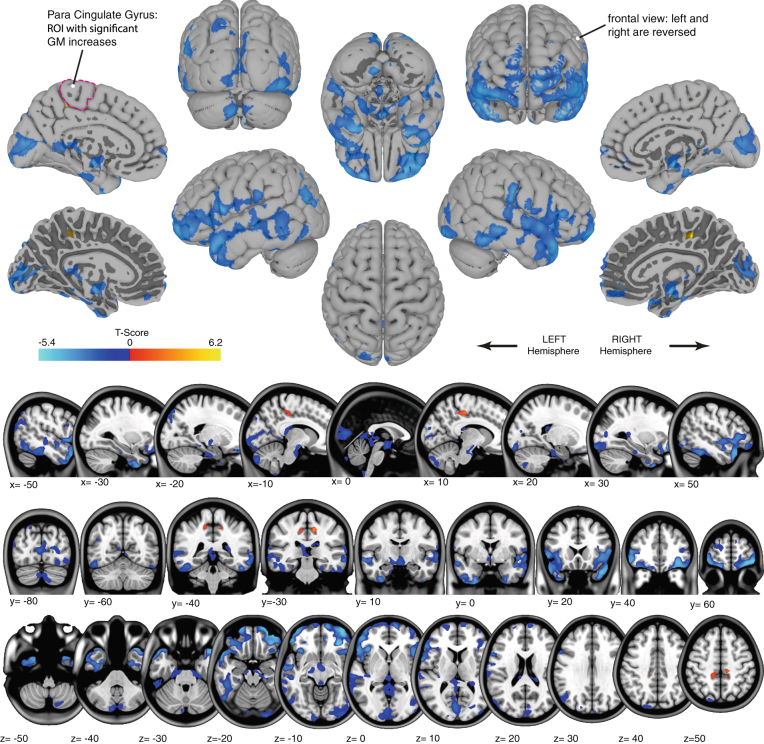
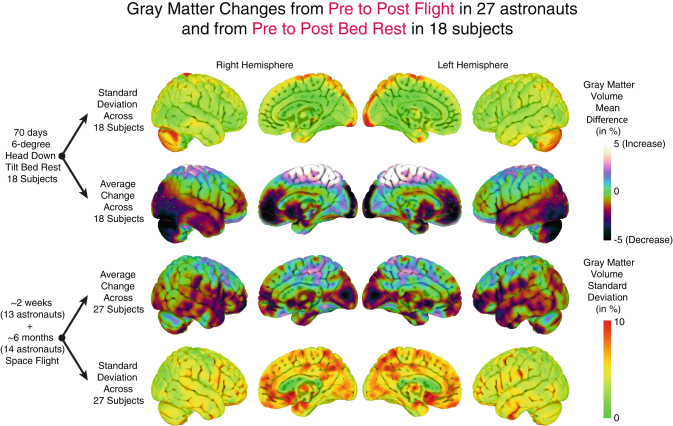
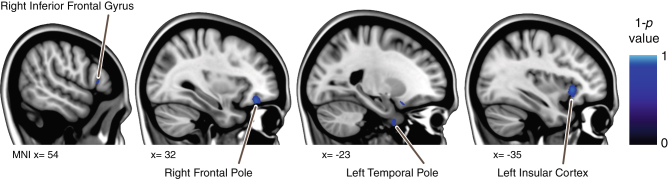
Humans undergo extensive sensorimotor adaptation during spaceflight due to altered vestibular inputs and body unloading. No studies have yet evaluated the effects of spaceflight on human brain structure despite the fact that recently reported optic nerve structural changes are hypothesized to occur due to increased intracranial pressure occurring with microgravity. This is the first report on human brain structural changes with spaceflight. We evaluated retrospective longitudinal T2-weighted MRI scans and balance data from 27 astronauts (thirteen ~2-week shuttle crew members and fourteen ~6-month International Space Station crew members) to determine spaceflight effects on brain structure, and whether any pre to postflight brain changes are associated with balance changes. Data were obtained from the NASA Lifetime Surveillance of Astronaut Health. Brain scans were segmented into gray matter maps and normalized into MNI space using a stepwise approach through subject specific templates. Non-parametric permutation testing was used to analyze pre to postflight volumetric gray matter changes. We found extensive volumetric gray matter decreases, including large areas covering the temporal and frontal poles and around the orbits. This effect was larger in International Space Station versus shuttle crew members in some regions. There were bilateral focal gray matter increases within the medial primary somatosensory and motor cortex; i.e., the cerebral areas where the lower limbs are represented. These intriguing findings are observed in a retrospective data set; future prospective studies should probe the underlying mechanisms and behavioral consequences.
由于前庭输入改变和身体失重,人类在太空飞行期间会经历广泛的感觉运动适应。尽管最近有报道称视神经结构变化被推测是由于微重力导致颅内压升高而发生的,但尚未有研究评估太空飞行对人类大脑结构的影响。这是关于太空飞行导致人类大脑结构变化的首份报告。我们评估了27名宇航员(13名约2周的航天飞机机组人员和14名约6个月的国际空间站机组人员)的回顾性纵向T2加权磁共振成像扫描和平衡数据,以确定太空飞行对大脑结构的影响,以及飞行前后大脑的任何变化是否与平衡变化相关。数据来自美国国家航空航天局的宇航员健康终身监测。通过逐步方法,利用特定于受试者的模板,将脑部扫描分割为灰质图并归一化到蒙特利尔神经学研究所(MNI)空间。使用非参数置换检验分析飞行前后灰质体积的变化。我们发现灰质体积广泛减少,包括覆盖颞极和额极以及眼眶周围的大片区域。在某些区域,国际空间站机组人员的这种影响比航天飞机机组人员更大。在内侧主要体感和运动皮层内有双侧局灶性灰质增加,即代表下肢的脑区。这些有趣的发现是在一个回顾性数据集中观察到的;未来的前瞻性研究应该探究其潜在机制和行为后果。