Department of Public Health, University of Otago, 23a Mein St, Newtown, Wellington 6037, New Zealand.
Division of Cancer Epidemiology &Genetics, National Cancer Institute, 9609 Medical Center Drive, Rockville, Maryland 20850, USA.
Nat Rev Urol. 2017 Sep;14(9):534-548. doi: 10.1038/nrurol.2017.90. Epub 2017 Jun 27.
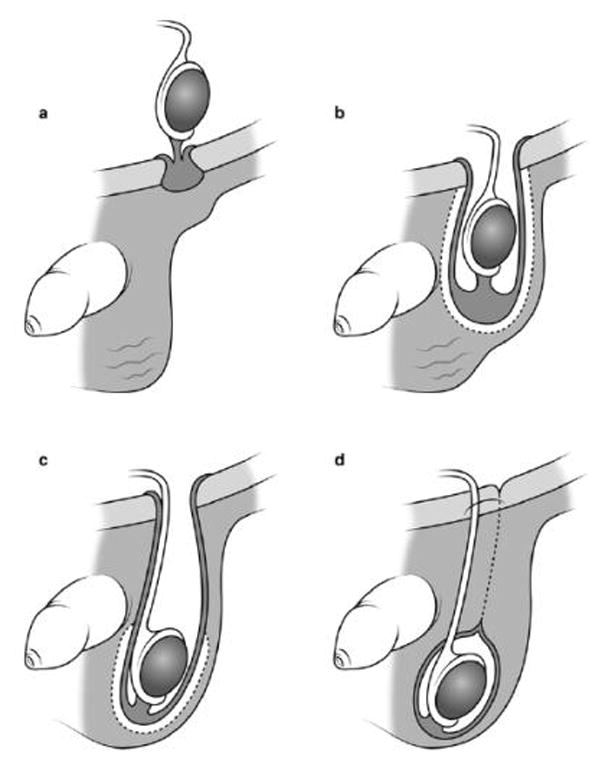
Undescended testis - known as cryptorchidism - is one of the most common congenital abnormalities observed in boys, and is one of the few known risk factors for testicular cancer. The key factors that contribute to the occurrence of cryptorchidism remain elusive. Testicular descent is thought to occur during two hormonally-controlled phases in fetal development - between 8-15 weeks (the first phase of decent) and 25-35 weeks gestation (the second phase of descent); the failure of a testis to descend permanently is probably caused by disruptions to one or both of these phases, but the causes and mechanisms of such disruptions are still unclear. A broad range of putative risk factors have been evaluated in relation to the development of cryptorchidism but their plausibility is still in question. Consistent evidence of an association with cryptorchidism exists for only a few factors, and in those cases in which evidence seems unequivocal the factor is likely to be a surrogate for the true causal exposure. The relative importance of each risk factor could vary considerably between mother-son pairs depending on an array of genetic, maternal, placental and fetal factors - all of which could vary between regions. Thus, the role of causative factors in aetiology of cryptorchidism requires further research.
隐睾症,又称睾丸未降,是男孩中最常见的先天性异常之一,也是少数已知的睾丸癌风险因素之一。导致隐睾症发生的关键因素仍难以捉摸。睾丸下降被认为发生在胎儿发育的两个受激素控制的阶段-8-15 周(第一阶段下降)和 25-35 周妊娠(第二阶段下降);睾丸不能永久性下降可能是由于这两个阶段之一或两个阶段都受到干扰,但这些干扰的原因和机制仍不清楚。已经评估了广泛的潜在风险因素与隐睾症的发展,但它们的合理性仍存在疑问。只有少数因素与隐睾症存在一致的关联证据,在那些证据似乎明确的情况下,该因素很可能是真正因果暴露的替代物。每个风险因素在母子对之间的相对重要性可能因一系列遗传、母体、胎盘和胎儿因素而有很大差异-所有这些因素在不同地区都可能有所不同。因此,隐睾症病因学中的因果因素的作用需要进一步研究。