• 文献检索
  • 文档翻译
  • 深度研究
  • 学术资讯
  • Suppr Zotero 插件Zotero 插件
  • 邀请有礼
  • 套餐&价格
  • 历史记录
应用&插件
Suppr Zotero 插件Zotero 插件浏览器插件Mac 客户端Windows 客户端微信小程序
定价
高级版会员购买积分包购买API积分包
服务
文献检索文档翻译深度研究API 文档MCP 服务
关于我们
关于 Suppr公司介绍联系我们用户协议隐私条款
关注我们

Suppr 超能文献

核心技术专利:CN118964589B侵权必究
粤ICP备2023148730 号-1Suppr @ 2026

文献检索

告别复杂PubMed语法,用中文像聊天一样搜索,搜遍4000万医学文献。AI智能推荐,让科研检索更轻松。

立即免费搜索

文件翻译

保留排版,准确专业,支持PDF/Word/PPT等文件格式,支持 12+语言互译。

免费翻译文档

深度研究

AI帮你快速写综述,25分钟生成高质量综述,智能提取关键信息,辅助科研写作。

立即免费体验

抗癌钌(II)配合物的发展:从单分子化合物到纳米材料。

The development of anticancer ruthenium(ii) complexes: from single molecule compounds to nanomaterials.

作者信息

Zeng Leli, Gupta Pranav, Chen Yanglu, Wang Enju, Ji Liangnian, Chao Hui, Chen Zhe-Sheng

机构信息

College of Pharmacy and Health Sciences, St. John's University, New York, NY 11439, USA.

出版信息

Chem Soc Rev. 2017 Oct 2;46(19):5771-5804. doi: 10.1039/c7cs00195a.

DOI:10.1039/c7cs00195a
PMID:28654103
原文链接:https://pmc.ncbi.nlm.nih.gov/articles/PMC5624840/
Abstract

Cancer is rapidly becoming the top killer in the world. Most of the FDA approved anticancer drugs are organic molecules, while metallodrugs are very scarce. The advent of the first metal based therapeutic agent, cisplatin, launched a new era in the application of transition metal complexes for therapeutic design. Due to their unique and versatile biochemical properties, ruthenium-based compounds have emerged as promising anti-cancer agents that serve as alternatives to cisplatin and its derivertives. Ruthenium(iii) complexes have successfully been used in clinical research and their mechanisms of anticancer action have been reported in large volumes over the past few decades. Ruthenium(ii) complexes have also attracted significant attention as anticancer candidates; however, only a few of them have been reported comprehensively. In this review, we discuss the development of ruthenium(ii) complexes as anticancer candidates and biocatalysts, including arene ruthenium complexes, polypyridyl ruthenium complexes, and ruthenium nanomaterial complexes. This review focuses on the likely mechanisms of action of ruthenium(ii)-based anticancer drugs and the relationship between their chemical structures and biological properties. This review also highlights the catalytic activity and the photoinduced activation of ruthenium(ii) complexes, their targeted delivery, and their activity in nanomaterial systems.

摘要

癌症正迅速成为全球头号杀手。美国食品药品监督管理局(FDA)批准的抗癌药物大多是有机分子,而金属药物非常稀少。第一种金属基治疗剂顺铂的出现,开启了过渡金属配合物应用于治疗设计的新时代。由于其独特且多样的生化特性,钌基化合物已成为有前景的抗癌剂,可作为顺铂及其衍生物的替代品。钌(III)配合物已成功用于临床研究,并且在过去几十年中,其抗癌作用机制已有大量报道。钌(II)配合物作为抗癌候选物也引起了广泛关注;然而,其中只有少数得到了全面报道。在本综述中,我们讨论了钌(II)配合物作为抗癌候选物和生物催化剂的发展,包括芳烃钌配合物、多吡啶钌配合物和钌纳米材料配合物。本综述重点关注钌(II)基抗癌药物可能的作用机制及其化学结构与生物学性质之间的关系。本综述还强调了钌(II)配合物的催化活性和光诱导活化、它们的靶向递送以及它们在纳米材料系统中的活性。
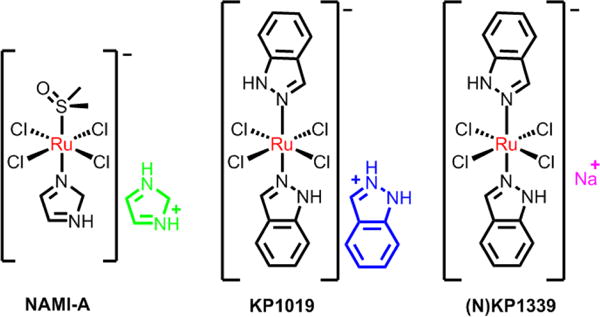
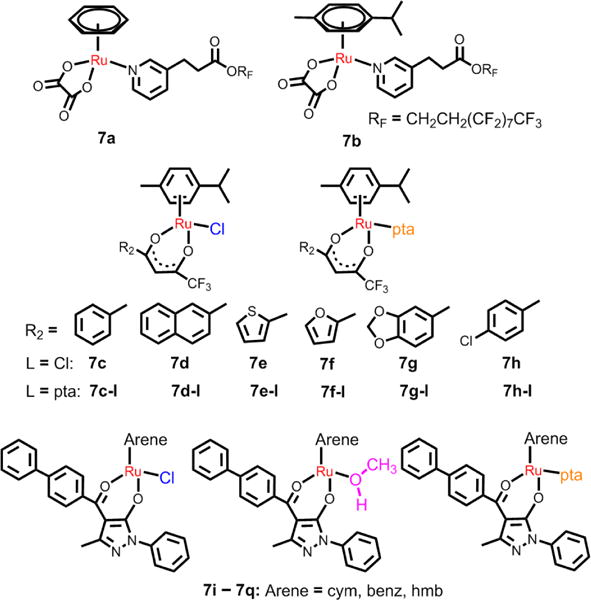
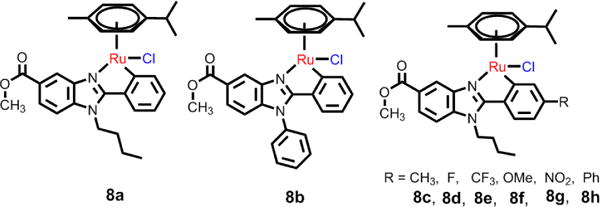
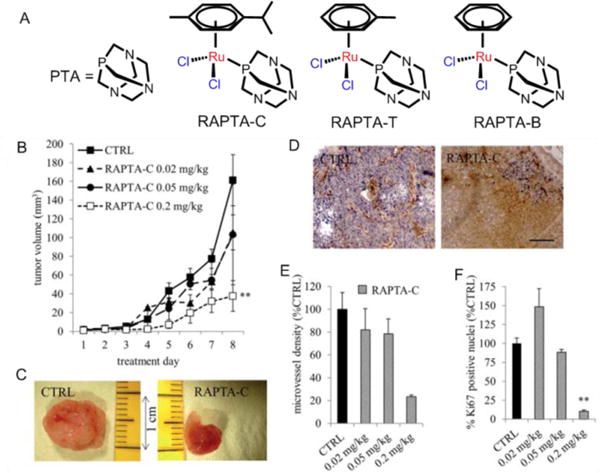
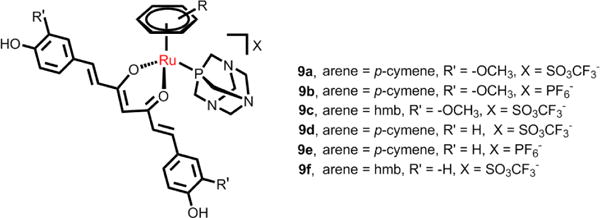
https://cdn.ncbi.nlm.nih.gov/pmc/blobs/9592/5624840/f82d70c6f2e4/nihms888530f33.jpg
https://cdn.ncbi.nlm.nih.gov/pmc/blobs/9592/5624840/48960fdcb6cd/nihms888530f1.jpg
https://cdn.ncbi.nlm.nih.gov/pmc/blobs/9592/5624840/425a86dfbcd6/nihms888530f2.jpg
https://cdn.ncbi.nlm.nih.gov/pmc/blobs/9592/5624840/f075856a8900/nihms888530f3.jpg
https://cdn.ncbi.nlm.nih.gov/pmc/blobs/9592/5624840/37a20573c851/nihms888530f4.jpg
https://cdn.ncbi.nlm.nih.gov/pmc/blobs/9592/5624840/49052f29fad7/nihms888530f5.jpg
https://cdn.ncbi.nlm.nih.gov/pmc/blobs/9592/5624840/852bbddb1091/nihms888530f6.jpg
https://cdn.ncbi.nlm.nih.gov/pmc/blobs/9592/5624840/e75b82df42bf/nihms888530f7.jpg
https://cdn.ncbi.nlm.nih.gov/pmc/blobs/9592/5624840/9751447a36f9/nihms888530f8.jpg
https://cdn.ncbi.nlm.nih.gov/pmc/blobs/9592/5624840/23ffa5dcccde/nihms888530f9.jpg
https://cdn.ncbi.nlm.nih.gov/pmc/blobs/9592/5624840/44e2a16db4a3/nihms888530f10.jpg
https://cdn.ncbi.nlm.nih.gov/pmc/blobs/9592/5624840/13bd1595f1fb/nihms888530f11.jpg
https://cdn.ncbi.nlm.nih.gov/pmc/blobs/9592/5624840/243e27b7357a/nihms888530f12.jpg
https://cdn.ncbi.nlm.nih.gov/pmc/blobs/9592/5624840/47512fc0d78c/nihms888530f13.jpg
https://cdn.ncbi.nlm.nih.gov/pmc/blobs/9592/5624840/00c6e9caccde/nihms888530f14.jpg
https://cdn.ncbi.nlm.nih.gov/pmc/blobs/9592/5624840/c1cf2f33e268/nihms888530f15.jpg
https://cdn.ncbi.nlm.nih.gov/pmc/blobs/9592/5624840/a88bad978ffc/nihms888530f16.jpg
https://cdn.ncbi.nlm.nih.gov/pmc/blobs/9592/5624840/b59dc7f2f533/nihms888530f17.jpg
https://cdn.ncbi.nlm.nih.gov/pmc/blobs/9592/5624840/6265d2fa7aff/nihms888530f18.jpg
https://cdn.ncbi.nlm.nih.gov/pmc/blobs/9592/5624840/e03720a9c74b/nihms888530f19.jpg
https://cdn.ncbi.nlm.nih.gov/pmc/blobs/9592/5624840/47241e492bc8/nihms888530f20.jpg
https://cdn.ncbi.nlm.nih.gov/pmc/blobs/9592/5624840/ea4608aca5f8/nihms888530f21.jpg
https://cdn.ncbi.nlm.nih.gov/pmc/blobs/9592/5624840/f8d4e345df0e/nihms888530f22.jpg
https://cdn.ncbi.nlm.nih.gov/pmc/blobs/9592/5624840/0dac4f24f087/nihms888530f23.jpg
https://cdn.ncbi.nlm.nih.gov/pmc/blobs/9592/5624840/0c1475c3d263/nihms888530f24.jpg
https://cdn.ncbi.nlm.nih.gov/pmc/blobs/9592/5624840/9668a1963774/nihms888530f25.jpg
https://cdn.ncbi.nlm.nih.gov/pmc/blobs/9592/5624840/d9bc4913bf1c/nihms888530f26.jpg
https://cdn.ncbi.nlm.nih.gov/pmc/blobs/9592/5624840/9683a19a1e87/nihms888530f27.jpg
https://cdn.ncbi.nlm.nih.gov/pmc/blobs/9592/5624840/2ba5b50dc58f/nihms888530f28.jpg
https://cdn.ncbi.nlm.nih.gov/pmc/blobs/9592/5624840/382af22323a3/nihms888530f29.jpg
https://cdn.ncbi.nlm.nih.gov/pmc/blobs/9592/5624840/ffa5f7e89048/nihms888530f30.jpg
https://cdn.ncbi.nlm.nih.gov/pmc/blobs/9592/5624840/50d9c7ebbffa/nihms888530f31.jpg
https://cdn.ncbi.nlm.nih.gov/pmc/blobs/9592/5624840/65e38271d0fb/nihms888530f32.jpg
https://cdn.ncbi.nlm.nih.gov/pmc/blobs/9592/5624840/f82d70c6f2e4/nihms888530f33.jpg
https://cdn.ncbi.nlm.nih.gov/pmc/blobs/9592/5624840/48960fdcb6cd/nihms888530f1.jpg
https://cdn.ncbi.nlm.nih.gov/pmc/blobs/9592/5624840/425a86dfbcd6/nihms888530f2.jpg
https://cdn.ncbi.nlm.nih.gov/pmc/blobs/9592/5624840/f075856a8900/nihms888530f3.jpg
https://cdn.ncbi.nlm.nih.gov/pmc/blobs/9592/5624840/37a20573c851/nihms888530f4.jpg
https://cdn.ncbi.nlm.nih.gov/pmc/blobs/9592/5624840/49052f29fad7/nihms888530f5.jpg
https://cdn.ncbi.nlm.nih.gov/pmc/blobs/9592/5624840/852bbddb1091/nihms888530f6.jpg
https://cdn.ncbi.nlm.nih.gov/pmc/blobs/9592/5624840/e75b82df42bf/nihms888530f7.jpg
https://cdn.ncbi.nlm.nih.gov/pmc/blobs/9592/5624840/9751447a36f9/nihms888530f8.jpg
https://cdn.ncbi.nlm.nih.gov/pmc/blobs/9592/5624840/23ffa5dcccde/nihms888530f9.jpg
https://cdn.ncbi.nlm.nih.gov/pmc/blobs/9592/5624840/44e2a16db4a3/nihms888530f10.jpg
https://cdn.ncbi.nlm.nih.gov/pmc/blobs/9592/5624840/13bd1595f1fb/nihms888530f11.jpg
https://cdn.ncbi.nlm.nih.gov/pmc/blobs/9592/5624840/243e27b7357a/nihms888530f12.jpg
https://cdn.ncbi.nlm.nih.gov/pmc/blobs/9592/5624840/47512fc0d78c/nihms888530f13.jpg
https://cdn.ncbi.nlm.nih.gov/pmc/blobs/9592/5624840/00c6e9caccde/nihms888530f14.jpg
https://cdn.ncbi.nlm.nih.gov/pmc/blobs/9592/5624840/c1cf2f33e268/nihms888530f15.jpg
https://cdn.ncbi.nlm.nih.gov/pmc/blobs/9592/5624840/a88bad978ffc/nihms888530f16.jpg
https://cdn.ncbi.nlm.nih.gov/pmc/blobs/9592/5624840/b59dc7f2f533/nihms888530f17.jpg
https://cdn.ncbi.nlm.nih.gov/pmc/blobs/9592/5624840/6265d2fa7aff/nihms888530f18.jpg
https://cdn.ncbi.nlm.nih.gov/pmc/blobs/9592/5624840/e03720a9c74b/nihms888530f19.jpg
https://cdn.ncbi.nlm.nih.gov/pmc/blobs/9592/5624840/47241e492bc8/nihms888530f20.jpg
https://cdn.ncbi.nlm.nih.gov/pmc/blobs/9592/5624840/ea4608aca5f8/nihms888530f21.jpg
https://cdn.ncbi.nlm.nih.gov/pmc/blobs/9592/5624840/f8d4e345df0e/nihms888530f22.jpg
https://cdn.ncbi.nlm.nih.gov/pmc/blobs/9592/5624840/0dac4f24f087/nihms888530f23.jpg
https://cdn.ncbi.nlm.nih.gov/pmc/blobs/9592/5624840/0c1475c3d263/nihms888530f24.jpg
https://cdn.ncbi.nlm.nih.gov/pmc/blobs/9592/5624840/9668a1963774/nihms888530f25.jpg
https://cdn.ncbi.nlm.nih.gov/pmc/blobs/9592/5624840/d9bc4913bf1c/nihms888530f26.jpg
https://cdn.ncbi.nlm.nih.gov/pmc/blobs/9592/5624840/9683a19a1e87/nihms888530f27.jpg
https://cdn.ncbi.nlm.nih.gov/pmc/blobs/9592/5624840/2ba5b50dc58f/nihms888530f28.jpg
https://cdn.ncbi.nlm.nih.gov/pmc/blobs/9592/5624840/382af22323a3/nihms888530f29.jpg
https://cdn.ncbi.nlm.nih.gov/pmc/blobs/9592/5624840/ffa5f7e89048/nihms888530f30.jpg
https://cdn.ncbi.nlm.nih.gov/pmc/blobs/9592/5624840/50d9c7ebbffa/nihms888530f31.jpg
https://cdn.ncbi.nlm.nih.gov/pmc/blobs/9592/5624840/65e38271d0fb/nihms888530f32.jpg
https://cdn.ncbi.nlm.nih.gov/pmc/blobs/9592/5624840/f82d70c6f2e4/nihms888530f33.jpg

相似文献

1
The development of anticancer ruthenium(ii) complexes: from single molecule compounds to nanomaterials.抗癌钌(II)配合物的发展:从单分子化合物到纳米材料。
Chem Soc Rev. 2017 Oct 2;46(19):5771-5804. doi: 10.1039/c7cs00195a.
2
Monomeric and dimeric coordinatively saturated and substitutionally inert Ru(ii) polypyridyl complexes as anticancer drug candidates.单核和二核配位饱和且取代惰性的 Ru(ii) 多吡啶配合物作为抗癌候选药物。
Chem Soc Rev. 2017 Nov 27;46(23):7317-7337. doi: 10.1039/c7cs00356k.
3
DNA binding mode of ruthenium complexes and relationship to tumor cell toxicity.钌配合物的DNA结合模式及其与肿瘤细胞毒性的关系。
Drug Resist Updat. 2006 Jun;9(3):111-22. doi: 10.1016/j.drup.2006.05.002. Epub 2006 Jun 21.
4
Vanadium, Ruthenium and Copper Compounds: A New Class of Nonplatinum Metallodrugs with Anticancer Activity.钒、钌和铜化合物:一类具有抗癌活性的新型非铂金属药物。
Curr Med Chem. 2017;24(2):112-148. doi: 10.2174/0929867323666160824162546.
5
Functionalization and cancer-targeting design of ruthenium complexes for precise cancer therapy.钌配合物的功能化及癌症靶向设计用于精准癌症治疗。
Chem Commun (Camb). 2019 Aug 15;55(67):9904-9914. doi: 10.1039/c9cc04098f.
6
Metal complexes as DNA intercalators.金属配合物作为 DNA 嵌入剂。
Acc Chem Res. 2011 May 17;44(5):349-59. doi: 10.1021/ar100140e. Epub 2011 Mar 29.
7
Versatile Impact of Serum Proteins on Ruthenium(II) Polypyridyl Complexes Properties - Opportunities and Obstacles.血清蛋白对钌(II)多吡啶配合物性质的多方面影响-机遇与挑战。
Curr Protein Pept Sci. 2019;20(11):1052-1059. doi: 10.2174/1389203720666190513090851.
8
Ruthenium(ii)-arene complexes as anti-metastatic agents, and related techniques.钌(II)-芳烃配合物作为抗转移剂及相关技术。
RSC Med Chem. 2021 Sep 15;13(1):22-38. doi: 10.1039/d1md00220a. eCollection 2022 Jan 27.
9
Metal Complexes in Cancer Treatment: Journey So Far.癌症治疗中的金属配合物:迄今的历程
Chem Biodivers. 2023 Apr;20(4):e202300061. doi: 10.1002/cbdv.202300061. Epub 2023 Mar 13.
10
Multinuclear Organometallic Ruthenium-Arene Complexes for Cancer Therapy.用于癌症治疗的多核有机金属钌-芳烃配合物
Met Ions Life Sci. 2018 Feb 5;18. doi: 10.1515/9783110470734-012.

引用本文的文献

1
Cyclometalated complexes: promising metallodrugs in the battle against cancer.环金属化配合物:抗癌斗争中颇具潜力的金属药物。
RSC Med Chem. 2025 Jul 31. doi: 10.1039/d5md00178a.
2
Arginine-Tryptophan Peptides Enhancing Antibacterial and Anticancer Effects of Ruthenium(II) Polypyridyl Complex Photosensitizers.精氨酸-色氨酸肽增强钌(II)多吡啶配合物光敏剂的抗菌和抗癌作用
ACS Omega. 2025 Jul 21;10(29):31452-31465. doi: 10.1021/acsomega.5c00997. eCollection 2025 Jul 29.
3
Novel tryptophan 2,3-dioxygenase-targeted ruthenium(ii)-indole complex activates immunotherapy and .

本文引用的文献

1
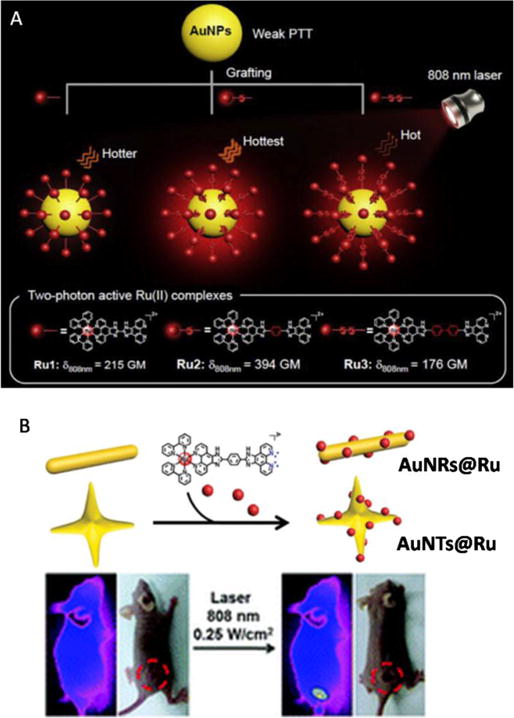
Enhancing the photothermal stability and photothermal efficacy of AuNRs and AuNTs by grafting with Ru(ii) complexes.通过与钌(II)配合物接枝来提高金纳米棒(AuNRs)和金纳米管(AuNTs)的光热稳定性和光热效率。
J Mater Chem B. 2017 Jan 28;5(4):671-678. doi: 10.1039/c6tb01991a. Epub 2016 Dec 13.
2
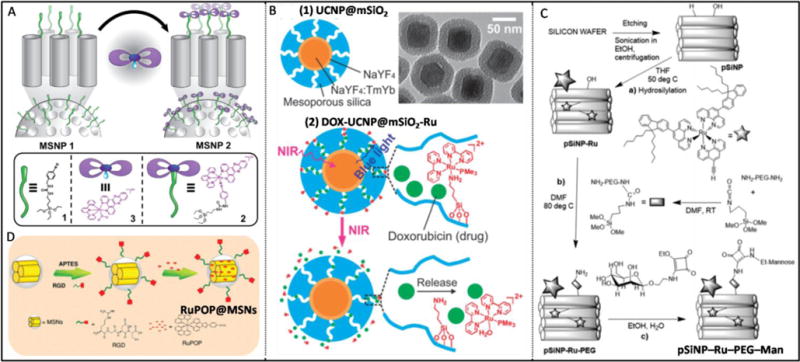
Ruthenium(ii) complex-photosensitized multifunctionalized porous silicon nanoparticles for two-photon near-infrared light responsive imaging and photodynamic cancer therapy.用于双光子近红外光响应成像和光动力癌症治疗的钌(II)配合物光敏多功能化多孔硅纳米颗粒
J Mater Chem B. 2016 Feb 21;4(7):1337-1342. doi: 10.1039/c5tb02726h. Epub 2016 Jan 26.
3
新型靶向色氨酸2,3-双加氧酶的钌(II)-吲哚配合物激活免疫疗法以及…… (原文结尾不完整)
Chem Sci. 2025 Jul 30. doi: 10.1039/d5sc03778f.
4
Eradicating fungal biofilm-based infections by ultrasound-assisted semiconductor sensitized upconversion photodynamic therapy.通过超声辅助半导体敏化上转换光动力疗法根除基于真菌生物膜的感染
Nat Commun. 2025 Jul 15;16(1):6499. doi: 10.1038/s41467-025-61519-1.
5
Bilosomal Encapsulation of Binuclear Phosphino Ru(II)-Cu(II) Compounds Enhances Their Selectivity and Activity toward Lung and Prostate Cancers.双核膦基钌(II)-铜(II)化合物的脂质体包封增强了它们对肺癌和前列腺癌的选择性和活性。
J Med Chem. 2025 Jul 24;68(14):14442-14464. doi: 10.1021/acs.jmedchem.5c00486. Epub 2025 Jul 9.
6
A Deep Generative Model for the Inverse Design of Transition Metal Ligands and Complexes.用于过渡金属配体和配合物逆向设计的深度生成模型
JACS Au. 2025 Apr 23;5(5):2294-2308. doi: 10.1021/jacsau.5c00242. eCollection 2025 May 26.
7
The Combination of Active-Targeted Photodynamic Therapy and Photoactivated Chemotherapy for Enhanced Cancer Treatment.主动靶向光动力疗法与光活化化疗联合用于增强癌症治疗
J Biophotonics. 2025 Jun;18(6):e70005. doi: 10.1002/jbio.70005. Epub 2025 Mar 14.
8
Hybrid Materials Based on Reduced Graphene Oxide; Synthesis and Characterization of V and Ru Metal Complexes.基于还原氧化石墨烯的杂化材料;V和Ru金属配合物的合成与表征
J Fluoresc. 2025 Feb 12. doi: 10.1007/s10895-025-04184-3.
9
Ruthenium(II) Complex with 1-Hydroxy-9,10-Anthraquinone Inhibits Cell Cycle Progression at G0/G1 and Induces Apoptosis in Melanoma Cells.钌(II)与1-羟基-9,10-蒽醌的配合物在G0/G1期抑制细胞周期进程并诱导黑色素瘤细胞凋亡。
Pharmaceuticals (Basel). 2025 Jan 8;18(1):63. doi: 10.3390/ph18010063.
10
A Novel Substituted Benzo[]quinoxaline-Based Cyclometalated Ru(II) Complex as a Biocompatible Membrane-Targeted PDT Colon Cancer Stem Cell Agent.一种新型的基于苯并[]喹喔啉取代的环金属化钌(II)配合物作为生物相容性膜靶向光动力疗法结肠癌干细胞剂。
J Med Chem. 2024 Dec 12;67(23):21470-21485. doi: 10.1021/acs.jmedchem.4c02357. Epub 2024 Dec 2.
Encapsulated Ruthenium(II) Complexes in Biocompatible Poly(d,l-lactide-co-glycolide) Nanoparticles for Application in Photodynamic Therapy.
用于光动力疗法的生物相容性聚(d,l-丙交酯-共-乙交酯)纳米颗粒包裹的钌(II)配合物
Chempluschem. 2014 Jan;79(1):171-180. doi: 10.1002/cplu.201300242. Epub 2014 Jan 7.
4
Green light-induced apoptosis in cancer cells by a tetrapyridyl ruthenium prodrug offering two coordination sites.一种具有两个配位位点的四吡啶钌前药通过绿光诱导癌细胞凋亡。
Chem Sci. 2016 Aug 1;7(8):4922-4929. doi: 10.1039/c6sc00167j. Epub 2016 Apr 25.
5
Structural tuning of organoruthenium compounds allows oxidative switch to control ER stress pathways and bypass multidrug resistance.有机钌化合物的结构调整可实现氧化开关,以控制内质网应激途径并绕过多药耐药性。
Chem Sci. 2016 Jul 1;7(7):4117-4124. doi: 10.1039/c6sc00268d. Epub 2016 Mar 1.
6
Delivering the cell-impermeable DNA 'light-switching' Ru(ii) complexes preferentially into live-cell nucleus an unprecedented ion-pairing method.通过一种前所未有的离子配对方法,将细胞不可渗透的DNA“光开关”钌(II)配合物优先递送至活细胞核中。
Chem Sci. 2016 Jul 1;7(7):4016-4023. doi: 10.1039/c5sc03796d. Epub 2016 Apr 5.
7
Correction: Chiral ruthenium polypyridyl complexes as mitochondria-targeted apoptosis inducers.更正:手性钌多吡啶配合物作为线粒体靶向凋亡诱导剂
Medchemcomm. 2018 Mar 19;9(4):745. doi: 10.1039/c8md90010h. eCollection 2018 Apr 1.
8
Cyclometalated iridium(iii) complexes as lysosome-targeted photodynamic anticancer and real-time tracking agents.环金属化铱(III)配合物作为溶酶体靶向光动力抗癌及实时追踪剂
Chem Sci. 2015 Oct 1;6(10):5409-5418. doi: 10.1039/c5sc01955a. Epub 2015 Jul 22.
9
Combination of Ru(ii) complexes and light: new frontiers in cancer therapy.钌(II)配合物与光的联合:癌症治疗的新前沿
Chem Sci. 2015 May 1;6(5):2660-2686. doi: 10.1039/c4sc03759f. Epub 2015 Jan 13.
10
Target profiling of an antimetastatic RAPTA agent by chemical proteomics: relevance to the mode of action.通过化学蛋白质组学对一种抗转移RAPTA制剂进行靶点分析:与作用模式的相关性
Chem Sci. 2015 Apr 1;6(4):2449-2456. doi: 10.1039/c4sc03905j. Epub 2015 Feb 9.