Gupta Savita, Sharma Rashmi
Department of Anesthesiology and Critical Care, Santosh Medical and Dental College and Hospital, Ghaziabad, Uttar Pradesh, India.
Indian J Anaesth. 2017 Jun;61(6):499-504. doi: 10.4103/ija.IJA_712_16.
Caudal epidural analgesia is commonly practised regional block technique in children undergoing infraumbilical surgeries but has a short duration of action after single shot local anaesthetic injection. The aim of this study was to compare ropivacaine 0.25% with dexmedetomidine and tramadol in caudal anaesthesia in paediatric infraumbilical surgeries.
In a randomised, prospective, double-blinded study, sixty children (1-8 years) belonging to American Society of Anesthesiologists' physical status I or II scheduled for infraumbilical surgeries were included. They were randomly assigned into two groups: Group ropivacaine with tramadol (RT) ( = 30) received 0.25% ropivacaine 1 mL/kg with 2 mg/kg of tramadol, and Group ropivacaine with dexmedetomidine (RD) ( = 30) received 0.25% ropivacaine 1 mL/kg with dexmedetomidine 2 μg/kg. The primary outcome variable was the duration of analgesia, and the secondary outcome variables included motor block, sedation score, time from caudal block to skin incision, emergence time and adverse effects.
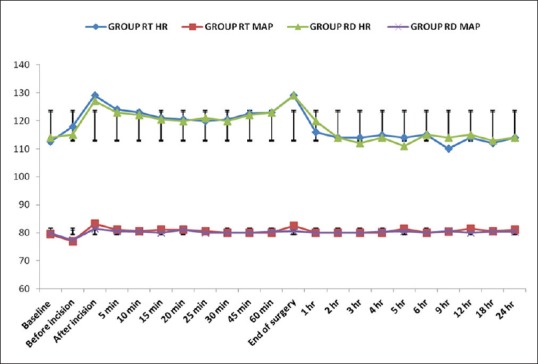
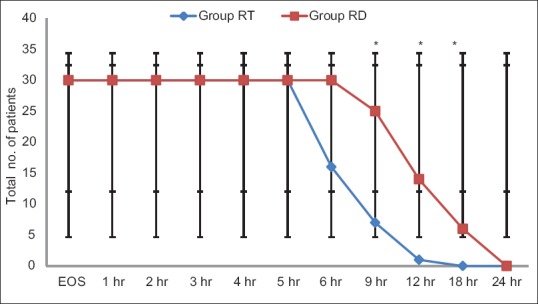
The mean duration of analgesia was 654.20 ± 78.38 min in Group RT, while in Group RD, it was 780.29 ± 71.21 min ( = 0.0001). The difference between the mean sedation score and mean emergence time between the two groups were statistically significant ( = 0.0001 and 0.0411, respectively). No significant difference was observed in the incidence of haemodynamic changes or side effects.
Caudal dexmedetomidine with ropivacaine prolongs post-operative analgesia compared to caudal tramadol with ropivacaine.
在接受脐下手术的儿童中,骶管硬膜外镇痛是常用的区域阻滞技术,但单次注射局部麻醉药后作用时间较短。本研究的目的是比较0.25%罗哌卡因与右美托咪定和曲马多在小儿脐下手术骶管麻醉中的效果。
在一项随机、前瞻性、双盲研究中,纳入了60例计划进行脐下手术的美国麻醉医师协会身体状况I或II级的儿童(1 - 8岁)。他们被随机分为两组:罗哌卡因联合曲马多组(RT)(n = 30)接受0.25%罗哌卡因1 mL/kg加2 mg/kg曲马多,罗哌卡因联合右美托咪定组(RD)(n = 30)接受0.25%罗哌卡因1 mL/kg加右美托咪定2 μg/kg。主要观察指标为镇痛持续时间,次要观察指标包括运动阻滞、镇静评分、从骶管阻滞到皮肤切开的时间、苏醒时间及不良反应。
RT组的平均镇痛持续时间为654.20 ± 78.38分钟,而RD组为780.29 ± 71.21分钟(P = 0.0001)。两组之间的平均镇静评分和平均苏醒时间差异具有统计学意义(分别为P = 0.0001和0.0411)。在血流动力学变化或副作用的发生率方面未观察到显著差异。
与罗哌卡因联合曲马多相比,罗哌卡因联合右美托咪定可延长小儿脐下手术后的镇痛时间。