de Wolf A Charlotte M T, van Aalst Susan, Ludwig Irene S, Bodinham Caroline L, Lewis David J, van der Zee Ruurd, van Eden Willem, Broere Femke
Division of Immunology, Department of Infectious Diseases & Immunology, Utrecht University, Utrecht, The Netherlands.
Surrey Clinical Research Centre, University of Surrey, Guildford, United Kingdom.
PLoS One. 2017 Jun 28;12(6):e0179942. doi: 10.1371/journal.pone.0179942. eCollection 2017.
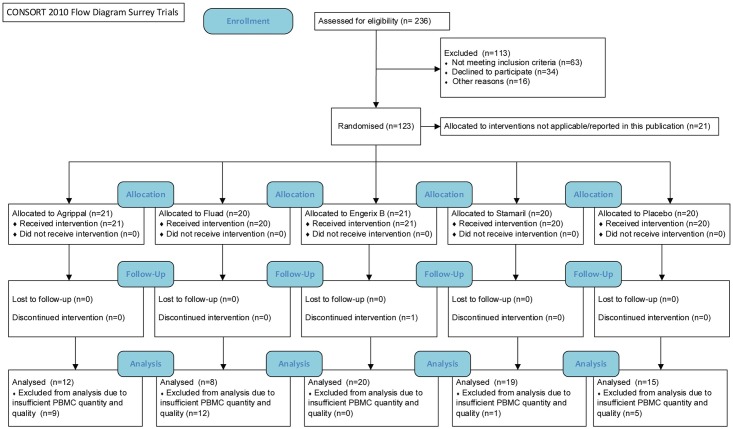
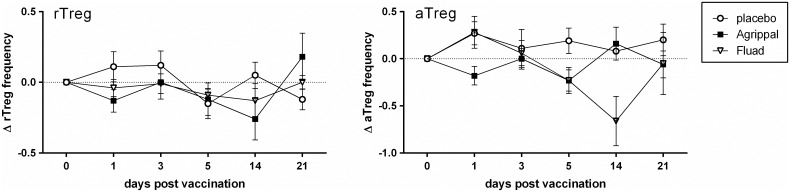
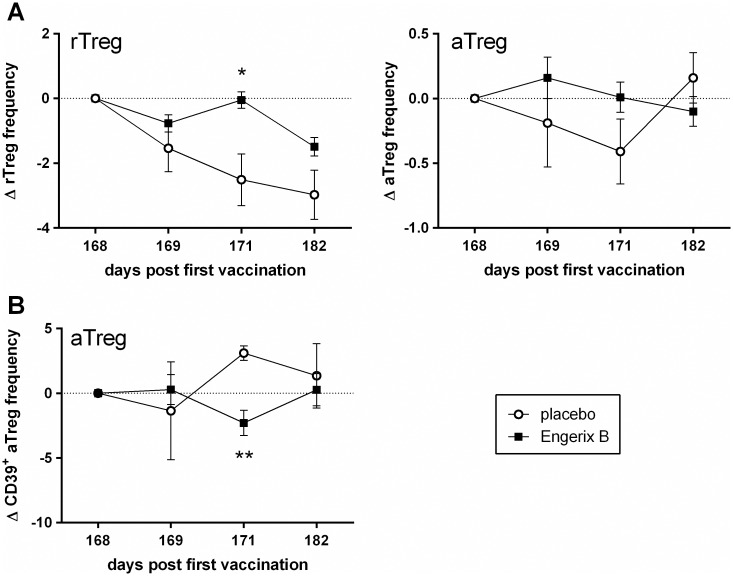
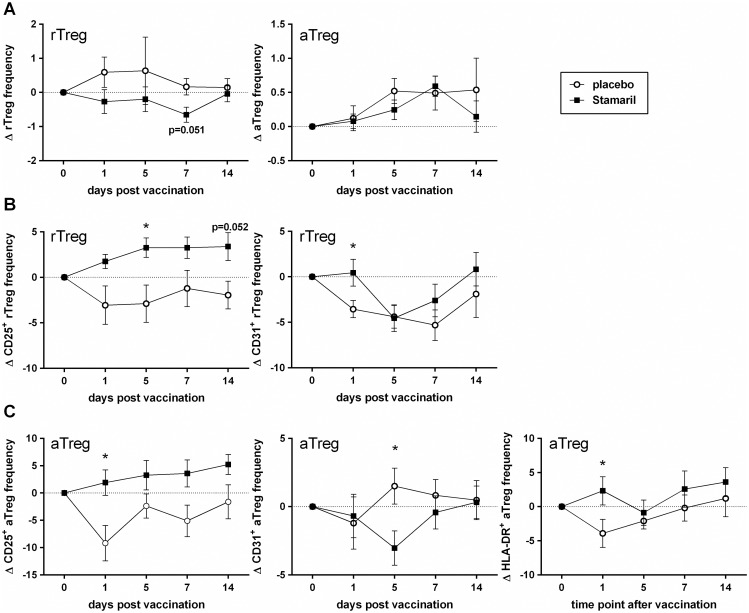
Regulatory T cells (Treg) function in the prevention of excessive inflammation and maintenance of immunological homeostasis. However, these cells may also interfere with resolution of infections or with immune reactions following vaccination. Effects of Treg on vaccine responses are nowadays investigated, but the impact of vaccination on Treg homeostasis is still largely unknown. This may be a relevant safety aspect, since loss of tolerance through reduced Treg may trigger autoimmunity. In exploratory clinical trials, healthy adults were vaccinated with an influenza subunit vaccine plus or minus the adjuvant MF59®, an adjuvanted hepatitis B subunit vaccine or a live attenuated yellow fever vaccine. Frequencies and phenotypes of resting (rTreg) and activated (aTreg) subpopulations of circulating CD4+ Treg were determined and compared to placebo immunization. Vaccination with influenza vaccines did not result in significant changes in Treg frequencies and phenotypes. Vaccination with the hepatitis B vaccine led to slightly increased frequencies of both rTreg and aTreg subpopulations and a decrease in expression of functionality marker CD39 on aTreg. The live attenuated vaccine resulted in a decrease in rTreg frequency, and an increase in expression of activation marker CD25 on both subpopulations, possibly indicating a conversion from resting to migratory aTreg due to vaccine virus replication. To study the more local effects of vaccination on Treg in lymphoid organs, we immunized mice and analyzed the CD4+ Treg frequency and phenotype in draining lymph nodes and spleen. Vaccination resulted in a transient local decrease in Treg frequency in lymph nodes, followed by a systemic Treg increase in the spleen. Taken together, we showed that vaccination with vaccines with an already established safe profile have only minimal impact on frequencies and characteristics of Treg over time. These findings may serve as a bench-mark of inter-individual variation of Treg frequencies and phenotypes following vaccination.
调节性T细胞(Treg)在预防过度炎症和维持免疫稳态中发挥作用。然而,这些细胞也可能干扰感染的消退或疫苗接种后的免疫反应。目前正在研究Treg对疫苗反应的影响,但疫苗接种对Treg稳态的影响仍 largely unknown。这可能是一个相关的安全方面,因为Treg减少导致的耐受性丧失可能引发自身免疫。在探索性临床试验中,健康成年人接种了流感亚单位疫苗(加或不加佐剂MF59®)、佐剂乙肝亚单位疫苗或减毒活黄热病疫苗。测定了循环CD4 + Treg的静息(rTreg)和活化(aTreg)亚群的频率和表型,并与安慰剂免疫进行比较。接种流感疫苗不会导致Treg频率和表型的显著变化。接种乙肝疫苗导致rTreg和aTreg亚群的频率略有增加,并且aTreg上功能标记CD39的表达降低。减毒活疫苗导致rTreg频率降低,并且两个亚群上活化标记CD25的表达增加,这可能表明由于疫苗病毒复制,静息Treg转变为迁移性aTreg。为了研究疫苗接种对淋巴器官中Treg的更局部影响,我们对小鼠进行免疫并分析引流淋巴结和脾脏中的CD4 + Treg频率和表型。疫苗接种导致淋巴结中Treg频率短暂局部降低,随后脾脏中Treg系统性增加。综上所述,我们表明接种具有既定安全概况的疫苗随着时间的推移对Treg的频率和特征只有最小的影响。这些发现可作为疫苗接种后Treg频率和表型个体间差异的基准。