Key Laboratory of Intelligent Perception and Image Understanding of Ministry of Education, Xidian University, Xi'an, 710071, China.
Sci Rep. 2017 Jun 28;7(1):4320. doi: 10.1038/s41598-017-04010-2.
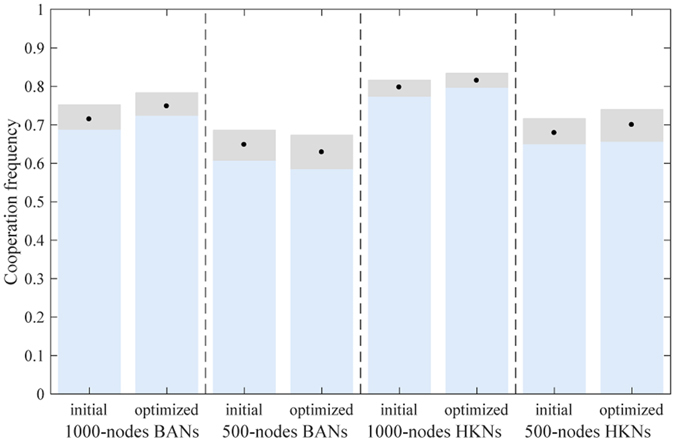
Understanding the emergence of cooperation has long been a challenge across disciplines. Even if network reciprocity reflected the importance of population structure in promoting cooperation, it remains an open question how population structures can be optimized, thereby enhancing cooperation. In this paper, we attempt to apply the evolutionary algorithm (EA) to solve this highly complex problem. However, as it is hard to evaluate the fitness (cooperation level) of population structures, simply employing the canonical evolutionary algorithm (EA) may fail in optimization. Thus, we propose a new EA variant named mlEA-C-SFN to promote the cooperation level of scale-free networks (SFNs) in the Prisoner's Dilemma Game (PDG). Meanwhile, to verify the preceding conclusions may not be applied to this problem, we also provide the optimization results of the comparative experiment (EA), which optimizes the clustering coefficient of structures. Even if preceding research concluded that highly clustered scale-free networks enhance cooperation, we find EA does not perform desirably, while mlEA-C-SFN performs efficiently in different optimization environments. We hope that mlEA-C-SFN may help promote the structure of species in nature and that more general properties that enhance cooperation can be learned from the output structures.
理解合作的出现一直是跨学科的挑战。即使网络互惠反映了人口结构在促进合作方面的重要性,但如何优化人口结构以提高合作水平仍然是一个悬而未决的问题。在本文中,我们试图应用进化算法(EA)来解决这个高度复杂的问题。然而,由于很难评估人口结构的适应度(合作水平),简单地采用标准进化算法(EA)可能无法进行优化。因此,我们提出了一种名为 mlEA-C-SFN 的新型 EA 变体,以提高无标度网络(SFN)在囚徒困境博弈(PDG)中的合作水平。同时,为了验证前面的结论可能不适用于这个问题,我们还提供了比较实验(EA)的优化结果,该实验优化了结构的聚类系数。尽管之前的研究得出结论,高度聚类的无标度网络可以提高合作水平,但我们发现 EA 的表现并不理想,而 mlEA-C-SFN 在不同的优化环境中表现高效。我们希望 mlEA-C-SFN 可以帮助促进自然界中物种的结构,并从输出结构中学习到更多增强合作的一般特性。