Thompson Heather L, Smithey Megan J, Surh Charles D, Nikolich-Žugich Janko
Department of Immunobiology, The Arizona Center on Aging, University of Arizona College of Medicine, Tucson, AZ, United States.
Academy of Immunology and Microbiology, Institute of Basic Science, Pohang, South Korea.
Front Immunol. 2017 Jun 14;8:706. doi: 10.3389/fimmu.2017.00706. eCollection 2017.
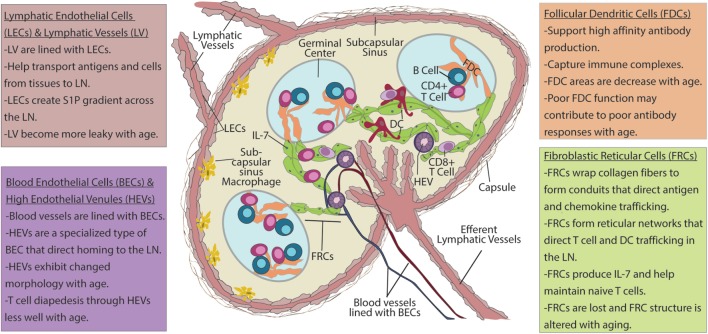
Adults over 65 years of age are more vulnerable to infectious disease and show poor responses to vaccination relative to those under 50. A complex set of age-related changes in the immune system is believed to be largely responsible for these defects. These changes, collectively termed immune senescence, encompass alterations in both the innate and adaptive immune systems, in the microenvironments where immune cells develop or reside, and in soluble factors that guide immune homeostasis and function. While age-related changes in primary lymphoid organs (bone marrow, and, in particular, the thymus, which involutes in the first third of life) have been long appreciated, changes affecting aging secondary lymphoid organs, and, in particular, aging lymph nodes (LNs) have been less well characterized. Over the last 20 years, LN stromal cells have emerged as key players in maintaining LN morphology and immune homeostasis, as well as in coordinating immune responses to pathogens. Here, we review recent progress in understanding the contributions of LN stromal cells to immune senescence. We discuss approaches to understand the mechanisms behind the decline in LN stromal cells and conclude by considering potential strategies to rejuvenate aging LN stroma to improve immune homeostasis, immune responses, and vaccine efficacy in the elderly.
65岁以上的成年人比50岁以下的成年人更容易感染传染病,并且对疫苗接种的反应较差。免疫系统中一系列与年龄相关的复杂变化被认为是造成这些缺陷的主要原因。这些变化统称为免疫衰老,包括先天免疫系统和适应性免疫系统的改变、免疫细胞发育或驻留的微环境的改变,以及指导免疫稳态和功能的可溶性因子的改变。虽然人们早就认识到初级淋巴器官(骨髓,特别是胸腺,在生命的前三分之一时间内会发生退化)中与年龄相关的变化,但影响衰老次级淋巴器官,特别是衰老淋巴结(LN)的变化,其特征描述较少。在过去20年中,LN基质细胞已成为维持LN形态和免疫稳态以及协调对病原体免疫反应的关键因素。在这里,我们综述了在理解LN基质细胞对免疫衰老贡献方面的最新进展。我们讨论了理解LN基质细胞减少背后机制的方法,并通过考虑恢复衰老LN基质活力以改善老年人免疫稳态、免疫反应和疫苗效力的潜在策略来得出结论。