Du Hewei, Zhu Jianxiong, Su Hang, Huang Ming, Wang Hongwei, Ding Shuangcheng, Zhang Binglin, Luo An, Wei Shudong, Tian Xiaohai, Xu Yunbi
Hubei Collaborative Innovation Center for Grain Industry, Yangtze UniversityJingzhou, China.
College of Life Science, Yangtze UniversityJingzhou, China.
Front Plant Sci. 2017 Jun 14;8:1022. doi: 10.3389/fpls.2017.01022. eCollection 2017.
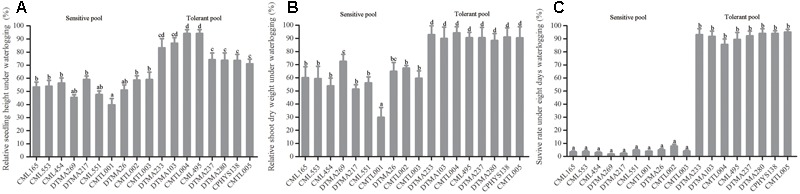
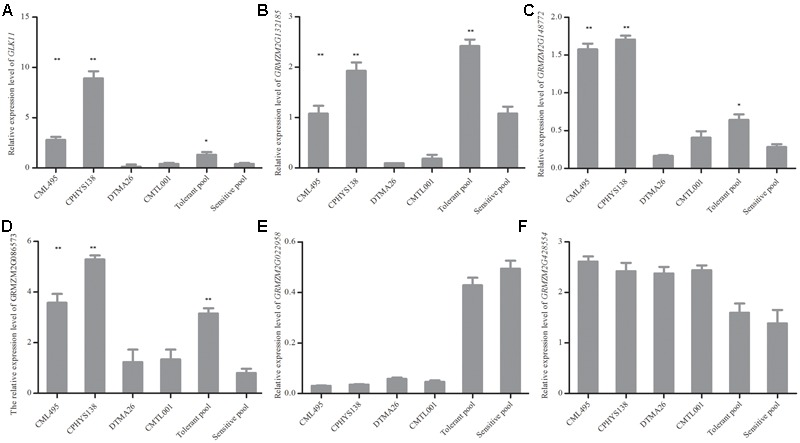
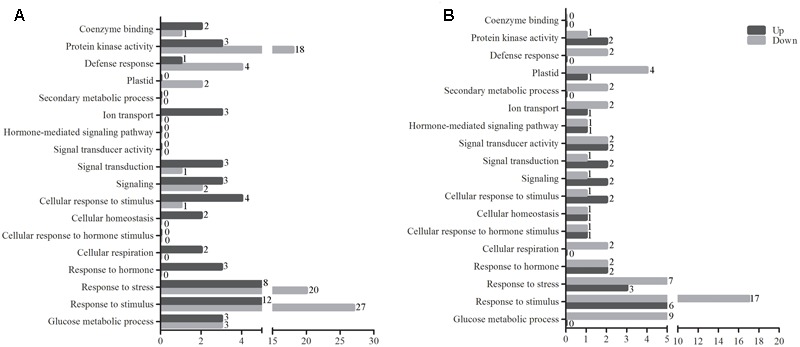
Waterlogging has increasingly become one of the major constraints to maize productivity in some maize production zones because it causes serious yield loss. Bulked segregant RNA-seq (BSR-seq) has been widely applied to profile candidate genes and map associated Single Nucleotide Polymorphism (SNP) markers in many species. In this study, 10 waterlogging sensitive and eight tolerant inbred lines were selected from 60 maize inbred lines with waterlogging response determined and preselected by the International Maize and Wheat Improvement Center (CIMMYT) from over 400 tropical maize inbred lines. BSR-seq was performed to identify differentially expressed genes and SNPs associated with waterlogging tolerance. Upon waterlogging stress, 354 and 1094 genes were differentially expressed in the tolerant and sensitive pools, respectively, compared to untreated controls. When tolerant and sensitive pools were compared, 593 genes were differentially expressed under untreated and 431 genes under waterlogged conditions, of which 122 genes overlapped. To validate the BSR-seq results, the expression levels of six genes were determined by qRT-PCR. The qRT-PCR results were consistent with BSR-seq results. Comparison of allelic polymorphism in mRNA sequences between tolerant and sensitive pools revealed 165 (normal condition) and 128 (waterlogged condition) high-probability SNPs. We found 18 overlapping SNPs with genomic positions mapped. Eighteen SNPs were contained in 18 genes, and eight and nine of 18 genes were responsive to waterlogging stress in tolerant and sensitive lines, respectively. Six alleles of the 18 originated from tolerant pool were significantly up-regulated under waterlogging, but not those from sensitive pool. Importantly, one allele () of the six genes was mapped between umc1619 and umc1948 on chromosome 1 where a QTL associated with waterlogging tolerance was identified in a previous research, strongly indicating that is a candidate gene responsive to waterlogging. Our research contributes to the knowledge of the molecular mechanism for waterlogging tolerance in maize.
在一些玉米产区,涝害日益成为限制玉米产量的主要因素之一,因为它会导致严重的产量损失。混合分组分析法(BSR-seq)已被广泛应用于许多物种中分析候选基因并定位相关单核苷酸多态性(SNP)标记。在本研究中,从国际玉米和小麦改良中心(CIMMYT)从400多个热带玉米自交系中测定并预选了具有耐涝性的60个玉米自交系中,挑选出10个耐涝敏感自交系和8个耐涝自交系。采用BSR-seq技术鉴定与耐涝性相关的差异表达基因和SNP。在涝害胁迫下,与未处理对照相比,耐涝组和敏感组分别有354个和1094个基因差异表达。当比较耐涝组和敏感组时,在未处理条件下有593个基因差异表达,在涝害条件下有431个基因差异表达,其中122个基因重叠。为了验证BSR-seq结果,通过qRT-PCR测定了6个基因的表达水平。qRT-PCR结果与BSR-seq结果一致。比较耐涝组和敏感组mRNA序列中的等位基因多态性,发现了165个(正常条件下)和128个(涝害条件下)高概率SNP。我们发现18个SNP的基因组位置相互重叠。18个SNP包含在18个基因中,耐涝系和敏感系中分别有8个和9个基因对涝害胁迫有响应。18个基因中的6个等位基因来自耐涝组,在涝害条件下显著上调,而来自敏感组的等位基因则没有。重要的是,这6个基因中的一个等位基因()位于第1染色体上的umc1619和umc1948之间,先前的一项研究在该位置鉴定出一个与耐涝性相关的QTL,强烈表明是一个对涝害有响应的候选基因。我们的研究有助于了解玉米耐涝性的分子机制。