Division of Pulmonary, Allergy, and Critical Care Medicine and Center for Translational Lung Biology, Perelman School of Medicine, University of Pennsylvania, Philadelphia, PA, USA.
Department of Medicine and Department of Anesthesia, University of California, San Francisco, CA, USA.
Lancet Respir Med. 2017 Jun;5(6):512-523. doi: 10.1016/S2213-2600(17)30187-X. Epub 2017 May 26.
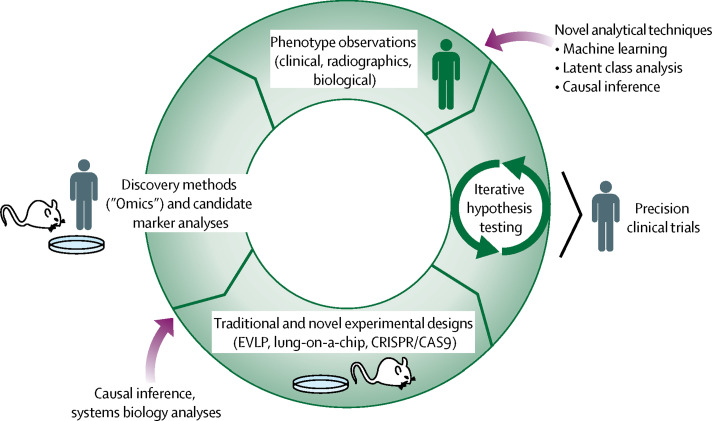
In the 50 years since acute respiratory distress syndrome (ARDS) was first described, substantial progress has been made in identifying the risk factors for and the pathogenic contributors to the syndrome and in characterising the protein expression patterns in plasma and bronchoalveolar lavage fluid from patients with ARDS. Despite this effort, however, pharmacological options for ARDS remain scarce. Frequently cited reasons for this absence of specific drug therapies include the heterogeneity of patients with ARDS, the potential for a differential response to drugs, and the possibility that the wrong targets have been studied. Advances in applied biomolecular technology and bioinformatics have enabled breakthroughs for other complex traits, such as cardiovascular disease or asthma, particularly when a precision medicine paradigm, wherein a biomarker or gene expression pattern indicates a patient's likelihood of responding to a treatment, has been pursued. In this Review, we consider the biological and analytical techniques that could facilitate a precision medicine approach for ARDS.
在急性呼吸窘迫综合征(ARDS)首次被描述后的 50 年里,人们在确定该综合征的危险因素和发病因素方面,以及在描述 ARDS 患者的血浆和支气管肺泡灌洗液中的蛋白表达模式方面,都取得了重大进展。然而,尽管付出了这些努力,ARDS 的药物治疗选择仍然很少。造成这种缺乏特异性药物治疗的常见原因包括:ARDS 患者的异质性、药物反应的潜在差异,以及可能研究了错误的靶点。应用生物分子技术和生物信息学的进步为其他复杂特征(如心血管疾病或哮喘)带来了突破,尤其是当采用精准医疗模式时,即生物标志物或基因表达模式表明患者对治疗的反应可能性。在这篇综述中,我们考虑了可以促进 ARDS 精准医疗方法的生物学和分析技术。