Wu Shaohuan, Li Ke, Li Yingshu, Zhao Tong, Li Ting, Yang Yu-Fei, Qian Wenfeng
State Key Laboratory of Plant Genomics, Institute of Genetics and Developmental Biology, Chinese Academy of Sciences, Beijing, China.
Key Laboratory of Genetic Network Biology, Institute of Genetics and Developmental Biology, Chinese Academy of Sciences, Beijing, China.
PLoS Comput Biol. 2017 Jun 30;13(6):e1005585. doi: 10.1371/journal.pcbi.1005585. eCollection 2017 Jun.
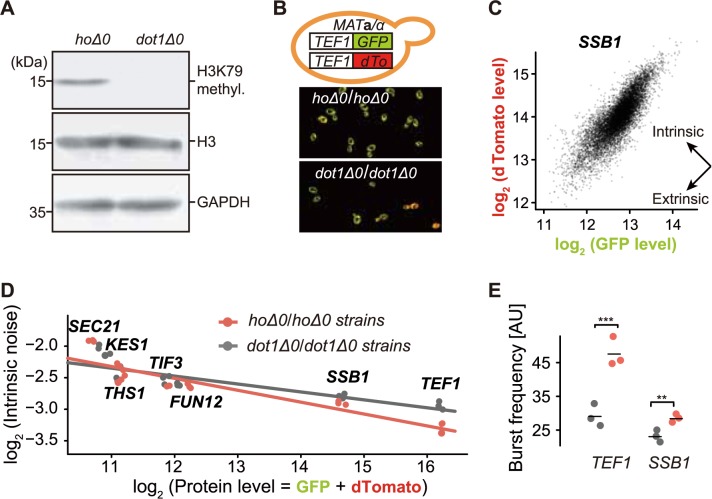
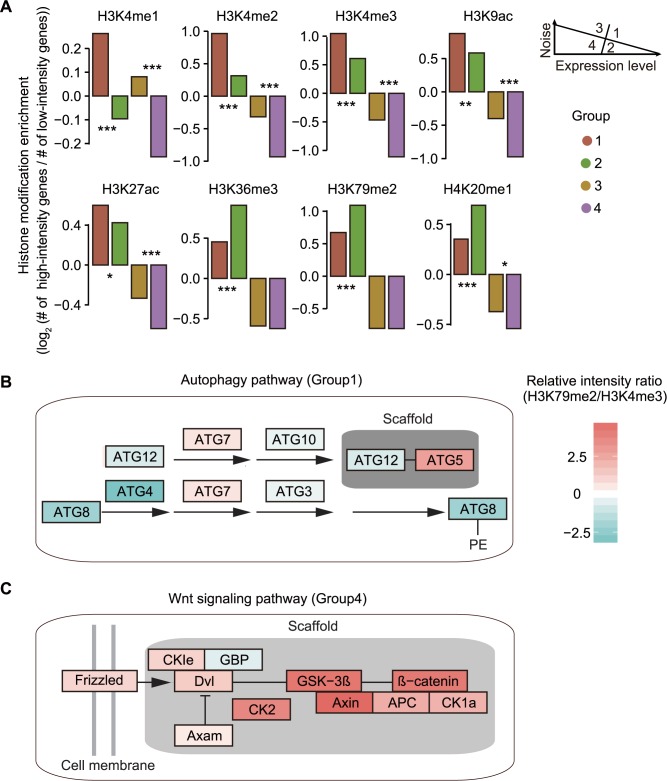
The inherent stochasticity generates substantial gene expression variation among isogenic cells under identical conditions, which is frequently referred to as gene expression noise or cell-to-cell expression variability. Similar to (average) expression level, expression noise is also subject to natural selection. Yet it has been observed that noise is negatively correlated with expression level, which manifests as a potential constraint for simultaneous optimization of both. Here, we studied expression noise in human embryonic cells with computational analysis on single-cell RNA-seq data and in yeast with flow cytometry experiments. We showed that this coupling is overcome, to a certain degree, by a histone modification strategy in multiple embryonic developmental stages in human, as well as in yeast. Importantly, this epigenetic strategy could fit into a burst-like gene expression model: promoter-localized histone modifications (such as H3K4 methylation) are associated with both burst size and burst frequency, which together influence expression level, while gene-body-localized ones (such as H3K79 methylation) are more associated with burst frequency, which influences both expression level and noise. We further knocked out the only "writer" of H3K79 methylation in yeast, and observed that expression noise is indeed increased. Consistently, dosage sensitive genes, such as genes in the Wnt signaling pathway, tend to be marked with gene-body-localized histone modifications, while stress responding genes, such as genes regulating autophagy, tend to be marked with promoter-localized ones. Our findings elucidate that the "division of labor" among histone modifications facilitates the independent regulation of expression level and noise, extend the "histone code" hypothesis to include expression noise, and shed light on the optimization of transcriptome in evolution.
内在的随机性在相同条件下的同基因细胞间产生显著的基因表达变异,这常被称为基因表达噪音或细胞间表达变异性。与(平均)表达水平类似,表达噪音也受到自然选择的影响。然而,已经观察到噪音与表达水平呈负相关,这表现为同时优化两者的潜在限制。在这里,我们通过对单细胞RNA测序数据的计算分析研究了人类胚胎细胞中的表达噪音,并通过流式细胞术实验研究了酵母中的表达噪音。我们表明,在人类多个胚胎发育阶段以及酵母中,一种组蛋白修饰策略在一定程度上克服了这种耦合。重要的是,这种表观遗传策略可以纳入一种爆发式基因表达模型:启动子定位的组蛋白修饰(如H3K4甲基化)与爆发大小和爆发频率都相关,它们共同影响表达水平,而基因体定位的修饰(如H3K79甲基化)则更多地与爆发频率相关,这影响表达水平和噪音。我们进一步敲除了酵母中H3K79甲基化的唯一“书写者”,并观察到表达噪音确实增加了。一致的是,剂量敏感基因,如Wnt信号通路中的基因,往往被基因体定位的组蛋白修饰所标记,而应激反应基因,如调节自噬的基因,往往被启动子定位的修饰所标记。我们的发现阐明了组蛋白修饰之间的“分工”促进了表达水平和噪音的独立调控,将“组蛋白密码”假说扩展到包括表达噪音,并为进化中转录组的优化提供了线索。