Yun Soon-Dong, Choi Sung-Hwan, Cha Jung-Yul, Yu Hyung-Seog, Kim Kwang-Mahn, Kim Jin, Hwang Chung-Ju
Department of Orthodontics, The Institute of Cranio-Facial Deformity, College of Dentistry, Yonsei University, Seoul, Korea.
Department and Research Institute of Dental Biomaterials and Bioengineering, BK21 PLUS Project, College of Dentistry, Yonsei University, Seoul, Korea.
Korean J Orthod. 2017 Jul;47(4):238-247. doi: 10.4041/kjod.2017.47.4.238. Epub 2017 May 26.
The aim of this study was to compare recycled and unused orthodontic miniscrews to determine the feasibility of reuse. The comparisons included both miniscrews with machined surfaces (MS), and those with etched surfaces (ES).
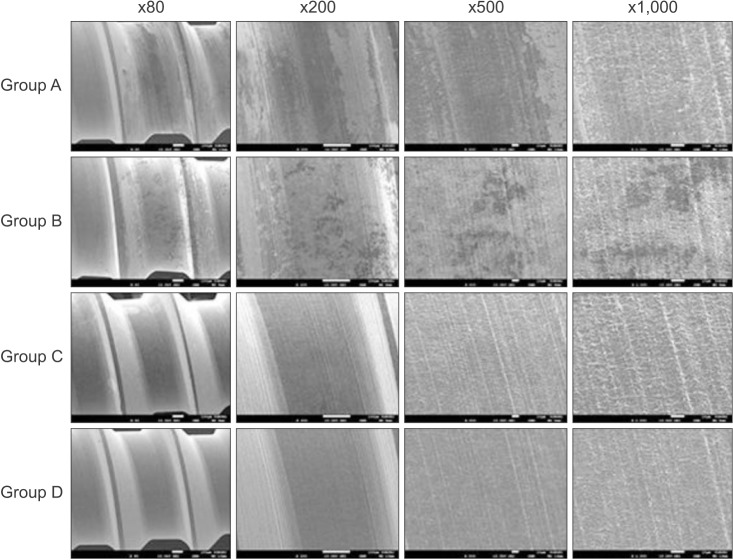
Retrieved MS and ES were further divided into three subgroups according to the assigned recycling procedure: group A, air-water spray; group B, mechanical cleaning; and group C, mechanical and chemical cleaning. Unused screws were used as controls. Scanning electron microscopy, energy-dispersive X-ray spectrometry, insertion time and maximum insertion torque measurements in artificial bone, and biological responses in the form of periotest values (PTV), bone-implant contact ratio (BIC), and bone volume ratio (BV) were assessed.
Morphological changes after recycling mainly occurred at the screw tip, and the cortical bone penetration success rate of recycled screws was lower than that of unused screws. Retrieved ES needed more thorough cleaning than retrieved MS to produce a surface composition similar to that of unused screws. There were no significant differences in PTV or BIC between recycled and unused screws, while the BV of the former was significantly lower than that of the latter ( < 0.05).
These results indicate that reuse of recycled orthodontic miniscrews may not be feasible from the biomechanical aspect.
本研究旨在比较回收利用的正畸微螺钉和未使用的正畸微螺钉,以确定再利用的可行性。比较对象包括具有机械加工表面(MS)的微螺钉和具有蚀刻表面(ES)的微螺钉。
根据指定的回收程序,将回收的MS和ES进一步分为三个亚组:A组,气水喷雾;B组,机械清洁;C组,机械和化学清洁。将未使用的螺钉用作对照。评估扫描电子显微镜、能量色散X射线光谱法、在人工骨中的插入时间和最大插入扭矩测量值,以及以牙周测试值(PTV)、骨-种植体接触率(BIC)和骨体积比(BV)形式表示的生物学反应。
回收后形态学变化主要发生在螺钉尖端,回收螺钉的皮质骨穿透成功率低于未使用的螺钉。与回收的MS相比,回收的ES需要更彻底的清洁才能产生与未使用螺钉相似的表面成分。回收螺钉和未使用螺钉之间的PTV或BIC没有显著差异,而前者的BV显著低于后者(<0.05)。
这些结果表明,从生物力学角度来看,回收正畸微螺钉再利用可能不可行。