Anderson Stephanie Maritza, Lim Hoi-Jeong, Kim Ki-Beom, Kim Sung-Wan, Kim Su-Jung
Department of Dentistry, Kyung Hee University Graduate School, Seoul, Korea.
Department of Orthodontics, Chonnam National University School of Dentistry, Gwangju, Korea.
Korean J Orthod. 2017 Jul;47(4):248-255. doi: 10.4041/kjod.2017.47.4.248. Epub 2017 May 26.
The purpose of this study was to investigate whether the craniofacial patterns of Korean children with snoring and adenotonsillar hypertrophy (ATH) could be categorized into characteristic clusters according to age.
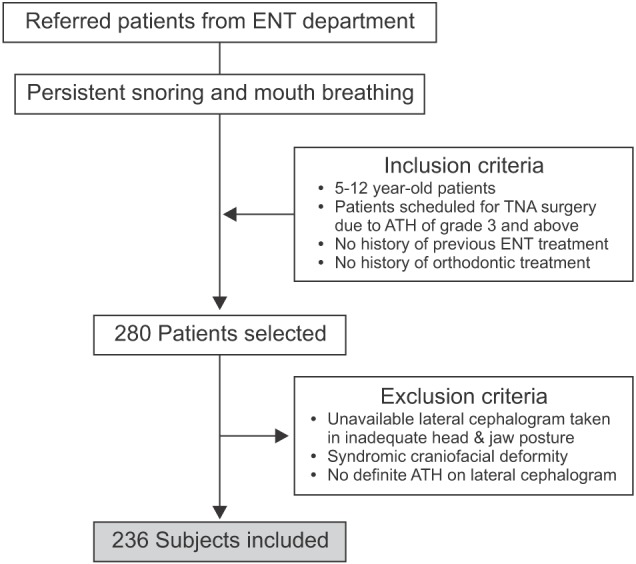
We enrolled 236 children with snoring and ATH (age range, 5-12 years) in this study. They were subdivided into four age groups: 5-6, 7-8, 9-10, and 11-12 years. Based on cephalometric analysis, the sagittal and vertical skeletal patterns of each individual were divided into Class I, II, and III, as well as the normodivergent, hypodivergent, and hyperdivergent patterns, respectively. Cluster analysis was performed using cephalometric principal components in addition to the age factor.
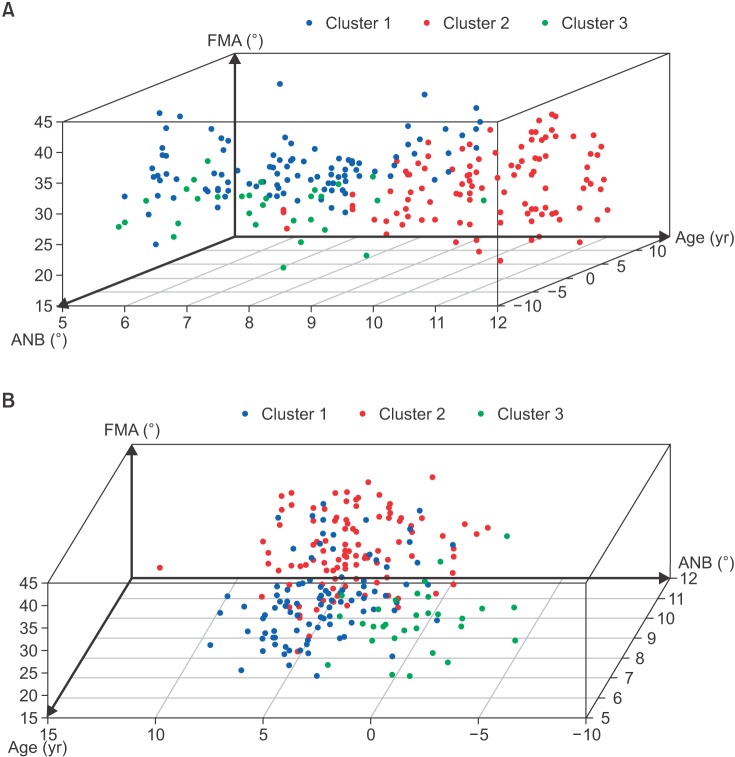
Three heterogeneous clusters of craniofacial patterns were obtained in relation to age: cluster 1 (41.9%) included patients aged 5-8 years with a skeletal Class I or mild Class II and hyperdivergent pattern; cluster 2 (45.3%) included patients aged 9-12 years with a Class II and hyperdivergent pattern; and cluster 3 (12.8%) included patients aged 7-8 years with a Class III and hyperdivergent pattern.
This study found that the craniofacial patterns of Korean children with snoring and ATH could be categorized into three characteristic clusters according to age groups. Although no significantly dominant sagittal skeletal discrepancy was observed, hyperdivergent vertical discrepancy was consistently evident in all clusters.
本研究旨在调查打鼾及腺样体扁桃体肥大(ATH)的韩国儿童的颅面模式是否可根据年龄分为特征性群组。
本研究纳入了236名打鼾及患有ATH的儿童(年龄范围5 - 12岁)。他们被分为四个年龄组:5 - 6岁、7 - 8岁、9 - 10岁和11 - 12岁。基于头影测量分析,将每个个体的矢状和垂直骨骼模式分别分为I类、II类和III类,以及正常发散、低发散和高发散模式。除年龄因素外,还使用头影测量主成分进行聚类分析。
根据年龄获得了三个不同的颅面模式群组:群组1(41.9%)包括5 - 8岁、骨骼为I类或轻度II类且高发散模式的患者;群组2(45.3%)包括9 - 12岁、II类且高发散模式的患者;群组3(12.8%)包括7 - 8岁、III类且高发散模式的患者。
本研究发现,打鼾及患有ATH的韩国儿童的颅面模式可根据年龄组分为三个特征性群组。尽管未观察到明显占主导的矢状骨骼差异,但在所有群组中高发散垂直差异始终明显。