Engle-Stone Reina, Williams Thomas N, Nankap Martin, Ndjebayi Alex, Gimou Marie-Madeleine, Oyono Yannick, Tarini Ann, Brown Kenneth H, Green Ralph
Department of Nutrition, University of California, Davis, CA 95616, USA.
KEMRI/Wellcome Trust Research Programme, Kilifi, Kenya.
Nutrients. 2017 Jul 3;9(7):693. doi: 10.3390/nu9070693.
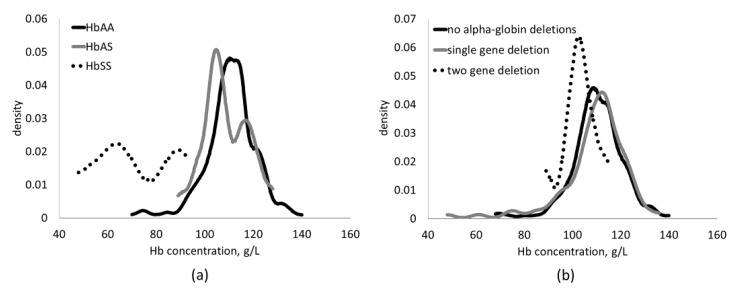
Information on the etiology of anemia is necessary to design effective anemia control programs. Our objective was to measure the prevalence of inherited hemoglobin disorders (IHD) in a representative sample of children in urban Cameroon, and examine the relationships between IHD and anemia. In a cluster survey of children 12-59 months of age ( = 291) in Yaoundé and Douala, we assessed hemoglobin (Hb), malaria infection, and plasma indicators of inflammation and micronutrient status. Hb S was detected by HPLC, and α⁺thalassemia (3.7 kb deletions) by PCR. Anemia (Hb < 110 g/L), inflammation, and malaria were present in 45%, 46%, and 8% of children. A total of 13.7% of children had HbAS, 1.6% had HbSS, and 30.6% and 3.1% had heterozygous and homozygous α⁺thalassemia. The prevalence of anemia was greater among HbAS compared to HbAA children (60.3 vs. 42.0%, = 0.038), although mean Hb concentrations did not differ, = 0.38). Hb and anemia prevalence did not differ among children with or without single gene deletion α⁺thalassemia. In multi-variable models, anemia was independently predicted by HbAS, HbSS, malaria, iron deficiency (ID; inflammation-adjusted ferritin <12 µg/L), higher C-reactive protein, lower plasma folate, and younger age. Elevated soluble transferrin receptor concentration (>8.3 mg/L) was associated with younger age, malaria, greater mean reticulocyte counts, inflammation, HbSS genotype, and ID. IHD are prevalent but contribute modestly to anemia among children in urban Cameroon.
了解贫血的病因对于设计有效的贫血控制项目至关重要。我们的目标是测量喀麦隆城市地区具有代表性的儿童样本中遗传性血红蛋白疾病(IHD)的患病率,并研究IHD与贫血之间的关系。在雅温得和杜阿拉对12 - 59个月大的儿童(n = 291)进行的整群调查中,我们评估了血红蛋白(Hb)、疟疾感染以及炎症和微量营养素状态的血浆指标。通过高效液相色谱法检测Hb S,通过聚合酶链反应检测α⁺地中海贫血(3.7 kb缺失)。45%、46%和8%的儿童存在贫血(Hb < 110 g/L)、炎症和疟疾。共有13.7%的儿童患有HbAS,1.6%患有HbSS,30.6%和3.1%的儿童分别患有杂合子和纯合子α⁺地中海贫血。与HbAA儿童相比,HbAS儿童的贫血患病率更高(60.3%对42.0%,P = 0.038),尽管平均Hb浓度无差异(P = 0.38)。有或无单基因缺失α⁺地中海贫血的儿童之间,Hb和贫血患病率无差异。在多变量模型中,贫血由HbAS、HbSS、疟疾、缺铁(ID;炎症校正铁蛋白<12 μg/L)、较高的C反应蛋白、较低的血浆叶酸以及较年轻的年龄独立预测。可溶性转铁蛋白受体浓度升高(>8.3 mg/L)与较年轻的年龄、疟疾、较高的平均网织红细胞计数、炎症、HbSS基因型和ID相关。IHD在喀麦隆城市儿童中普遍存在,但对贫血的影响较小。