Furue Masutaka, Tsuji Gaku, Chiba Takahito, Kadono Takafumi
Department of Dermatology, Kyushu University, Japan.
Department of Dermatology, St. Marianna University School of Medicine, Japan.
Intern Med. 2017;56(13):1613-1619. doi: 10.2169/internalmedicine.56.8209. Epub 2017 Jul 1.
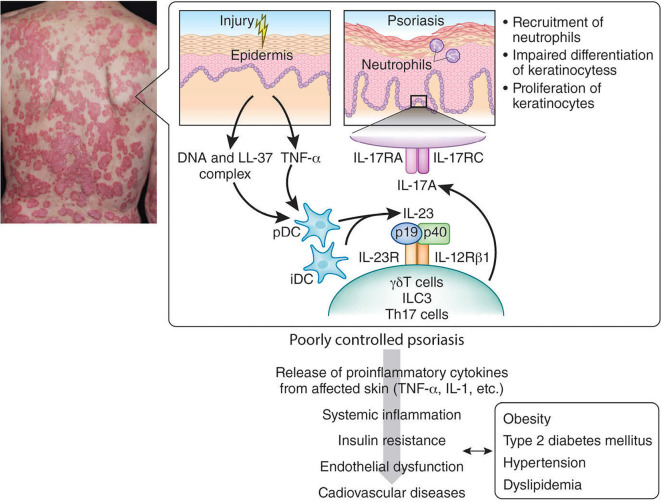
A close association of systemic inflammation with cardiovascular diseases and metabolic syndrome is recently a popular topic in medicine. Psoriasis is a chronic inflammatory skin disease with a prevalence of approximately 0.1-0.5% in Asians. It is characterized by widespread scaly erythematous macules that cause significant physical and psychological burdens for the affected individuals. The accelerated inflammation driven by the TNF-α/IL-23/IL-17A axis is now known to be the major mechanism in the development of psoriasis. Psoriasis is not a mere skin disease; it is significantly associated with cardiovascular diseases and metabolic syndrome, which suggests that the chronic skin inflammation extends the systemic inflammation beyond the skin. In this article, we review the epidemiological and pathological aspects of psoriasis and its comorbidities.
全身炎症与心血管疾病和代谢综合征的密切关联是近年来医学领域的热门话题。银屑病是一种慢性炎症性皮肤病,在亚洲人群中的患病率约为0.1-0.5%。其特征为广泛的鳞屑性红斑丘疹,给患者带来巨大的身心负担。目前已知,由肿瘤坏死因子-α/白细胞介素-23/白细胞介素-17A轴驱动的炎症加速是银屑病发病的主要机制。银屑病并非单纯的皮肤病;它与心血管疾病和代谢综合征显著相关,这表明慢性皮肤炎症使全身炎症超出了皮肤范围。在本文中,我们综述了银屑病及其合并症的流行病学和病理学方面。