School of Public Health, Nanjing Medical University, Nanjing, China.
Jiangsu Provincial Center for Disease Control and Prevention, Nanjing, China.
Influenza Other Respir Viruses. 2017 Sep;11(5):418-424. doi: 10.1111/irv.12461. Epub 2017 Jul 26.
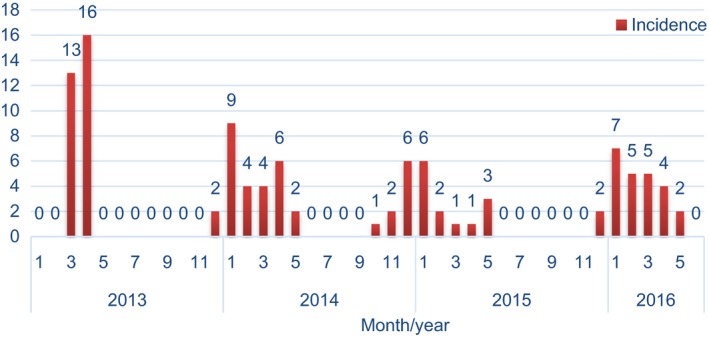
Four epidemic waves of human infection with H7N9 have been recorded in China up to 1 June 2016, including in Jiangsu Province. However, few studies have investigated the differences in patients' characteristics among the four epidemic waves, and the analyses of factors associated with fatal infection lacked statistical power in previous studies due to limited sample size.
All laboratory-confirmed A(H7N9) patients in Jiangsu province were analysed. Patients' characteristics were compared across four waves and between survivors and those who died. Multivariate analyses were used to identify independent predictors of death.
Significant differences were found in the lengths of several time intervals (from onset of disease to laboratory confirmation, to onset of ARDS and respiratory failure, and to death) and in the development of heart failure. The proportions of overweight patients and rural patients increased significantly across the four waves. Administration of glucocorticoids and double-dose neuraminidase inhibitors became the norm. Predictors of death included complications such as ARDS, heart failure and septic shock, administration of glucocorticoids, and disease duration.
Characteristics of H7N9 patients and clinical treatment options changed over time. Particular complications and the use of particular treatment, along with disease duration, could help clinicians predict the outcome of H7N9 infections.
截至 2016 年 6 月 1 日,中国已记录到四起人感染 H7N9 的疫情,包括江苏省。然而,很少有研究调查过这四起疫情中患者特征的差异,并且由于样本量有限,以前的研究中与致命感染相关因素的分析缺乏统计学效力。
对江苏省所有实验室确诊的 A(H7N9)患者进行分析。比较了四个波次之间以及幸存者和死亡者之间的患者特征。采用多变量分析来确定死亡的独立预测因素。
在几个时间间隔(从发病到实验室确诊,到 ARDS 和呼吸衰竭发作,到死亡)和心力衰竭的发展方面存在显著差异。超重患者和农村患者的比例在四个波次中显著增加。糖皮质激素和双剂量神经氨酸酶抑制剂的使用成为常规。死亡的预测因素包括 ARDS、心力衰竭和感染性休克等并发症、糖皮质激素的使用以及疾病持续时间。
H7N9 患者的特征和临床治疗选择随时间而变化。特定的并发症和特定的治疗方法的使用,以及疾病持续时间,可以帮助临床医生预测 H7N9 感染的结果。