Laboratorio de Neurofisiologia, Departamento de Biologia, Instituto Universitario de Investigacion en Ciencias de la Salud, Universidad de las Islas Baleares (UIB), Mallorca, Spain.
Curr Neuropharmacol. 2018 Jan 30;16(2):126-136. doi: 10.2174/1570159X15666170703113212.
Classically the oxidative stress and more recently inflammatory processes have been identified as the major causes of brain aging. Oxidative stress and inflammation affect each other, but there is more information about the effects of oxidative stress on aging than regarding the contribution of inflammation on it.
In the intense research for methods to delay or mitigate the effects of aging, are interesting polyphenols, natural molecules synthesized by plants (e.g. resveratrol). Their antioxidant and anti-inflammatory properties make them useful molecules in the prevention of aging.
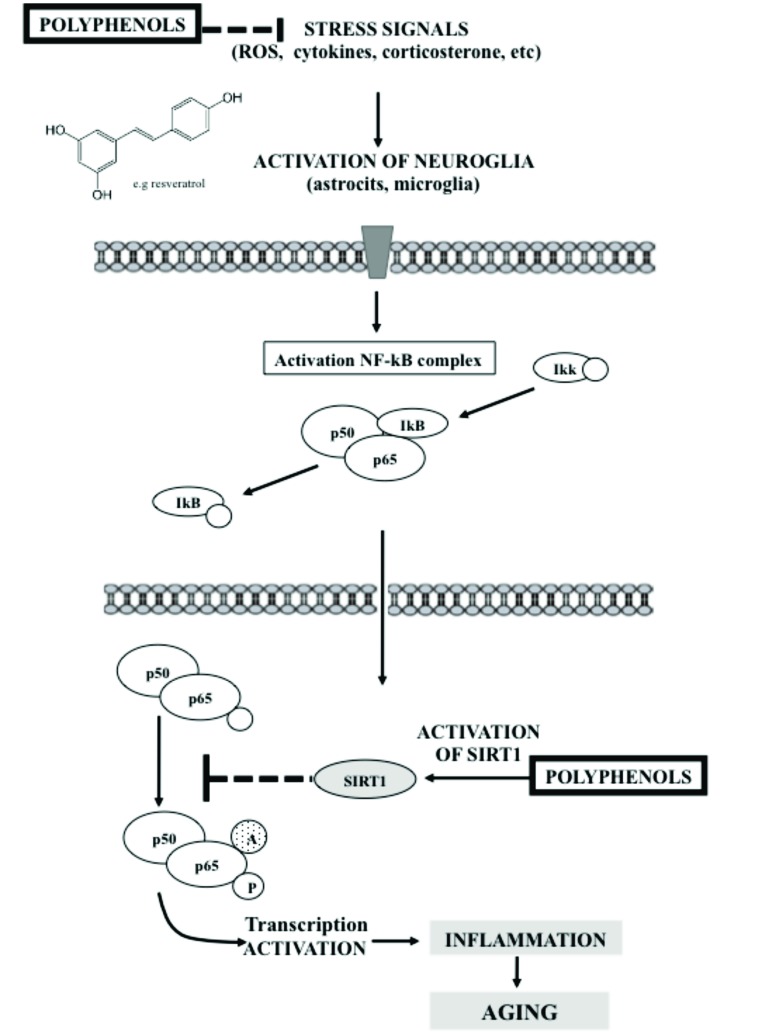
The antiaging effects of polyphenols could be due to several related mechanisms, among which are the prevention of oxidative stress, SIRT1 activation and inflammaging modulation, via regulation of some signaling pathways, such as NF-κB.
In this review, we describe the positive effects of polyphenols on the prevention of the changes that occur during aging in the brain and their consequences on cognition, emphasizing the possible modulation of inflammaging by polyphenols through a SIRT1-mediated mechanism.
传统上,氧化应激和最近的炎症过程被认为是大脑衰老的主要原因。氧化应激和炎症相互影响,但关于氧化应激对衰老的影响的信息比关于炎症对其的贡献的信息更多。
在为延缓或减轻衰老影响的方法进行的深入研究中,多酚类物质是有趣的天然分子,这些天然分子由植物合成(例如白藜芦醇)。它们的抗氧化和抗炎特性使它们成为预防衰老的有用分子。
多酚类的抗衰老作用可能归因于几种相关的机制,其中包括预防氧化应激、通过调节 NF-κB 等信号通路来激活 SIRT1 和调节炎症老化,。
在这篇综述中,我们描述了多酚类物质对预防大脑衰老过程中发生的变化及其对认知的影响的积极作用,强调了多酚类物质通过 SIRT1 介导的机制可能对炎症老化的调节。